
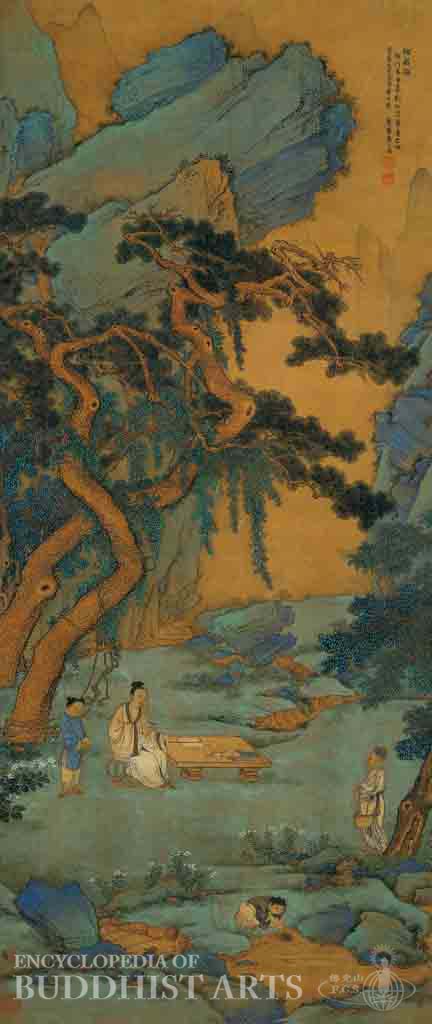
Inscription on a Fan by Yu Zhiding; Qing dynasty
Ink and color on paper
Yu Zhiding
CHINA, Jiangsu, Taizhou; Qing dynasty
Yu Zhiding, also known as Shangji or Shenzhai, was a painter from Yangzhou (present day Xinghua, Taizhou), although he later resided in Jiangdu district (present day Yangzhou, Jiangsu). Coming from a poor family, he learned painting at a young age. He later entered the imperial palace to serve during the rule of Emperor Kangxi (reigned 1662–1722) and worked as a clerical officer.
His painting style was initially modeled after that of Lanying, a painter active during the Ming dynasty (1368–1644), becoming so versed in copying that his works were often confused with the originals. Later he learned by studying the works of various painters of the Song (960–1279) and Yuan (1271–1368) dynasties. He also adopted the lanye (orchid leaf) technique from Wu Daozi, a renowned Tang dynasty (618–907) painter, in which a light red-brown color was applied on the cheeks of figures to produce a more elegant appearance.
Adept in painting figures, landscape, flowers, birds, and animals, he also specialized in portraiture using line drawing and coloring techniques. His line drawings were modeled after Li Gonglin’s and his liuye (willow tree leaf) technique was influenced by Ma Hezhi. The majority of the small portraits of celebrities of his era were painted by Yu. He employed fine wrinkling and wash in painting portraits, showing refined illustrations with realistic appearances.
Extant paintings by Yu are plentiful and include Avalokitesvara Bodhisattva on a Banana Leaf, Inscription on a Fan, Granted Books and Ink-Slabs, Villa in Qingliangshan, and Seeking Plum Flowers in West Suburb, all of which are kept at the Palace Museum in Beijing; a copy of Nine Mountain Peaks in Snow by Wang Gongwang is at the at the Beijing Municipal Bureau of Cultural Heritage. A large amount of Yu’s works are kept at museums and galleries throughout China, Japan, and Taiwan including the Shanghai Museum, the Tianjin Municipal Museum of Arts, the National Palace Museum in Taipei, Taiwan, the Shanxi Museum in Taiyuan, and the Hunan Provincial Museum in Changsha.
For more details, go to the Encyclopedia of Buddhist Arts: People, page 327.
Cite this article:
author = Hsingyun and Youheng and Youlu and Pokorski, Stefanie and Yichao and Mankuang and Miaohsi,
booktitle = {Encyclopedia of Buddhist Arts: People },
pages = 327,
title = {{Yu Zhiding}},
volume = 19,
year = {2016}}