
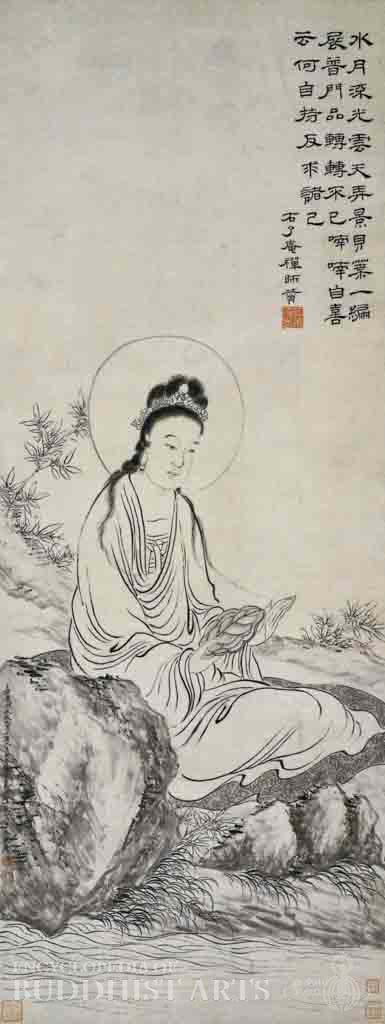
Avalokitesvara Bodhisattva by Xi Gang; Qing dynasty
Ink on paper
Xi Gang
CHINA, Anhui, Huangshan; Qing dynasty
Xi Gang, known also as Tiesheng or Chunzhang among several other aliases, was a seal engraver, calligrapher, and painter born in Shexian county of Huangshan, but resided in Zhejiang. His seal engraving techniques were based on the ancient works of the Qin (221–207 BCE) and Han (206 BCE–220 CE) dynasties, and he was trained in the Zhejiang school style. Xi’s seals were executed with clean, precise cuts, and he achieved what was described as “creating roundness within a square block.” The side colophons found on his works were also intricately incised. Alongside Ding Jing, Wang Yi, and Jiang Ren, he was renowned as one of the Four Masters of Xiling. The four of them, in addition to Chen Yuzhong, Chen Hongshou, Zhao Zhichen, and Qian Song, are regarded as the Eight Masters of Xiling.
Skilled in several types of calligraphic scripts, Xi modeled his regular script after Chu Suiliang. The strokes are sparse and clear, but at the same time thin and firm. His pieces written in clerical script are considered superb. Also a talented poet, his written pieces were compiled into a book entitled Winter Flower Temple Collection.
As a painter, he specialized in portraying landscapes, flowers and plants, orchids, and bamboo. He also enjoyed painting portraits of Avalokitesvara Bodhisattva, several of such works still exist today. Often regarded alongside the painter Fang Xun, they are commonly referred to as Fang-Xi. Many of Xi’s early landscape paintings were influenced by the Ming dynasty (1368–1644) painters, Shen Chou, Wen Zhengming, and Dong Qichang. However, in his later years, he also incorporated the styles of Li Liufang and Huang Gongwang. Xi’s floral compositions were modeled largely after Yun Shouping
Several of his works, such as Sutra Transcription Pavilion, Staying to Read in the Boat, Plum Blossoms, and Bodhisattva, are kept at the Palace Museum in Beijing. In addition, Avalokitesvara Bodhisattva, Flower and Plant, and a seal engraving are kept in the Shanghai Museum. Many more works by Xi are retained in museums around China.
For more details, go to the Encyclopedia of Buddhist Arts: People, page 302.
Cite this article:
author = Hsingyun and Youheng and Youlu and Pokorski, Stefanie and Yichao and Mankuang and Miaohsi,
booktitle = {Encyclopedia of Buddhist Arts: People },
pages = 302,
title = {{Xi Gang}},
volume = 19,
year = {2016}}