
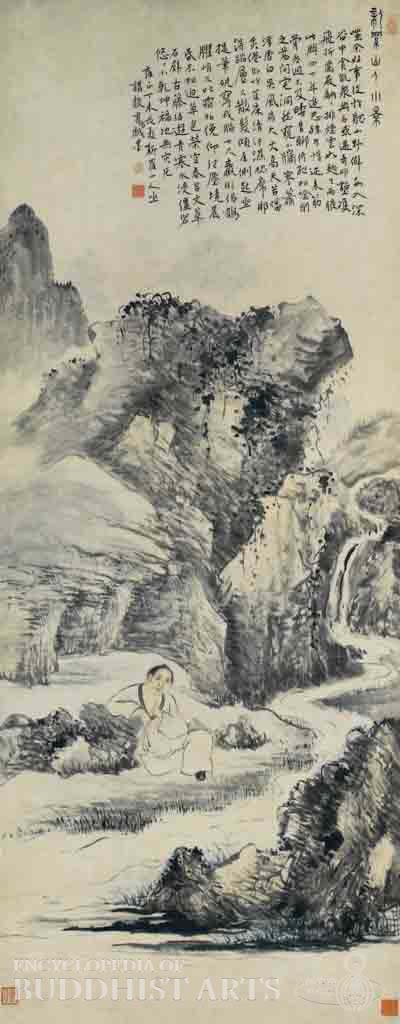
Self-Portrait by Hua Yan; Qing dynasty, dated 1727
Ink and color on paper
Hua Yan
CHINA, Fujian, Longyan; Qing dynasty
Hua Yan was an artist originally from Shanghang, Longyan. He later relocated to Hangzhou, where he made his living selling paintings. Hua was considered an excellent calligrapher and poet, and alongside Zhongyao and Yu Shinan, he was known as one of the Three Calligraphers Masters of the Qing dyansty.
The influence of Wang Shugu and Chen Laolian are evident in Hua’s portrait paintings, and his landscape paintings followed the styles of the Song (960–1279) and Yuan (1271–1368) dynasties. Styles such as those of Fayun Shouping and Zhou Zhimian were also imitated by Hua to create lively paintings of birds and flowers.
Several of Hua’s paintings were based on subjects such as historical figures, folklore, and local customs. Buddhist-themed works include a painting of the Thousand-Armed Avalokitesvara, which is currently retained at the Nantong Museum in Jiangsu. Other well-known works include Snow Scene of Tianshan, in addition to his Self-Portrait, currently kept at the Palace Museum in Beijing.
For more details, go to the Encyclopedia of Buddhist Arts: People, page 98.
Cite this article:
author = Hsingyun and Youheng and Youlu and Pokorski, Stefanie and Yichao and Mankuang and Miaohsi,
booktitle = {Encyclopedia of Buddhist Arts: People },
pages = 98,
title = {{Hua Yan}},
volume = 19,
year = {2016}}