
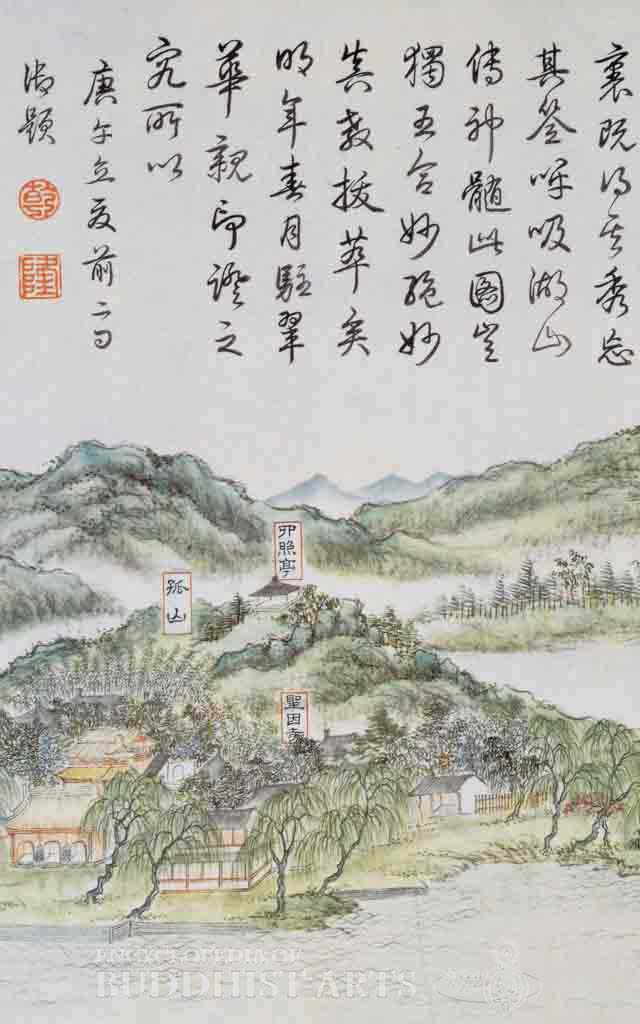
Ten Scenes of West Lake by Dong Bangda (detail); Qing dynasty
Ink and color on paper
Dong Bangda
CHINA, Zhejiang, Fuyang; Qing dynasty
Dong Bangda was an artist who was also known as Feiwen or Dongshan. He passed the imperial examination and became an Imperial Scholar in 1733, and later he worked as an editor in the Hanlin Academy. In addition, Dong assisted in the compilation and editing of various texts. He was known to have had a long and prosperous career as an official.
Skilled in calligraphy, Dong excelled in seal and clerical scripts. In painting, his landscapes were modeled after works of the Yuan dynasty (1271–1368). Majestic and imposing, the style of Dong’s paintings also imparts the influence of Juran, Huang Gongwang, Dong Yuan, and Dong Qichang. He created a coarse texture by using a brush with dry ink, and completed the image with a light wash. This was a style somewhere in the Loudong and Yushan schools.
While his figure paintings extant today are limited, his landscape paintings are numerous. Among them are: Ten Scenes of West Lake, which features locations around the West Lake in Hangzhou, Zhejiang such as Zhaoqing Temple, Baoshu Pagoda, and Dafo Temple; and Desolate Monastery in Autumn Mountains. These landscape depictions, in addition to many others totaling around 90 paintings, including Avalokitesvara Bodhisattva, are currently kept at the National Palace Museum in Taipei, Taiwan.
For more details, go to the Encyclopedia of Buddhist Arts: People, page 46.
Cite this article:
author = Hsingyun and Youheng and Youlu and Pokorski, Stefanie and Yichao and Mankuang and Miaohsi,
booktitle = {Encyclopedia of Buddhist Arts: People },
pages = 46,
title = {{Dong Bangda}},
volume = 19,
year = {2016}}