
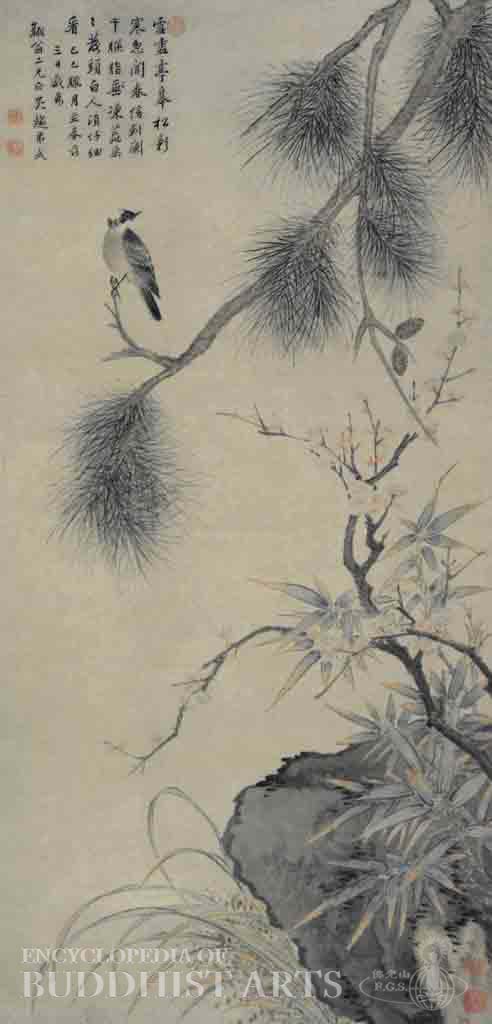
White-Headed Bird on a Pine Tree with Bamboo by Wang Wu; Qing dynasty, dated 1689
Ink and color on paper
Wang Wu
CHINA, Jiangsu, Suzhou; Ming to Qing dynasty
Wang Wu, a native of Wuxian (present day Suzhou, Jiangsu), was a painter and art collector also known as Qinzhong or Rushi Weng. Although he came from an aristocratic family of the Ming dynasty (1368–1644), he showed no interest in seeking an official position when the Qing dynasty began. Instead, he entertained himself by painting and collecting art. Wang skillfully copied the masterpieces of various painting masters from the Song (960–1279), Yuan (1271–1368), and Ming dynasties.
Paintings by Wang focused mainly on landscapes during his early years, and he later switched to flower and bird depictions. Some critics commented that his floral paintings surpassed that of masters Chen Daofu and Lu Shuping. His works were neat and beautiful in style, exquisite in coloring, and widely collected. Wang once used ink to create a painting of Dongchan Temple, which was praised by Zhu Yizun, a famous poet of the Qing dynasty.
Wang’s extant works, Flowers and White-Headed Bird on a Pine Tree with Bamboo, are kept at the Palace Museum in Beijing. Other paintings, such as Flowers and Birds, and Four Seasonal Fruits, are kept at the Shanghai Museum, while another work of Flowers is collected at the Guangzhou Art Museum in Guangdong.
For more details, go to the Encyclopedia of Buddhist Arts: People, page 284.
Cite this article:
author = Hsingyun and Youheng and Youlu and Pokorski, Stefanie and Yichao and Mankuang and Miaohsi,
booktitle = {Encyclopedia of Buddhist Arts: People },
pages = 284,
title = {{Wang Wu}},
volume = 19,
year = {2016}}