
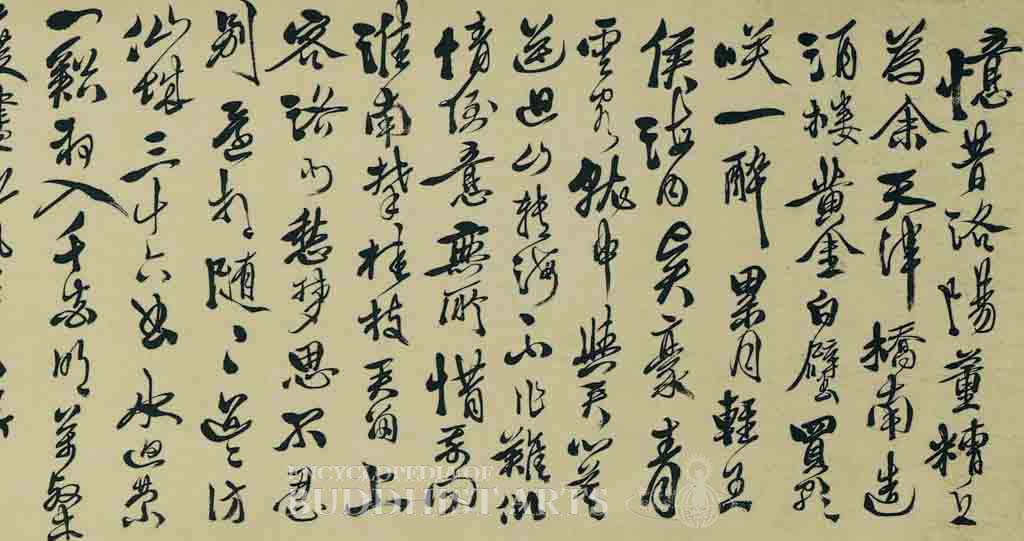
Frontispiece of Li Bai’s Poems and Sushi’s Proses by Xu Wei (detail); Ming dynasty
Ink on paper
Xu Wei
CHINA, Zhejiang, Shaoxing; Ming dynasty
Also known as Wencheng or Qingteng Jushi, Xu Wei was a painter, calligrapher, and scholar from Shanyin (present day Shaoxing, Zhejiang). Possessing a multitude of talents with an open and unrestrained character, Xu became a Provincal Scholar in 1561 when he was 40 years old.
In his early calligraphy work, he modeled after Huang Tingjian, and later, after Mi Fu. Xu learned painting in his middle age and inherited the freehand styles of Lin Liang and Shen Zhou. His floral paintings in ink were spontaneous and expressed his inner emotions with unrestrained, yet leisurely strokes. This approach evolved into a new style that greatly influenced future generations, earning Xu the name of Wild Chan Jushi. Qing dynasty (1644–1911) artists Shi Tao and Bada Shanren highly praised his artistic talents, and Wu Changshuo complimented him as a sage of painters. Xu, along with Chen Chun were known as Qingteng Baiyang (Green Vine, White Sun). His calligraphic works include the Frontispiece of Li Bai’s Poems and Sushi’s Proses kept at the Shanghai Museum; and Poem on Tianwa Temple kept at the Hong Kong Museum of Art.
With the integration of painting with poetry and calligraphy, Xu’s landscape and figure paintings are refreshing and formed his own style. His most well-known Buddhist painting is Avalokitesvara Bodhisattva on a Lotus Boat, and other works include Sixteen Varieties of Flowers, Flowers of Four Seasons, Grapes, and others are kept at the Palace Museum in Beijing. In addition, several of his works are at museums and galleries around the world, including the Shanghai Museum; Nanjing Museum in Jiangsu; National Palace Museum in Taipei, Taiwan; Honolulu Academy of Arts in Hawaii; Tokyo National Museum in Japan; and Freer Gallery of Art in Washington, DC, USA.
For more details, go to the Encyclopedia of Buddhist Arts: People, page 308.
Cite this article:
author = Hsingyun and Youheng and Youlu and Pokorski, Stefanie and Yichao and Mankuang and Miaohsi,
booktitle = {Encyclopedia of Buddhist Arts: People },
pages = 308,
title = {{Xu Wei}},
volume = 19,
year = {2016}}