
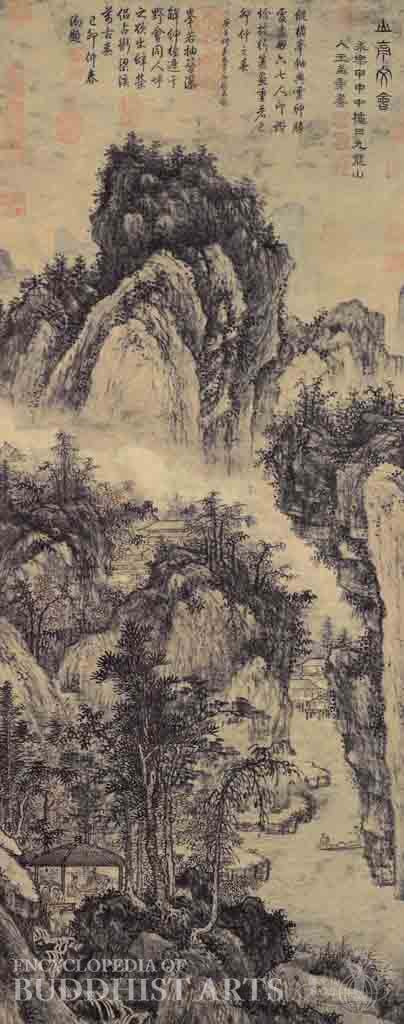
Literati Meeting in a Mountain Pavilion by Wang Fu; Ming dynasty, dated 1404
Ink and color on paper
Wang Fu
CHINA, Jiangsu, Wuxi; Yuan to Ming dynasty (1271–1644)
Wang Fu, also known as Mengduan or Youshi, was a painter and government official. He lived in seclusion in Jiulongshan for several years and practiced poetry, calligraphy, and painting. His works inherited the tradition of the Yuan dynasty (1271–1368), as well as the styles of various well-known painters.
Most highly regarded for his landscape and bamboo paintings in ink, Wang modeled his works after that of Wang Meng and Ni Zan. His landscape paintings utilized delicate brushstrokes with rich ink, and his bamboo paintings adopted the styles of works by Wen Tong and Wu Zhen, as well as the strengths of Ni Zan and Ke Jiusi’s artwork. Wang also authored Collected Works of Youshi Mountain House.
Wang’s paintings, Bamboos, Secluded Living, and Autumn in Xiaoxiang, are kept at the Palace Museum in Beijing; and Eight Scenes of Beijing is housed in the National Museum of China in Beijing. His painting of Avalokitesvara Bodhisattva, a line drawing of an elegant figure seated on a rock with mountains and bamboo in the background, is coupled with the Diamond Sutra written in running script, and considered one of his most outstanding works. It is now kept at the Liaoning Provincial Museum in Shenyang. Aged Trees, Bamboo and Rocks, and Literati Meeting in a Mountain Pavilion are kept at the National Palace Museum in Taipei, Taiwan.
For more details, go to the Encyclopedia of Buddhist Arts: People, page 278.
Cite this article:
author = Hsingyun and Youheng and Youlu and Pokorski, Stefanie and Yichao and Mankuang and Miaohsi,
booktitle = {Encyclopedia of Buddhist Arts: People },
pages = 278,
title = {{Wang Fu}},
volume = 19,
year = {2016}}