
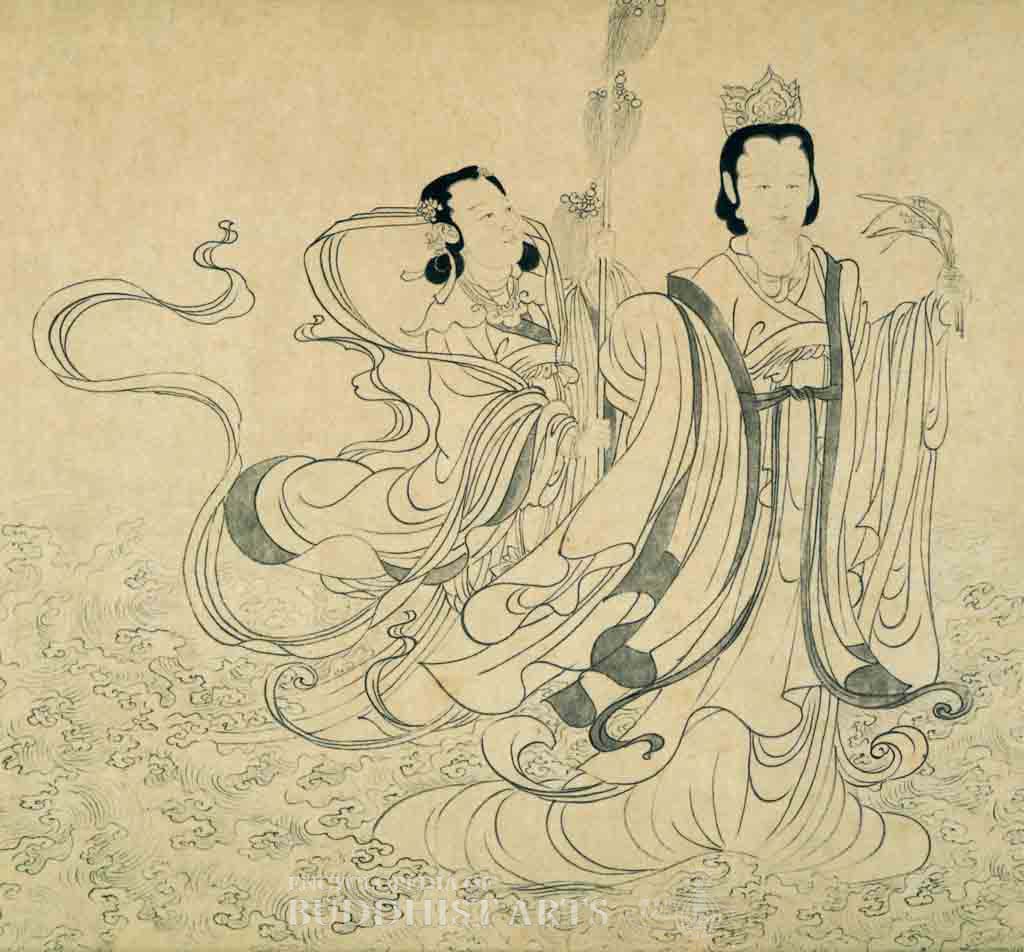
Copy of Li Gonglin’s Nine Songs attributed to Zhang Wo (detail); Yuan dynasty, dated 1346
Ink on paper
Zhang Wo
CHINA, Zhejiang, Hangzhou; Yuan dynasty
Zhang Wo, also known as Shuhou or Zhenqisheng, was a painter and poet who was erudite and multi-talented. His ancestors were from Huainan, Anhui, but he was born in Hangzhou. Good at painting figures, especially Buddhist and Daoist subjects, he learned line painting from Li Gonglin, although some believe he studied under Liang Kai. His brush technique was fine, strong, and unrestrained, producing lively and vivid images.
Paintings by Zhang include a Copy of Longmian’s Arhats, Amithaba Buddha, and Joyously Greeting the Immortals at Jade Lake, all of which are kept at the National Palace Museum in Taipei, Taiwan. Copy of Li Gonglin’s Nine Songs is kept at the Jilin Provincial Museum in Changchun and the Cleveland Art Museum in Ohio, USA; while Visiting Dai Kui on a Snowy Night is kept at the Shanghai Museum. Among those kept at the National Palace Museum in Taipei is a painting of Sixteen-Armed Bodhisattva, which is said to be painted by Zhang Wo but is also suspected to be a forgery from the Ming dynasty (1368–1644).
For more details, go to the Encyclopedia of Buddhist Arts: People, page 341.
Cite this article:
author = Hsingyun and Youheng and Youlu and Pokorski, Stefanie and Yichao and Mankuang and Miaohsi,
booktitle = {Encyclopedia of Buddhist Arts: People },
pages = 341,
title = {{Zhang Wo}},
volume = 19,
year = {2016}}