
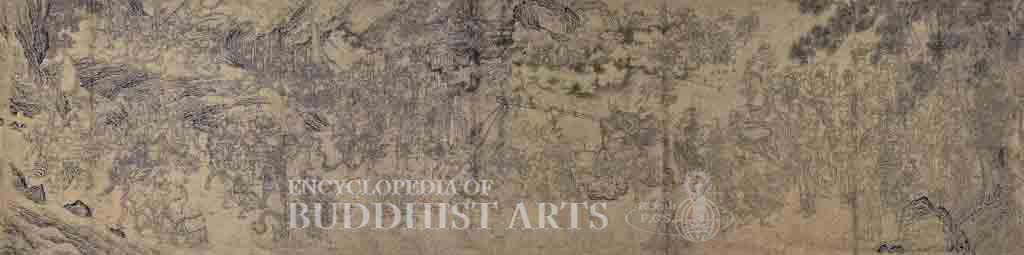
Hariti Rescuing Her Son by Zhu Yu; Yuan dynasty
Ink on paper
Zhu Yu
CHINA, Jiangsu, Suzhou; Yuan dynasty
Born in Kunshan, Suzhou, Zhu Yu was a painter who, while indifferent to fame and wealth, was more interested in visiting scenic places. Learning from Wang Zhenpeng, a renowned painter, he specialized not only in Buddhist and Daoist figure painting, but also in “jiehua,” which was a technique of creating uncolored architectural drawings in a fine-line style using a ruler for precision.
Naga Palace in Purple Mist and Heavenly Palace in Green, both now lost, were his masterpieces. They took him ten years to finish, exemplifying his sincere and pious attitude towards painting. He often chose Buddhist stories as his subject; an example of which is Hariti Rescuing Her Son. Other works include Alms-Bowl, depicting a story from the Maharatnakuta Sutra, kept in Zhejiang Province Museum, and Illustration of the Hells, which is recorded in Evaluation of Famous Chinese Paintings and is now kept in Japan. It is marked with the calligraphy of Emperor Qianlong (reigned 1736–1795) of the Qing dynasty, praising it as “ingenious and vivid.”
For more details, go to the Encyclopedia of Buddhist Arts: People, page 364.
Cite this article:
author = Hsingyun and Youheng and Youlu and Pokorski, Stefanie and Yichao and Mankuang and Miaohsi,
booktitle = {Encyclopedia of Buddhist Arts: People },
pages = 364,
title = {{Zhu Yu}},
volume = 19,
year = {2016}}