
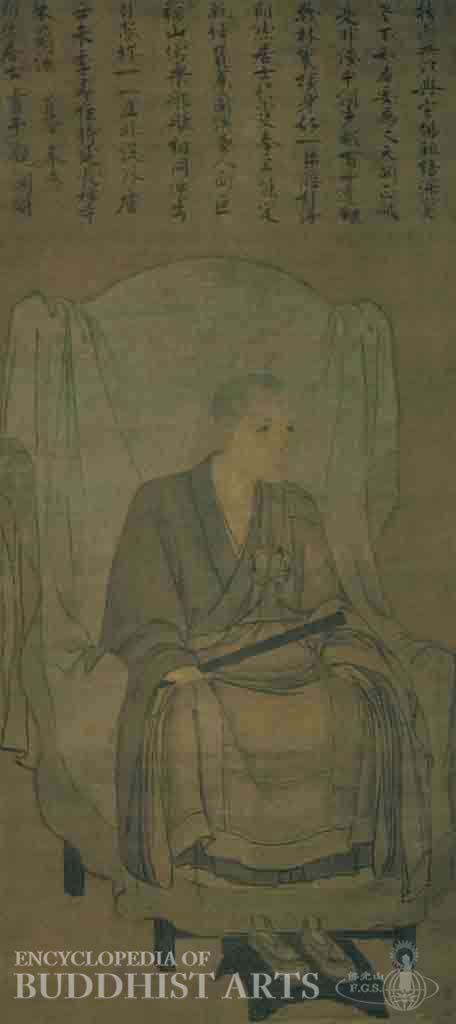
Lanxi Daolong; Kamakura period
Ink and color on silk
Lanxi Daolong
CHINA, Chongqing, Fuling; Southern Song dynasty
Lanxi Daolong, also known by his Japanese name Rankei Doryo, was a calligrapher and Chan master of the Linji school of Chan Buddhism from Fuzhou, Xishu (present day Fuling, Chongqing). He renounced at the age of 13 at Daci Temple in Sichuan, studied Buddhism under Wuzhun Shifan, and eventually became the Dharma heir of Wuming Huxing.
In 1246, he moved to Japan where he helped establish and served as abbot of Kenchoji Temple in Kanagawa in 1253. His disciples there regarded him as the founder of the Daikaku school, one of the 24 schools of Zen Buddhism in Japan. Lanxi resolved to promote the teachings of Zen Buddhism throughout the country, and after his passing, Emperor Kameyama (reigned 1259–1274) accorded him the posthumous title of Zen Master Daikaku, which means “Great Enlightenment.”
Lanxi’s calligraphic style imparts the influence of Huang Tingjian and exhibits elements of Zhang Ji’s style. Due to his Chan mind, he was able to incorporate the philosophy into his works and introduce a unique style of calligraphy that emphasized expression rather than form. His calligraphy is written in simple yet powerful strokes.
Among Lanxi’s famous works are Advice on Diligence in Meditation Practice and Temple Discipline, both of which were written to instill proper ethics on practicing monks in Kenjochi Temple and are listed as National Treasures of Japan. In addition, his inscriptions on a temple bell at Kenjochi Temple is also listed as a National Treasure, as are his written copy of the Diamond Sutra, kept at Ryuko Temple in Kyoto, and his calligraphy that appears on a painting of Bodhidharma at Kogakuji Temple in Yamanashi. A copy of the Sutra in Forty-Two Sections is attributed to Lanxi and is listed as an Important Cultural Property collected at the Tokyo National Museum. Another calligraphy, Sutra Announcement Board kept at Takiwayama Bunko Foundation in Kamakura, is also listed as an Important Cultural Property.
For more details, go to the Encyclopedia of Buddhist Arts: People, page 151.
Cite this article:
author = Hsingyun and Youheng and Youlu and Pokorski, Stefanie and Yichao and Mankuang and Miaohsi,
booktitle = {Encyclopedia of Buddhist Arts: People },
pages = 151,
title = {{Lanxi Daolong}},
volume = 19,
year = {2016}}