
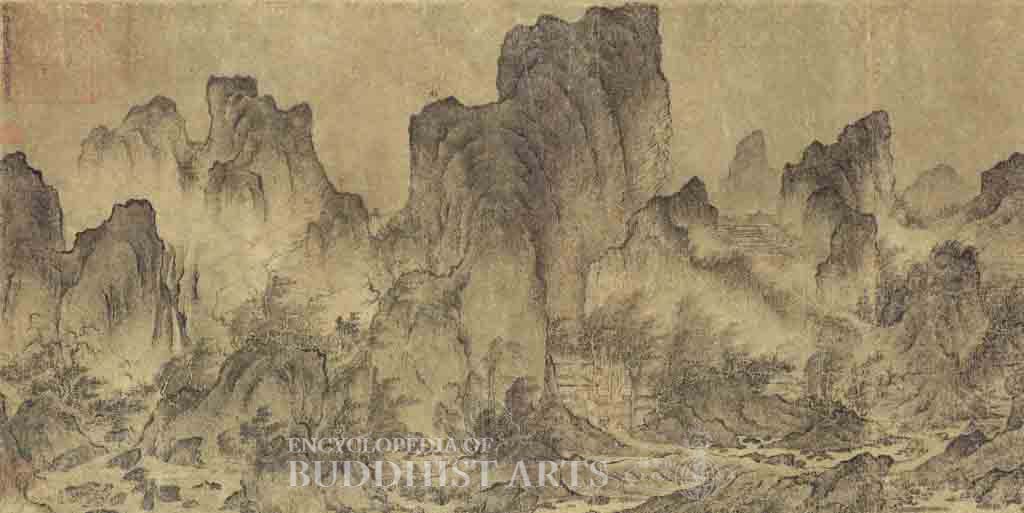
Landscape Viewing at Jiangshan Pavilion attributed to Yan Wengui; Northern Song dynasty
Ink and color on paper
Yan Wengui
CHINA, Zhejiang, Huzhou; Northern Song dynasty
Yan Wengui was a painter from Wuxing (present day Huzhou, Zhejiang). He was also known as Yan Gui, and Yan Wenji. Originally a soldier, Yan later made a living by selling paintings in Kaifeng, Henan. Skilled in depicting landscapes, figures, and rule-lined architectural paintings, Yan first learned from Qi Hui, and his landscapes were delicate, clear, and elegant.
Gao Yi, a painter-in-attendance in the Imperial Painting Academy, is said to have bought one of Yan’s paintings and presented it to Emperor Taizong (reigned 976–997) of the Northern Song dynasty. Gao recommended Yan to paint murals at Xiangguo Temple in Henan, stating that he was the only artist capable of drawing realistic trees and rocks in murals. As a result, Emperor Taizong allowed Yan to join the Imperial Painting Academy.
Yan painted the landscape scenery among the murals such as King Asoka and Tejaprabha Buddha Subdues Nine Luminaries, in which the figures were illustrated by Gao Yi. He also participated in painting murals at Yuqing Chaoying Palace.
Extant paintings by Yan include Landscape Viewing at Xishan Pavilion and Hillside Temple in Autumn kept at the National Palace Museum in Taipei, Taiwan. In addition, Landscape Viewing at Jiangshan Pavilion, kept at the Osaka Municipal Museum of Art in Japan, is attributed to him.
For more details, go to the Encyclopedia of Buddhist Arts: People, page 315.
Cite this article:
author = Hsingyun and Youheng and Youlu and Pokorski, Stefanie and Yichao and Mankuang and Miaohsi,
booktitle = {Encyclopedia of Buddhist Arts: People },
pages = 315,
title = {{Yan Wengui}},
volume = 19,
year = {2016}}