
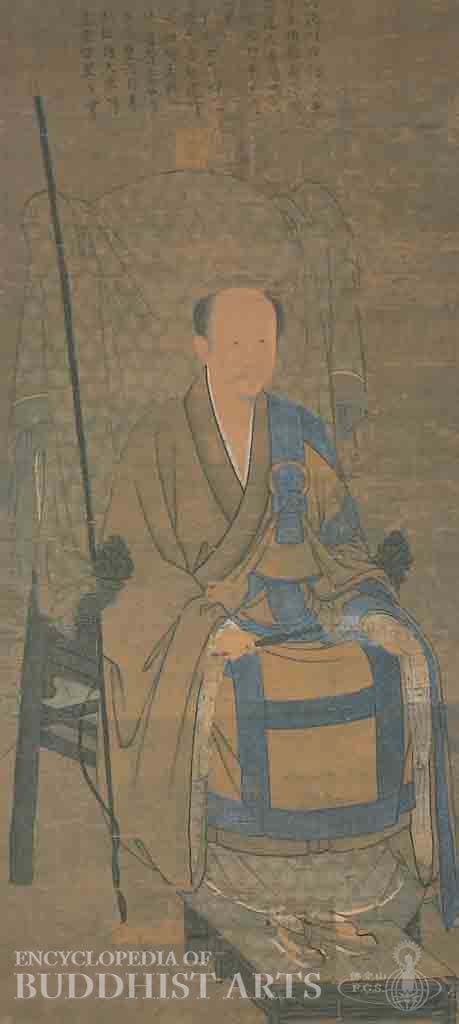
Master Xutang Zhiyu; Southern Song dynasty
Ink and color on silk
Xutang Zhiyu
CHINA, Zhejiang, Ningbo; Southern Song dynasty
Xutang Zhiyu, also known as Xigengsou, was a calligrapher and Chan master of the Yangqi branch of the Linji school of Chan Buddhism. He was born into a family with a surname of Chen from Siming (present day Xiangshan, Ningbo). He renounced at age 16 at Puming Temple and became a disciple of Yunan Puyan. After visiting and studying in many famous monasteries around China, he served as the abbot of Xingsheng Temple in 1229, and later held the position of abbot in other temples such as Wanshou Temple in Zhejiang and Baolin Temple. Both Emperor Lizong (reigned 1224–1264) and Emperor Duzong (reigned 1264–1274) of the Southern Song dynasty took refuge under him.
Many Japanese monks paid visits to and became disciples of Master Xutang. Among them was Japanese Zen Master Nanpo Jomyo who brought back tea books and tools to Japan and was regarded as a master of the Japanese Tea Ceremony. He also returned to Japan with a painted portrait of Master Xutang Zhiyu with a handwritten inscription by Xutang himself, which is now an Important Cultural Property of Japan kept at Daitokuji Temple in Kyoto, Japan.
Master Xutang excelled in calligraphy using smooth, flowing brushstrokes resulting in decorative characters. Several of his works made their way to Japan through his disciples and were highly regarded. His well-known works include a horizontal inscribed board of Characters - Above the Clouds, kept at Daitokuji Temple in Kyoto, Japan; Advice on Chan Teachings, a gift to Zen Master Musho Josho, kept at the Tokyo National Museum as a National Treasure of Japan; Words of Incense Offering in Memory of Bodhidharma at Daitokuji Temple; and two letters written to Wuweng Xiangyou kept at the Tokyo National Museum as Important Cultural Properties of Japan. In addition, Master Xutang authored ten fascicles of Quotes of Chan Master Xutang Zhiyu, which collected his famous Dharma words, verses, odes, and poems.
For more details, go to the Encyclopedia of Buddhist Arts: People, page 312.
Cite this article:
author = Hsingyun and Youheng and Youlu and Pokorski, Stefanie and Yichao and Mankuang and Miaohsi,
booktitle = {Encyclopedia of Buddhist Arts: People },
pages = 312,
title = {{Xutang Zhiyu}},
volume = 19,
year = {2016}}