
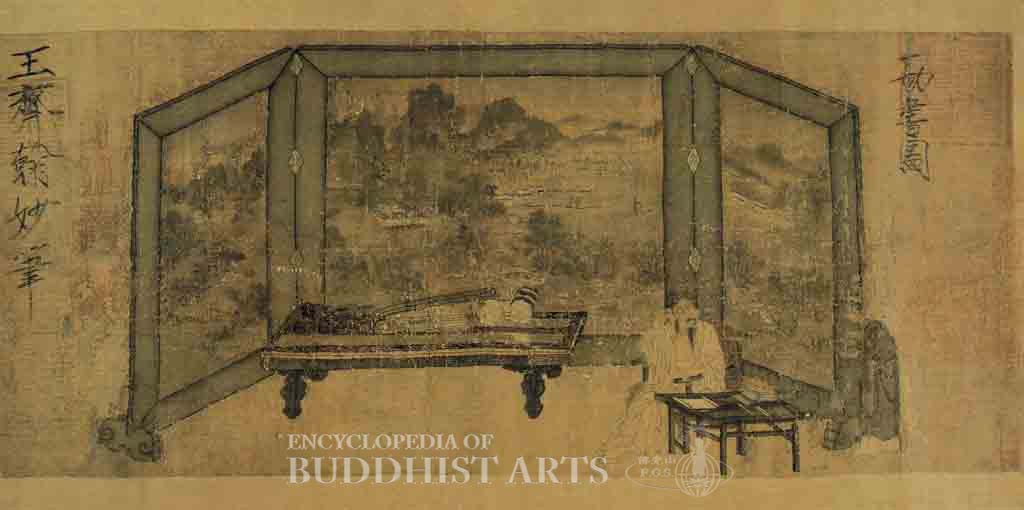
Collating Books by Wang Qihan; Southern Tang Kingdom
Ink and color on silk
Wang Qihan
CHINA, Jiangsu, Nanjing; Southern Tang Kingdom
Wang Qihan was a painter from Jiankang (present day Nanjing, Jiangsu). He was appointed as a scholar in the Hanlin Academy and worked as a painter-in-attendance to Emperor Houzhu (reigned 961–975) of the Southern Tang dynasty and specialized in the painting of Buddhist images and figures. Evaluation of Famous Painters of the Song Dynasty praised Wang as, “Neither Cao Buxing nor Wu Daozi, forming a class of his own with an outstanding style that was second to none in recent time.” It was also recorded that Emperor Taizong (reigned 976–997) of the Northern Song dynasty highly regarded Wang’s paintings of the Sixteen Arhats, and kept them in the imperial palace.
Xuanhe Catalog of Paintings records 119 of his paintings, most of which feature Buddhist or Daoist figures, as well as Noblemen and Landscape. His many Buddhist artworks include images of the Sakyamuni Buddha, Avalokitesvara Bodhisattva, Mahasthamaprapta Bodhisattva, Maitreya Bodhisattva, Avalokitesvara in a White Robe, Subhuti, and the Sixteen Arhats.
His painting, Collating Books, contained inscriptions by Su Shi, Su Che, Wang Shen, in addition to one written by Emperor Huizong (reigned 1100–1125) of the Northern Song dynasty. It is now kept at the Nanjing University in Jiangsu. Another painting on a circular fan entitled Children Playing in the Lotus Pavilion is kept at the Museum of Fine Arts in Boston, Massachusetts, USA.
For more details, go to the Encyclopedia of Buddhist Arts: People, page 281.
Cite this article:
author = Hsingyun and Youheng and Youlu and Pokorski, Stefanie and Yichao and Mankuang and Miaohsi,
booktitle = {Encyclopedia of Buddhist Arts: People },
pages = 281,
title = {{Wang Qihan}},
volume = 19,
year = {2016}}