
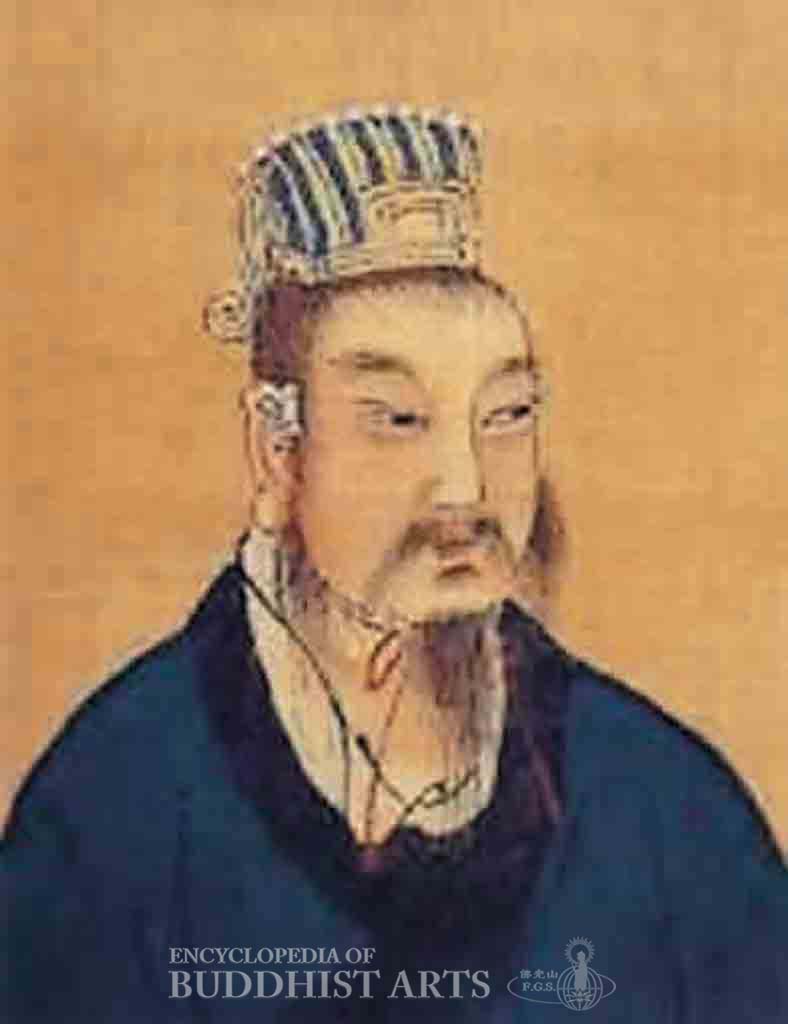
Emperor Yuan of Liang

Periodical Offering attributed to Emperor Yuan (detail); Southern Liang dynasty
Color on silk

Periodical Offering attributed to Emperor Yuan (detail); Southern Liang dynasty
Color on silk
Emperor Yuan of Liang
CHINA, Jiangsu, Changzhou; Southern Liang dynasty
Originally named Xiao Yi, Emperor Yuan (reigned 552–554) of the Liang dynasty was the seventh son of Emperor Wu (reigned 502–549). Before ascending the throne to become emperor, he was appointed as Prince Xiang Dong and served as the governor of Jingzhou.
Although he was born blind in one eye, Emperor Yuan became a proficient and well-known calligrapher and painter. The Continuation of Classification of Ancient Painters praises him as a learned man and was famous for his vivid and refined figure paintings with fluid and precise brushwork. His contributions to the development of art and literature during the Southern Liang dynasty (502–557), which included the establishment of an art school, were significant. Emperor Yuan authored Principles of Landscapes, Rocks, and Pines, in which various painting methods and styles are described. The discourse reflects the progression towards maturity of landscape painting during the Southern Liang period.
Famous Paintings in History documents Emperor Yuan’s expertise in painting portraits and costumes. His painting of Manjusri Bodhisattva is listed in Painting Annals of the Zhengguan Period. Periodical Offering, which is currently kept at the National Museum of China, was said to have been originally painted by Yuan and replicated during the Song dynasty (960–1279).
For more details, go to the Encyclopedia of Buddhist Arts: People, page 60.
Cite this article:
author = Hsingyun and Youheng and Youlu and Pokorski, Stefanie and Yichao and Mankuang and Miaohsi,
booktitle = {Encyclopedia of Buddhist Arts: People },
pages = 60,
title = {{Emperor Yuan of Liang}},
volume = 19,
year = {2016}}