
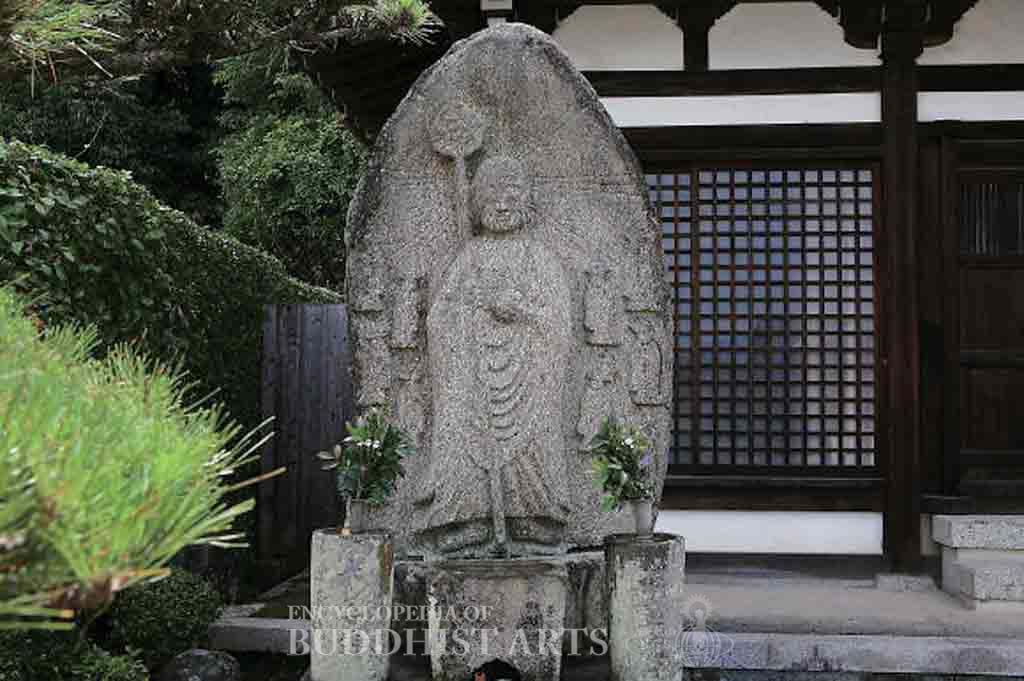
Kukaiji Temple: Ksitigarbha Bodhisattva
Granite
Kukaiji Temple: Ksitigarbha Bodhisattva
JAPAN, Nara; Muromachi period
The sculpture is located in front of the main hall of Kukaiji Temple. Ksitigarbha Bodhisattva is carved in mid-relief on the boat-shaped natural stone that serves as a mandorla. The figure is dressed in monastic robes and stands holding a monk’s staff in the right hand and in the left hand, a jewel. Images of the Ten Kings of Hell, whose cult was strong during the late Muromachi period (1392–1573), are incorporated into the mandorla, carved in low relief. The sculptural technique is rudimentary. Shallow chisel cuts create the rays that emanate from the head in place of a nimbus, and run to the edges of the stone.
For more details, go to the Encyclopedia of Buddhist Arts: Sculpture G-M, page 566.
Cite this article:
Hsingyun, et al. "Kukaiji Temple: Ksitigarbha Bodhisattva." Encyclopedia of Buddhist Arts: Sculpture G-M, vol. 11, 2016, pp. 566.
Hsingyun, Youheng, Yann Lovelock, Yuan Chou, Susan Huntington, Gary Edson, and Robert Neather. 2016. "Kukaiji Temple: Ksitigarbha Bodhisattva" In Encyclopedia of Buddhist Arts: Sculpture G-M, 11:566.
Hsingyun, Youheng, Lovelock, Y., Chou, Y., Huntington, S., Edson, G., & Neather, R.. (2016). Kukaiji Temple: Ksitigarbha Bodhisattva. In Encyclopedia of Buddhist Arts: Sculpture G-M (Vol. 11, pp. 566).
@misc{Hsingyun2016,
author = Hsingyun and Youheng and Lovelock, Yann and Chou, Yuan and Huntington, Susan and Edson, Gary and Neather, Robert,
booktitle = {Encyclopedia of Buddhist Arts: Sculpture G-M},
pages = 566,
title = {{Kukaiji Temple: Ksitigarbha Bodhisattva}},
volume = 11,
year = {2016}}
author = Hsingyun and Youheng and Lovelock, Yann and Chou, Yuan and Huntington, Susan and Edson, Gary and Neather, Robert,
booktitle = {Encyclopedia of Buddhist Arts: Sculpture G-M},
pages = 566,
title = {{Kukaiji Temple: Ksitigarbha Bodhisattva}},
volume = 11,
year = {2016}}