
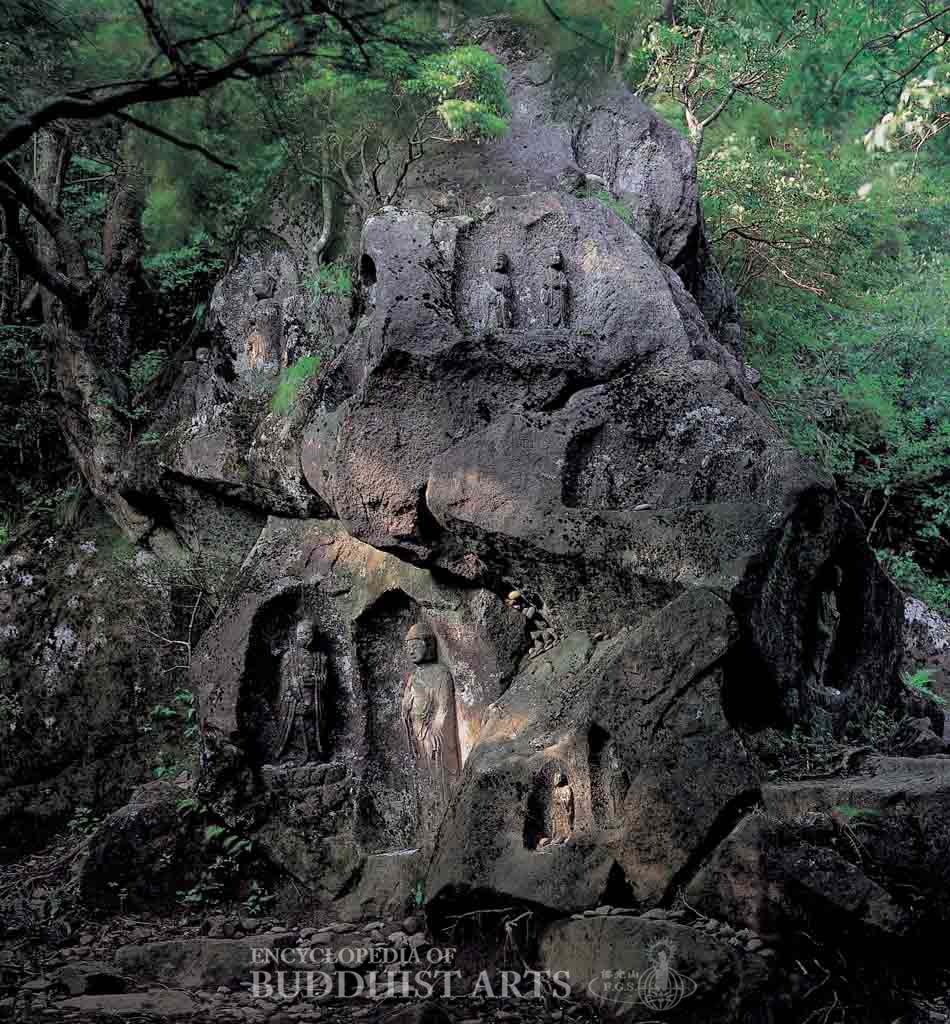
Motohakone Rock Carvings: Twenty-Five Bodhisattvas (detail); Dated 1293
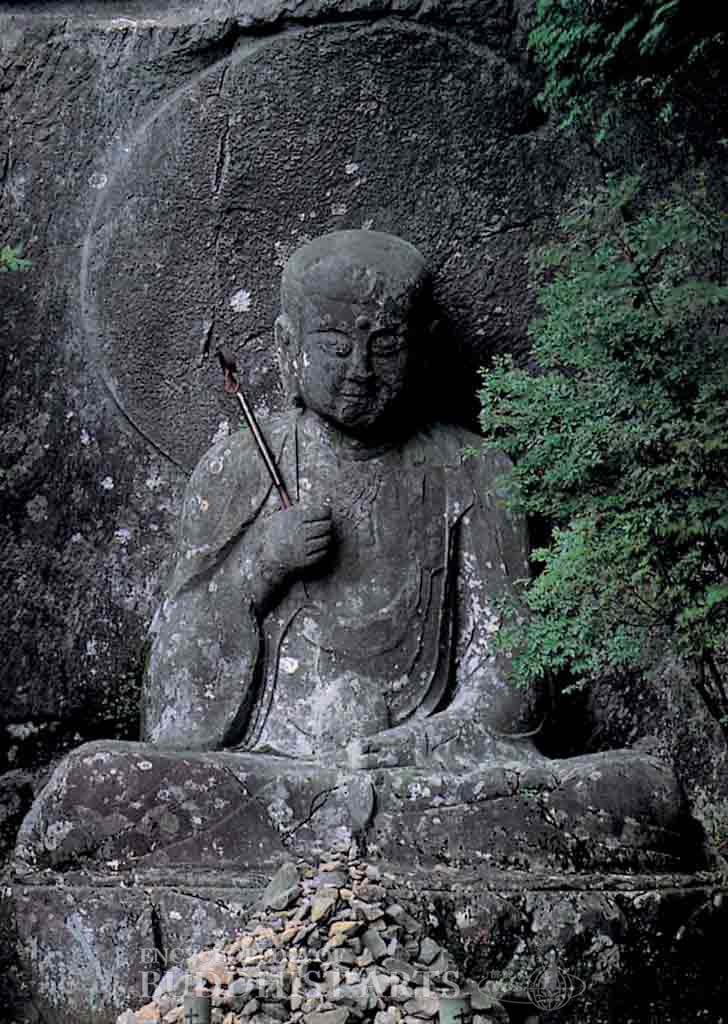
Motohakone Rock Carvings: Ksitigarbha of the Six Realms; Dated 1300
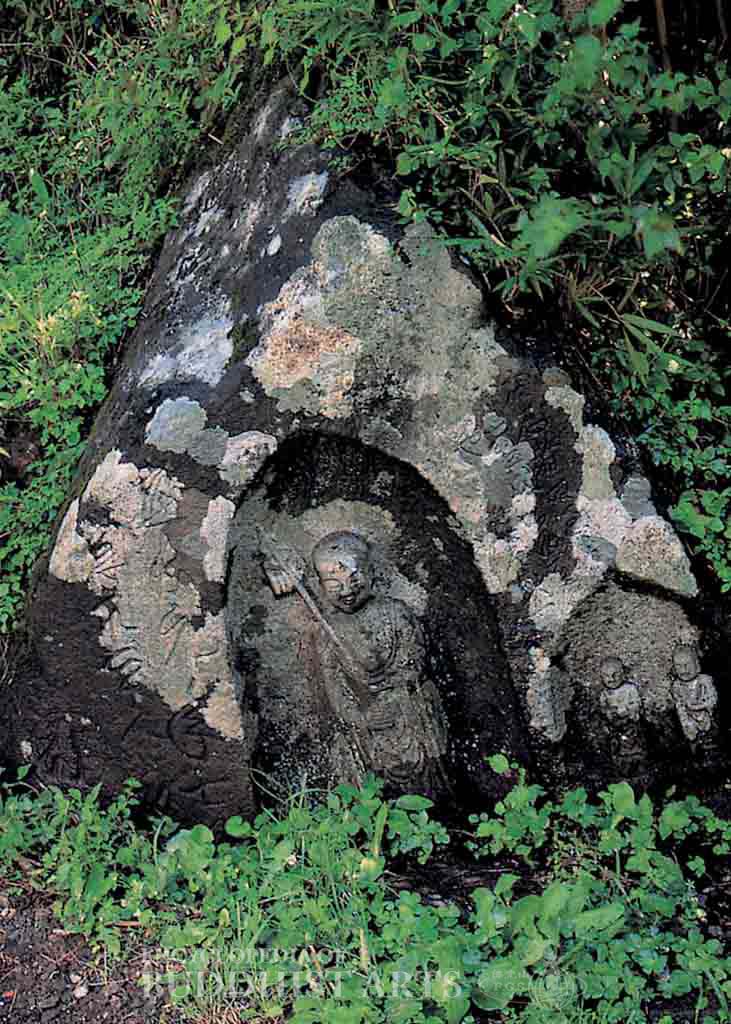
Motohakone Rock Carvings: Ksitigarbha of Kindling Fire; Dated 1311
Motohakone Rock Carvings
JAPAN, Kanagawa, Ashigarashimo
These rock carvings are in Motohakone and comprise three groups: Ksitigarbha of the Six Realms, Ksitigarbha of Kindling Fire, and the Twenty-Five Bodhisattvas. Dating from the Kamakura period (1185–1333), the area is listed as a National Historic Site.
Ksitigarbha of the Six Realms, which refers to the deliverance of sentient beings in the realms of rebirth, is dated to 1300 and is in the central niche. The 3.2 m high freestanding Ksitigarbha carries a monk’s staff in the right hand and lifts a wish-fulfilling jewel in the left. The sturdy figure sits in full lotus position with both knees projecting beyond a lotus throne and is backed by a large nimbus.
The Ksitigarbha of Kindling Fire features three figures of Ksitigarbha in two niches with an inscription dated to 1311. The larger Ksitigarbha stands on a lotus pedestal, wearing sandals and carrying a monk’s staff and a jewel. The name is derived from local cremation practices, where praying to Ksitigarbha Bodhisattva and burning rituals are common within 49 days following the death of a villager.
The Twenty-Five Bodhisattvas were mostly produced between 1293 and 1311. They are sculpted in high relief and stand on lotus pedestals within niches. The figures are sculpted along the face of the rock, presumably produced as watchful guardians for the souls of the deceased.
For more details, go to the Encyclopedia of Buddhist Arts: Caves Mo-S, page 1249.
Cite this article:
author = Hsingyun and Youheng and Johnson, Peter and Mankuang and Huntington, Susan and Edson, Gary and Neather, Robert,
booktitle = {Encyclopedia of Buddhist Arts: Caves Mo-S},
pages = 1249,
title = {{Motohakone Rock Carvings}},
volume = 8,
year = {2016}}