
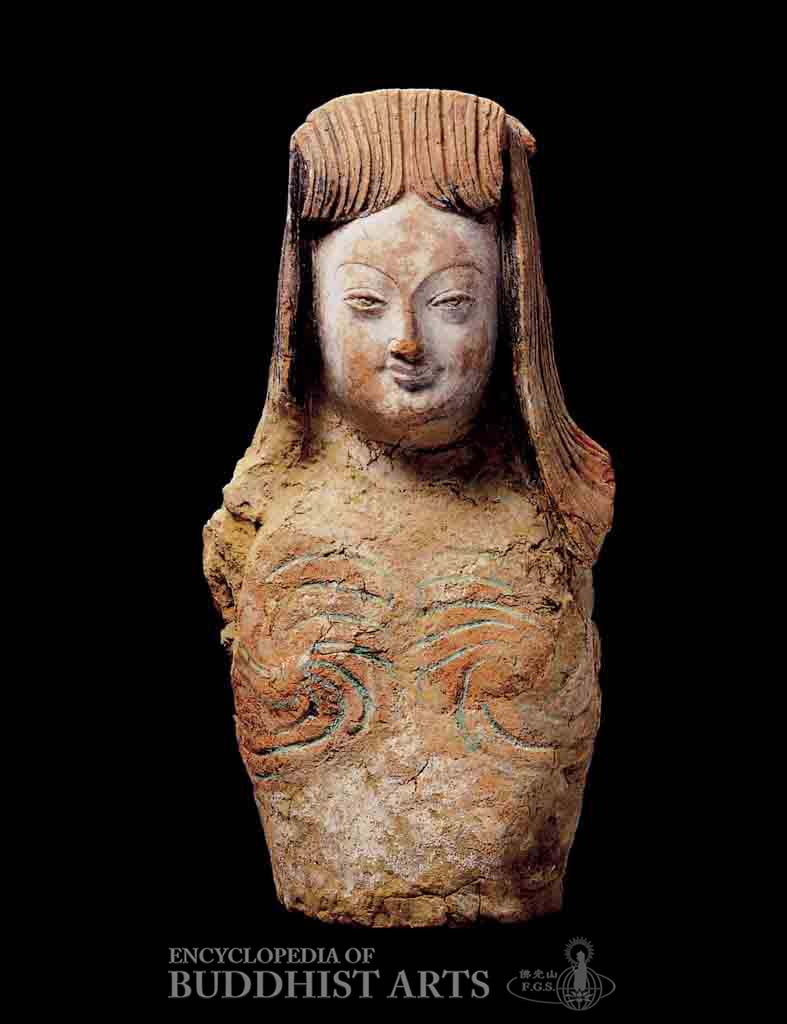
Murtuk: Heavenly Being
Clay
Murtuk: Heavenly Being
CHINA, Xinjiang, Turpan
The bust was discovered at the site of Murtuk during the Japanese Otani expeditions between 1902 to 1914. A variety of techniques were used to craft the work, including line engraving, molding and externally shaping the clay. The figure has been tentatively identified as a heavenly being with the delicate face of a young female. The forward-swept hair falls neatly to the brow over a frame and sweeps to the shoulders at both sides. The line of the eyebrows curves down to define the high nose, beneath which the small mouth turns upward. The figure’s gaze is frank and direct. After such careful molding, the chest area is roughly defined by swirling patterns.
For more details, go to the Encyclopedia of Buddhist Arts: Sculpture G-M, page 733.
Cite this article:
author = Hsingyun and Youheng and Lovelock, Yann and Chou, Yuan and Huntington, Susan and Edson, Gary and Neather, Robert,
booktitle = {Encyclopedia of Buddhist Arts: Sculpture G-M},
pages = 733,
title = {{Murtuk: Heavenly Being}},
volume = 11,
year = {2016}}