
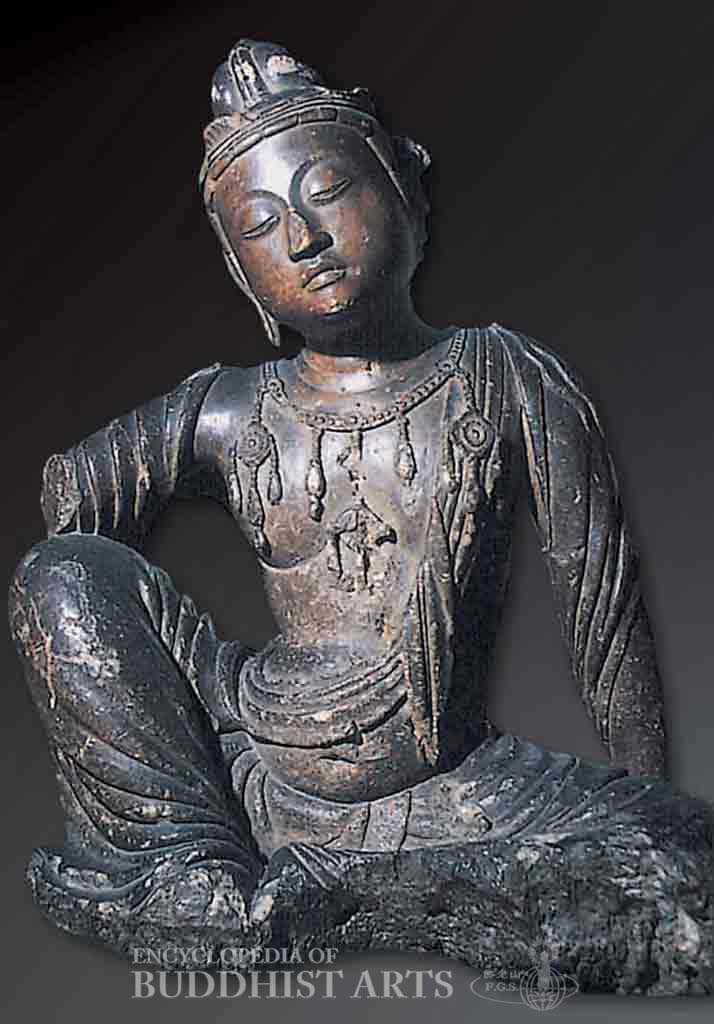
Hotsumisaki Temple: Cintamanicakra Avalokitesvara
Marble
Hotsumisaki Temple: Cintamanicakra Avalokitesvara
JAPAN, Kochi, Muroto; Kamakura period
There are different accounts of the statue’s origin, some claiming that the carving was executed in Japan, others that it was brought from China. It is now kept at Hotsumisaki Temple. The damage done to various parts of the statue is supposed to have been caused by fishermen praying for a good catch and chipping off small parts to take with them.
The Bodhisattva sits leaning on one arm in the posture of royal ease with the head inclined to one side. The figure wears a headdress, necklace, and stoles that encircle the arms and upper body. The raised folds of the stoles and the skirt are a striking feature.
For more details, go to the Encyclopedia of Buddhist Arts: Sculpture G-M, page 461.
Cite this article:
Hsingyun, et al. "Hotsumisaki Temple: Cintamanicakra Avalokitesvara." Encyclopedia of Buddhist Arts: Sculpture G-M, vol. 11, 2016, pp. 461.
Hsingyun, Youheng, Yann Lovelock, Yuan Chou, Susan Huntington, Gary Edson, and Robert Neather. 2016. "Hotsumisaki Temple: Cintamanicakra Avalokitesvara" In Encyclopedia of Buddhist Arts: Sculpture G-M, 11:461.
Hsingyun, Youheng, Lovelock, Y., Chou, Y., Huntington, S., Edson, G., & Neather, R.. (2016). Hotsumisaki Temple: Cintamanicakra Avalokitesvara. In Encyclopedia of Buddhist Arts: Sculpture G-M (Vol. 11, pp. 461).
@misc{Hsingyun2016,
author = Hsingyun and Youheng and Lovelock, Yann and Chou, Yuan and Huntington, Susan and Edson, Gary and Neather, Robert,
booktitle = {Encyclopedia of Buddhist Arts: Sculpture G-M},
pages = 461,
title = {{Hotsumisaki Temple: Cintamanicakra Avalokitesvara}},
volume = 11,
year = {2016}}
author = Hsingyun and Youheng and Lovelock, Yann and Chou, Yuan and Huntington, Susan and Edson, Gary and Neather, Robert,
booktitle = {Encyclopedia of Buddhist Arts: Sculpture G-M},
pages = 461,
title = {{Hotsumisaki Temple: Cintamanicakra Avalokitesvara}},
volume = 11,
year = {2016}}