
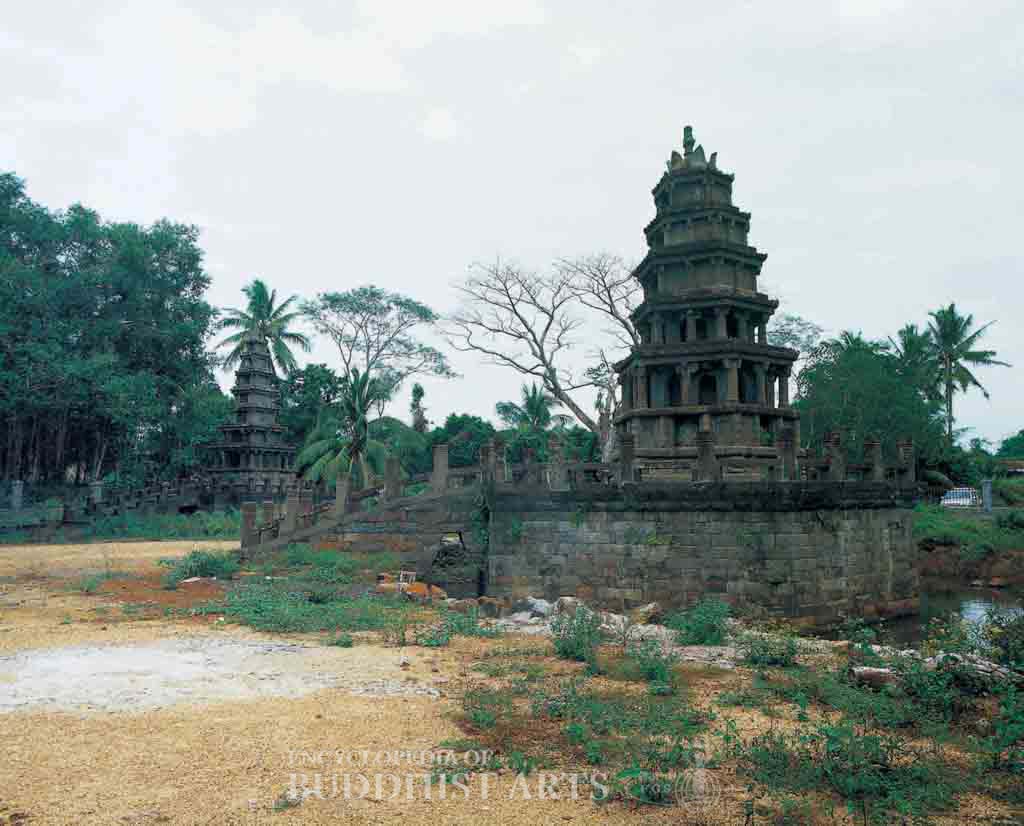
Meilang Pagodas
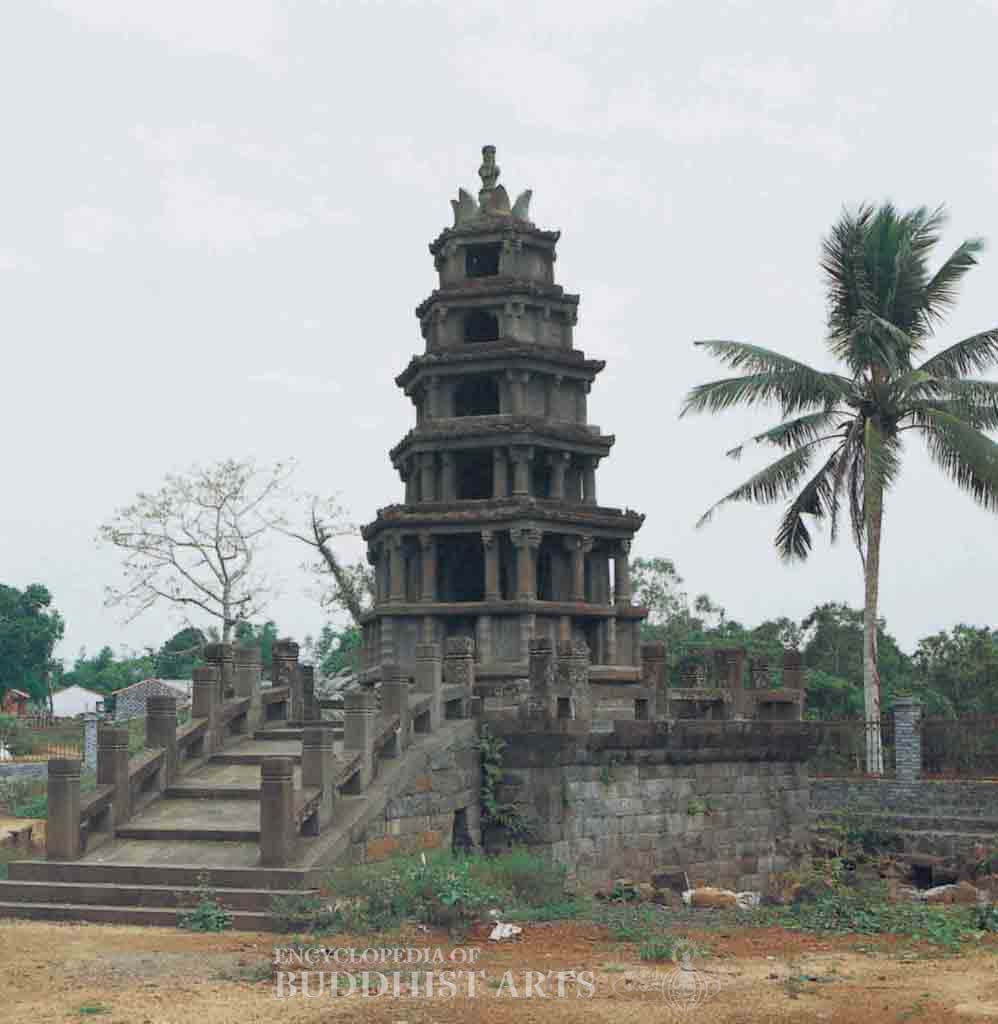
Meilang Pagodas: Elder Sister Pagoda
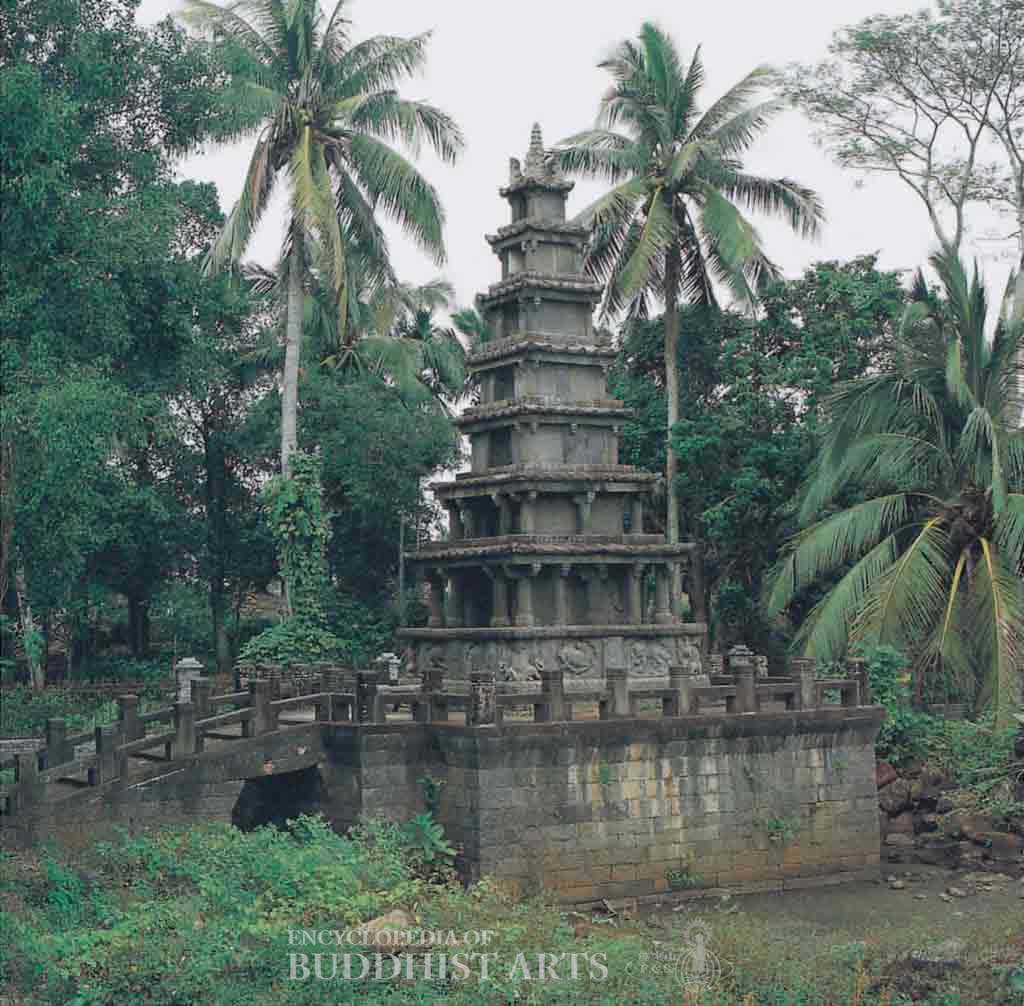
Meilang Pagodas: Younger Sister Pagoda
Meilang Pagodas
CHINA, Hainan, Chengmai
These twin pagodas were built during the Yuan dynasty (1271–1368). According to the local gazetteer from the Ming dynasty (1368–1644), they were built by Chen Daoxu in memory of his two daughters, who were followers of Buddhism. They are also known as the Sister Pagodas. They were listed as a National Cultural Heritage Site in 1996.
The pagodas are 20 m apart and are constructed from lava stone from nearby Ma’anshan (Saddle Mountain). Since the pagodas were built on water, the bases had to be large. Balustrades surround the top of the bases and arched bridges link them to dry land. The six-tier, hexagonal Elder Sister Pagoda is built in imitation of a timber structure. It is 13 m high and faces northwest. The pagoda stands on a double-layer base platform that is 4.4 m high with a perimeter that measures 31.4 m. From tiers one to three, each level is supported by 12 pillars, but from tier four upwards, the pillars are replaced by pilasters. Carvings of donors decorate the pagoda body.
The seven-tier, square Younger Sister Pagoda is built in imitation of a wooden structure. The pagoda faces west and has a height of 13.6 m. It stands on a 4.5 m base platform with a perimeter of 29.6 m. The Sumeru base has carvings of Buddhist themes, as well as animals. Stone warriors at the four corners support the pagoda. The spire rests on an upright lotus and consists of seven stacked rings topped by a jewel.
For more details, go to the Encyclopedia of Buddhist Arts: Architecture M-S, page 727.
Cite this article:
author = Hsingyun and Youheng and Johnson, Peter and Mankuang and Lancaster, Lewis,
booktitle = {Encyclopedia of Buddhist Arts: Architecture M-S},
pages = 727,
title = {{Meilang Pagodas}},
volume = 3,
year = {2016}}