
Horyuji Temple: Amitabha Buddha Pentad
Brick
Horyuji Temple: Amitabha Buddha Pentad
JAPAN, Nara, Ikoma; Hakuho period
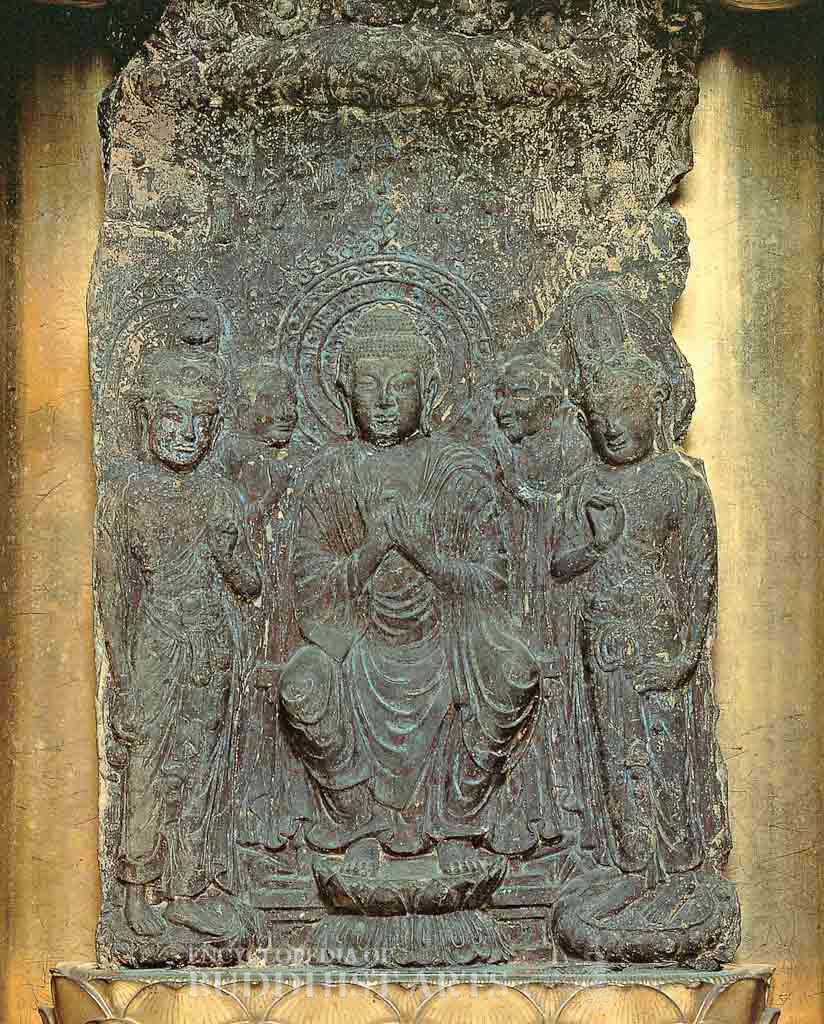
This is the largest existing fired clay pentad in Japan, measuring 4 cm thick, and is listed as an Important Cultural Property. Such artifacts were first introduced during the 7th century for decorating the walls of a main building or pagoda and as devotional objects.
The main figure of Amitabha Buddha sits on a throne with legs pendent, his feet supported by a double lotus. The figure is teaching, with hands in the Dharmacakra (Dharma wheel) mudra. A radiating nimbus behind the Buddha has floral designs and a pattern of flames about the rim. The Bodhisattvas Avalokitesvara and Mahasthamaprapta incline towards Amitabha on either side, standing on simpler lotus pedestals. They form mudras with opposite hands while Avalokitesvara also carries a vase. Two disciples pay reverence in the background. A canopy and some branches hang above the five figures.
For more details, go to the Encyclopedia of Buddhist Arts: Sculpture G-M, page 442.
Cite this article:
author = Hsingyun and Youheng and Lovelock, Yann and Chou, Yuan and Huntington, Susan and Edson, Gary and Neather, Robert,
booktitle = {Encyclopedia of Buddhist Arts: Sculpture G-M},
pages = 442,
title = {{Horyuji Temple: Amitabha Buddha Pentad}},
volume = 11,
year = {2016}}