
Udonoiwaya Rock Carvings
Udonoiwaya Rock Carvings
JAPAN, Saga, Katatsu
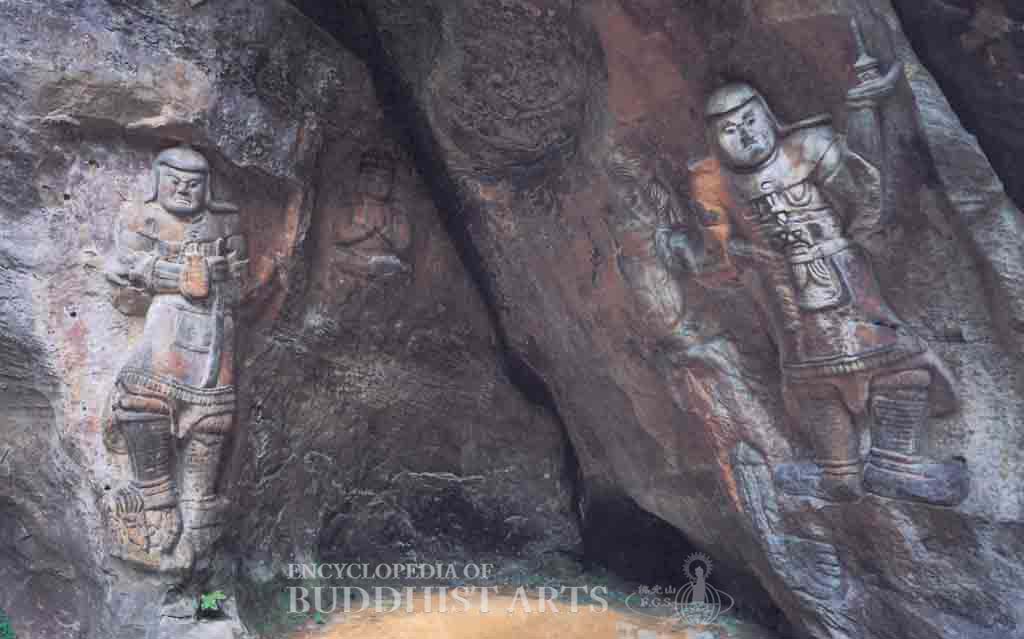
Fifty-eight figures are carved in this natural cave situated halfway up a hill. Legend has it that Master Kukai initiated the carvings of Amitabha Buddha, Sakyamuni Buddha, and Avalokitesvara Bodhisattva when the cave served as a gathering place for practitioners of the Shingon school of Japanese Buddhism. Most of the figures were damaged during warfare between 1532 and 1555 during the Muromachi period, and were reconstructed between 1570 and 1573.
The center of the picture shows Vairocana Buddha seated in full lotus position on a throne with joined palms. The Buddha is flanked by Vaisravana, who holds a pagoda in the left hand and a weapon in the right, and Dhrtarastra, who makes a warding gesture with the left hand and grasps a long handled sword with the other. These armored Heavenly Kings stare angrily with set mouths. Some of the coloring is still preserved and the styling suggests that they are local work, dating from the Nanbokucho (1336–1392) to Muromachi (1392–1573) period.
For more details, go to the Encyclopedia of Buddhist Arts: Caves T-Z, page 1476.
Cite this article:
author = Hsingyun and Youheng and Johnson, Peter and Mankuang and Huntington, Susan and Edson, Gary and Neather, Robert,
booktitle = {Encyclopedia of Buddhist Arts: Caves T-Z},
pages = 1476,
title = {{Udonoiwaya Rock Carvings}},
volume = 9,
year = {2016}}