
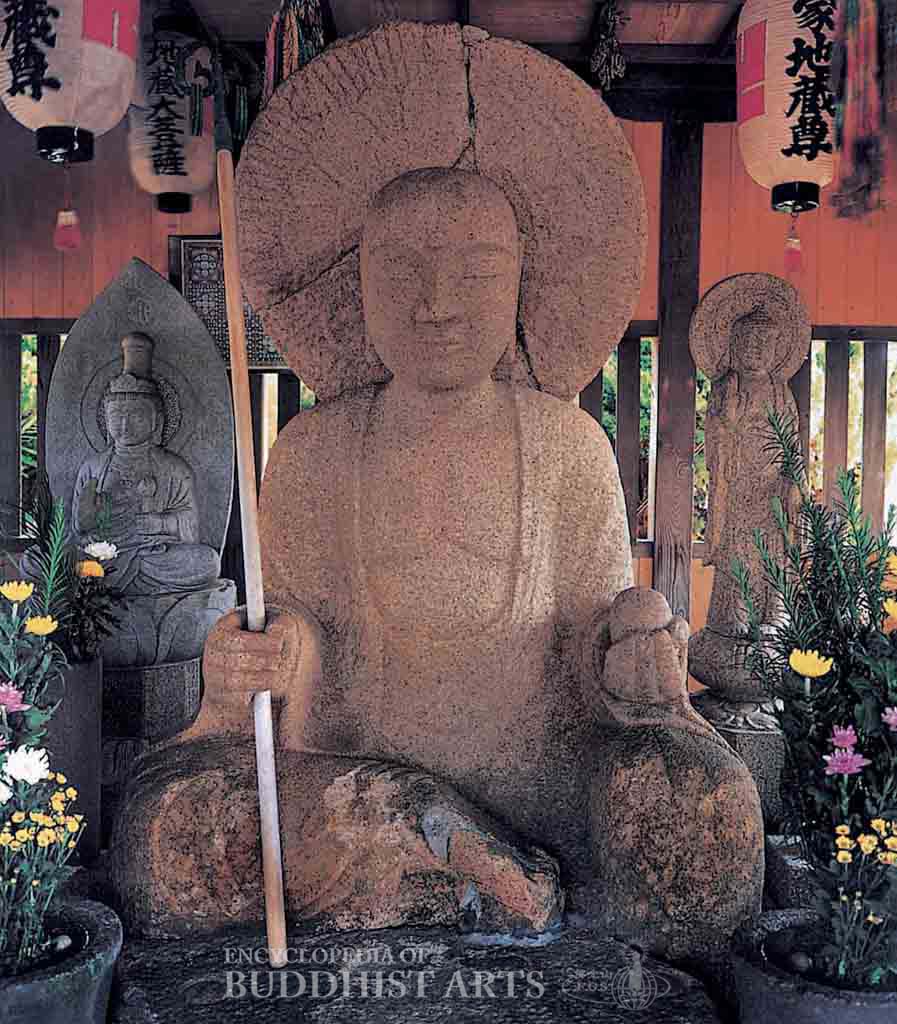
Ksitigarbha Hall: Ksitigarbha Bodhisattva
Granite
Ksitigarbha Hall: Ksitigarbha Bodhisattva
JAPAN, Hyogo, Himeji; Kamakura period
The figure of Ksitigarbha was sculpted during the mid-Kamakura period at a time when this particular representation began to gain popularity. The figure is seated in the relaxation posture with the legs out of proportion to the rest of the body. The elbows are held close to the waist with the right hand supporting a monk’s staff that is missing, and holding a wish-fulfilling jewel in the left hand. The head and body are simply carved, with the monastic robe cut shallowly, apart from the fall of the sleeves over the wrist. The features in the serene face are likewise suggested by shallow cuts of the chisel. Behind the head is a radiating lotus-patterned nimbus that was repaired.
For more details, go to the Encyclopedia of Buddhist Arts: Sculpture G-M, page 565.
Cite this article:
author = Hsingyun and Youheng and Lovelock, Yann and Chou, Yuan and Huntington, Susan and Edson, Gary and Neather, Robert,
booktitle = {Encyclopedia of Buddhist Arts: Sculpture G-M},
pages = 565,
title = {{Ksitigarbha Hall: Ksitigarbha Bodhisattva}},
volume = 11,
year = {2016}}