
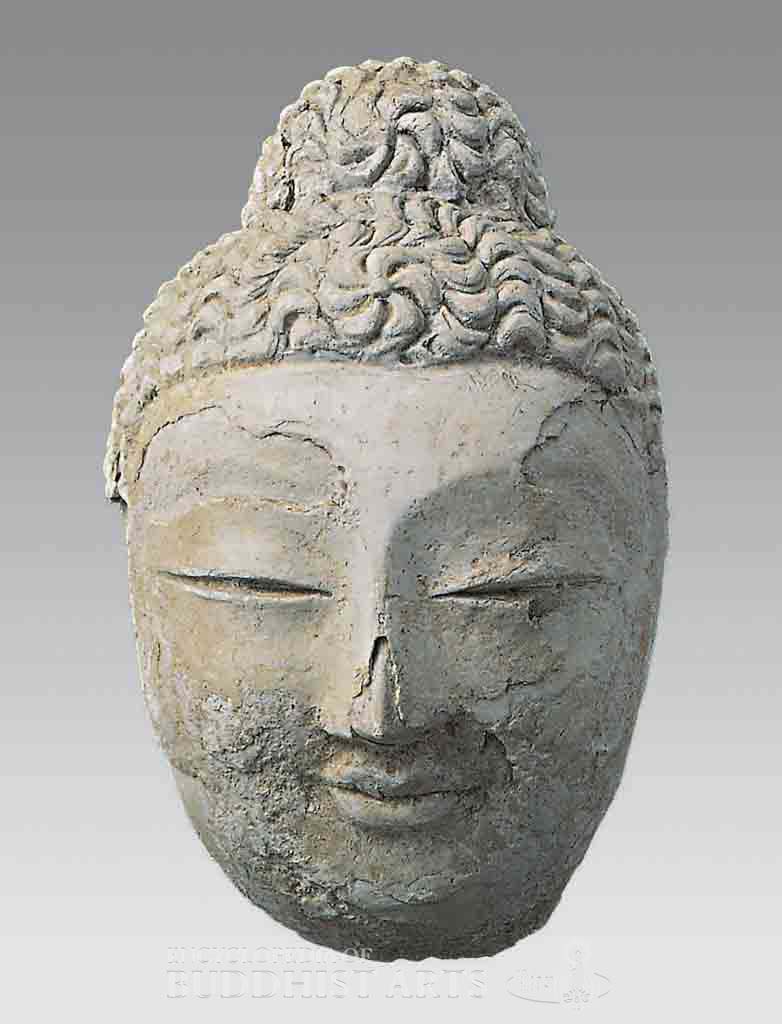
Head of a Buddha
Gypsum
Head of a Buddha
CHINA
The sculpture is believed to have been unearthed from Hotan, Xinjiang. The size of the head suggests the original statue was probably life-sized. The hair and the usnisa are formed with wave-like curls in a style apparently influenced by Gandharan sculpture. The eyebrows are almost indistinct above the slitted eyes. The nose is quite prominent and pointed, while the smiling mouth is small. The style of the statue differs from earlier finds in Central Asia. The flaking layers suggest that the sculpting process was quite complex and may have involved three or four different types of materials.
For more details, go to the Encyclopedia of Buddhist Arts: Sculpture G-M, page 416.
Cite this article:
Hsingyun, et al. "Head of a Buddha." Encyclopedia of Buddhist Arts: Sculpture G-M, vol. 11, 2016, pp. 416.
Hsingyun, Youheng, Yann Lovelock, Yuan Chou, Susan Huntington, Gary Edson, and Robert Neather. 2016. "Head of a Buddha" In Encyclopedia of Buddhist Arts: Sculpture G-M, 11:416.
Hsingyun, Youheng, Lovelock, Y., Chou, Y., Huntington, S., Edson, G., & Neather, R.. (2016). Head of a Buddha. In Encyclopedia of Buddhist Arts: Sculpture G-M (Vol. 11, pp. 416).
@misc{Hsingyun2016,
author = Hsingyun and Youheng and Lovelock, Yann and Chou, Yuan and Huntington, Susan and Edson, Gary and Neather, Robert,
booktitle = {Encyclopedia of Buddhist Arts: Sculpture G-M},
pages = 416,
title = {{Head of a Buddha}},
volume = 11,
year = {2016}}
author = Hsingyun and Youheng and Lovelock, Yann and Chou, Yuan and Huntington, Susan and Edson, Gary and Neather, Robert,
booktitle = {Encyclopedia of Buddhist Arts: Sculpture G-M},
pages = 416,
title = {{Head of a Buddha}},
volume = 11,
year = {2016}}