
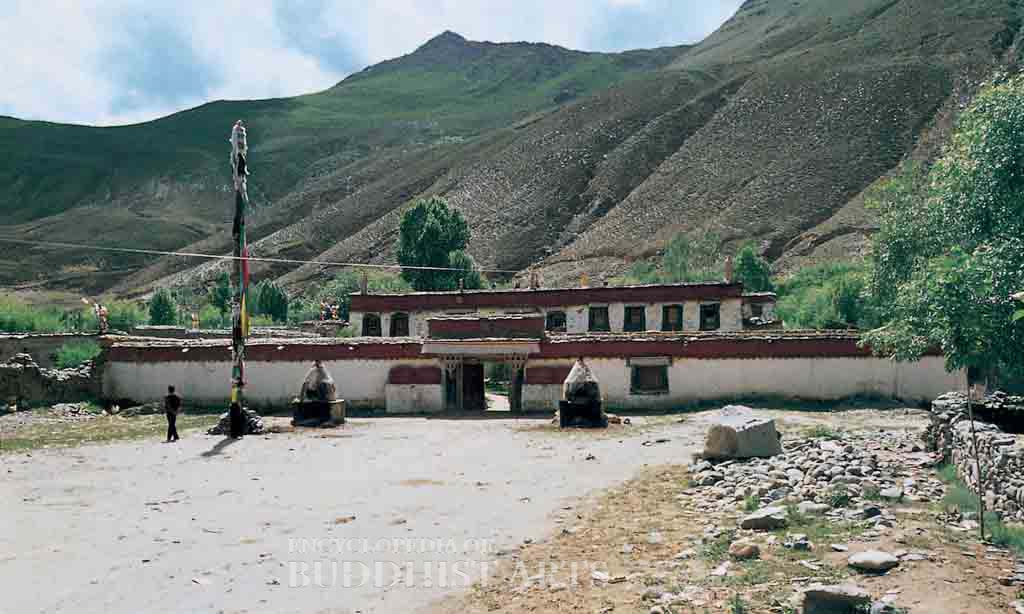
Keru Monastery
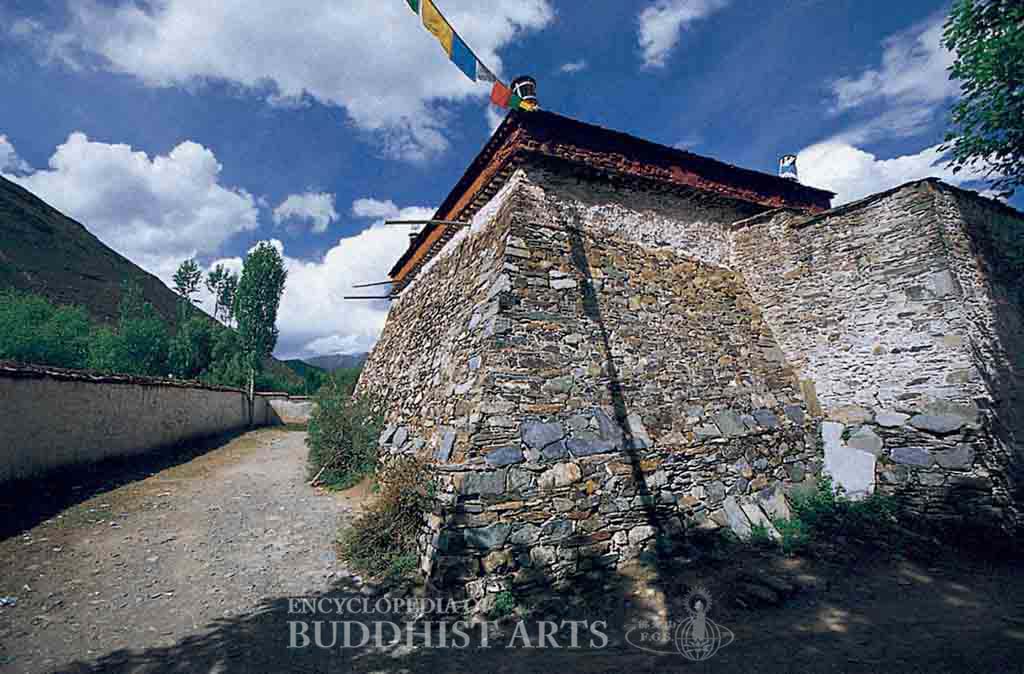
Keru Monastery: Circumambulation Passage with Prayer Wheels
Keru Monastery
CHINA, Tibet, Lhoka
This temple is one of the oldest existing Buddhist buildings in Tibet. It was constructed during the rule of the King Me Agtsom (reigned 704–755) and was listed as a National Cultural Heritage Site in 2001.
The temple faces east and is divided into north and south sections. The Sakyamuni Hall, assembly hall and the circumambulation passage lined with prayer wheels are in the south section, while the Namnang Hall and Karchung Hall are in the north. The three-by-three bay Sakyamuni Hall is the main building with a wide central bay. It is a typical Tibetan structure with flat roofs, closely-placed beams, and bulky structural members, including the bracket sets. The building elements are decorated with a variety of valuable line engravings, which is an art form from an earlier period. Within the Sakyamuni Hall there is a statue of Sakyamuni Buddha, flanked by colored clay statues of the Eight Great Disciples, warriors, and figures making offerings.
The temple houses an extensive collection of more than 100,000 pages of handwritten sutra manuscripts, many of which are written on fine paper.
For more details, go to the Encyclopedia of Buddhist Arts: Architecture G-L, page 600.
Cite this article:
author = Hsingyun and Youheng and Johnson, Peter and Mankuang and Lancaster, Lewis,
booktitle = {Encyclopedia of Buddhist Arts: Architecture G-L},
pages = 600,
title = {{Keru Monastery}},
volume = 2,
year = {2016}}