
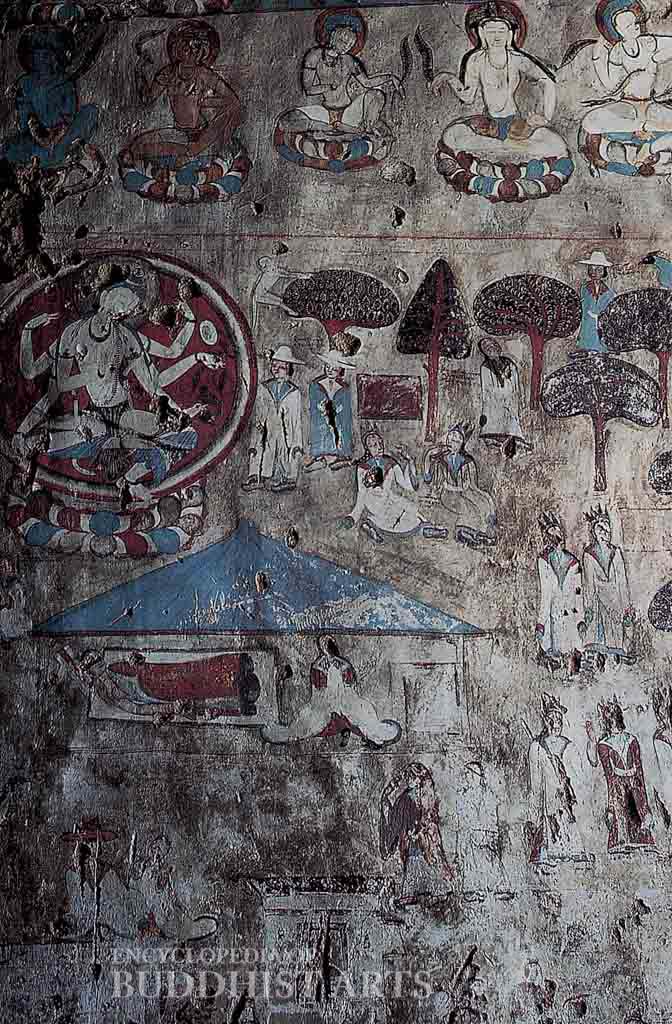
Dubu Cave: Mural (detail)
Dubu Cave: Mural
CHINA, Tibet, Ngari; Guge Kingdom
This mural is located in the front chamber of the Dubu Cave, near the Dunkar Caves and Toling Monastery in Zanda county, Ngari, Tibet. The cave and mural date from the 11th to 13th century, when the region was under the control of the Guge Kingdom (circa 10th–17th century).
The mural is almost 4 m long, and is divided into an upper, middle, and lower registers. The upper register features a row of Bodhisattvas clad in dhotis, with double-layered nimbuses behind their heads. They each hold a long leaf in one hand and sit on lotus thrones in differing poses. Their bodies are colored white, brown, or blue.
In the middle register, the Six-Armed Vasudhara sits in the relaxation posture, garbed in a sacred thread and a white dhoti with a blue hem, and surrounded by a red mandorla with a red, white, and black rim. Not all of the hands are visible due to chipping, but it is clear that one of them form the varada (wish-granting) mudra, and another holds leaves. To the right of Vasudhara there are trees with a bird and monkey housed within them, and various people wearing white, blue, or yellow Tibetan coats with upturned collars, felt boots, and wide-brimmed hats. Two of these figures face Vasudhara, two sit under a tree, and two stand among the trees on the right. Two people wearing crown-like hats can also be seen in between the middle and bottom sections.
The bottom section contains images of a figure lying on a white bed within a blue nomadic tent while another figure prays on the right. The remaining figures within this section are depicted strolling, wearing a variety of colorful clothing and hats. Throughout the mural, there are various Tibetan inscriptions, but most of them are no longer discernible.
For more details, go to the Encyclopedia of Buddhist Arts: Caves A-E, page 315.
Cite this article:
author = Hsingyun and Youheng and Johnson, Peter and Mankuang and Huntington, Susan and Edson, Gary and Neather, Robert,
booktitle = {Encyclopedia of Buddhist Arts: Caves A-E},
pages = 315,
title = {{Dubu Cave: Mural}},
volume = 5,
year = {2016}}