
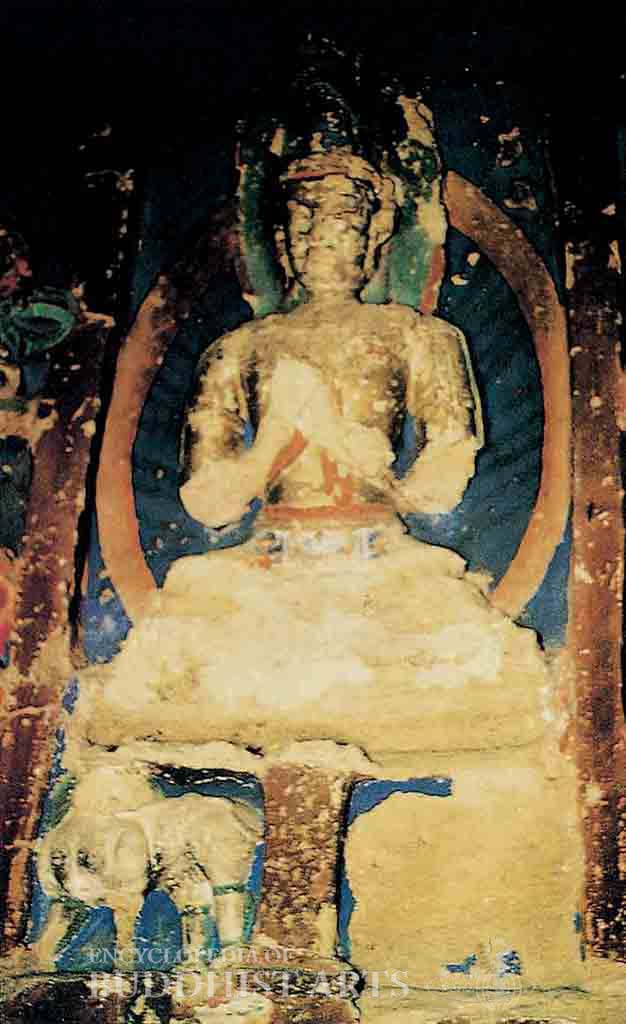
Naijiaqiemu Cave: Cave 4 - Vairocana Buddha (back wall)
Naijiaqiemu Cave
CHINA, Tibet, Shigatse
This cave is located near Najia village, Shigatse, Tibet. The caves are located in the partially collapsed cliff of a small hill fort north of the Kuqu River. There are five caves, each facing south and more than 10 m above the ground. The caves are in the Gupta style and date to the late 10th to early 13th century, making them some of the earliest caves in Tibet.
Cave 4 is well preserved, with 33 reliefs of Buddhas and Bodhisattvas on the four walls. The main sculpture is a golden Vairocana Buddha on the back (north) wall, seated in full lotus position on a raised throne, with two lions at the front. The background consists of an oval nimbus and a round mandorla surrounded by vajras, and wish-fulfilling jewels. A seated yellow Ratnasambhava Buddha on a Sumeru throne, with two elephants, is depicted on the left side of the east wall. The figure wears a sacred thread across the chest and forms the varada (wish-granting) mudra with the right hand. The blue Aksobhya Buddha, located on the right side of the east wall, is on a Sumeru throne with two horses, and forms the bhumisparsa (earth-touching) mudra with the right hand. The green Amoghasiddhi Buddha on the right side of the west wall is bare-chested with a sacred thread across the chest. Amoghasiddhi forms a mudra with the left hand, and is seated on a Sumeru throne supported by two garudas. The red Amitabha Buddha, on the left side of the west wall, also wears a sacred thread across a bare chest, forms the dhyana (meditation) mudra, and is seated on a Sumeru throne with two peacocks at the front.
For more details, go to the Encyclopedia of Buddhist Arts: Caves Mo-S, page 1253.
Cite this article:
author = Hsingyun and Youheng and Johnson, Peter and Mankuang and Huntington, Susan and Edson, Gary and Neather, Robert,
booktitle = {Encyclopedia of Buddhist Arts: Caves Mo-S},
pages = 1253,
title = {{Naijiaqiemu Cave}},
volume = 8,
year = {2016}}