
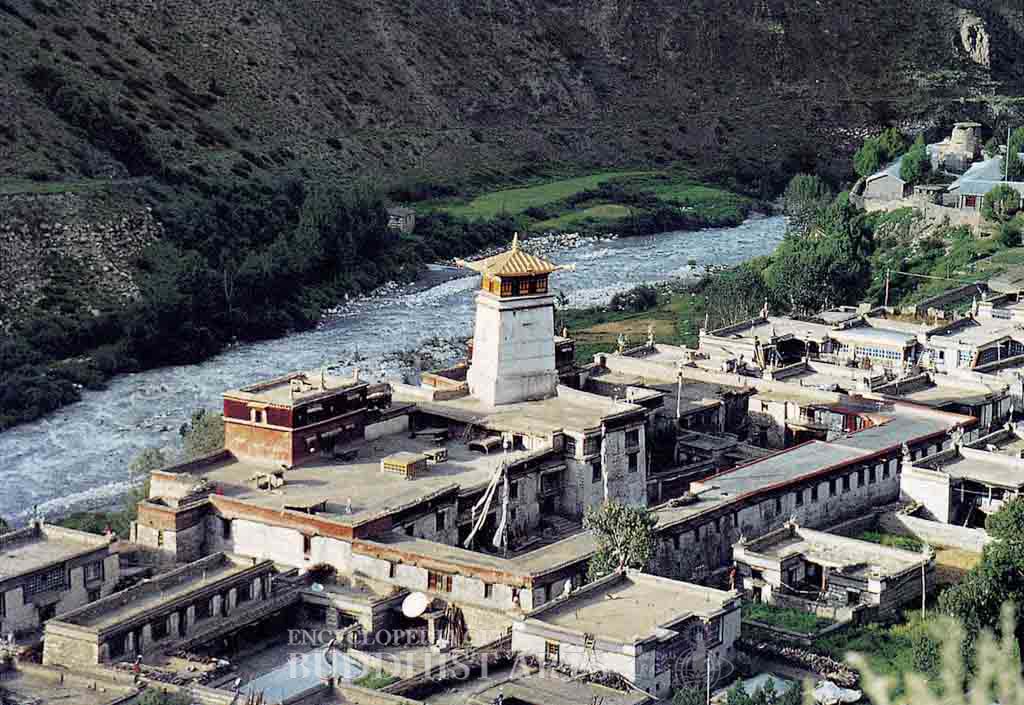
Sekhar Gutog Monastery (aerial view)
Sekhar Gutog Monastery
CHINA, Tibet, Lhoka
The monastery is located 50 km south of Lhozhag in Lhoka, near the border with Bhutan. It was built in the 11th century by Milarepa, under the orders of his master Marpa, as an act of repentance for his evil deeds. After enormous hardship, Milarepa completed the Sekhar Gutog Tower, which means the Nine-Story House for the Son, and a Twelve Column Hall underneath. Large-scale renovations and expansion in the first half of the 16th century by Pawo Tsuglag Threngwa, a great scholar of the Kagyu school, resulted in its current appearance. It was a Kagyu monastery until the last renovation by an incarnate lama of Samdrup Gon Monastery, when it was converted to a Gelug monastery. It was listed as a National Cultural Heritage Site in 2001.
The rectangular monastery faces east and is 98 m long and 48 m wide. It is surrounded by boundary walls. The existing buildings include the Sekhar Gutog Tower, Twelve Column Hall, and central hall. The nine-story Sekhar Gutog Tower is 28 m high and has a golden roof. The first and second stories are the basement and storage room, and the third through seventh stories constitute the original structure, while the eighth and ninth stories were rebuilt in 1985. There are Buddha statues on every story except for the first two. The two-story Twelve Column Hall is the main building, with the assembly hall and Buddha hall located on its first story.
It is said that the central hall was built by Pawo Tsuglag Threngwa, who is attributed as the artist of the murals inside. There is a two-bay wide circumambulation passage in the front of the central hall. The assembly hall is 30 bays wide, and its walls are filled with murals. Behind the assembly hall is a four-bay wide inner shrine. To the west of the inner shrine there is a two-bay wide Vajrayana shrine, which contains 2.4 m high statues of various Vajrayana figures.
For more details, go to the Encyclopedia of Buddhist Arts: Architecture M-S, page 950.
Cite this article:
author = Hsingyun and Youheng and Johnson, Peter and Mankuang and Lancaster, Lewis,
booktitle = {Encyclopedia of Buddhist Arts: Architecture M-S},
pages = 950,
title = {{Sekhar Gutog Monastery}},
volume = 3,
year = {2016}}