
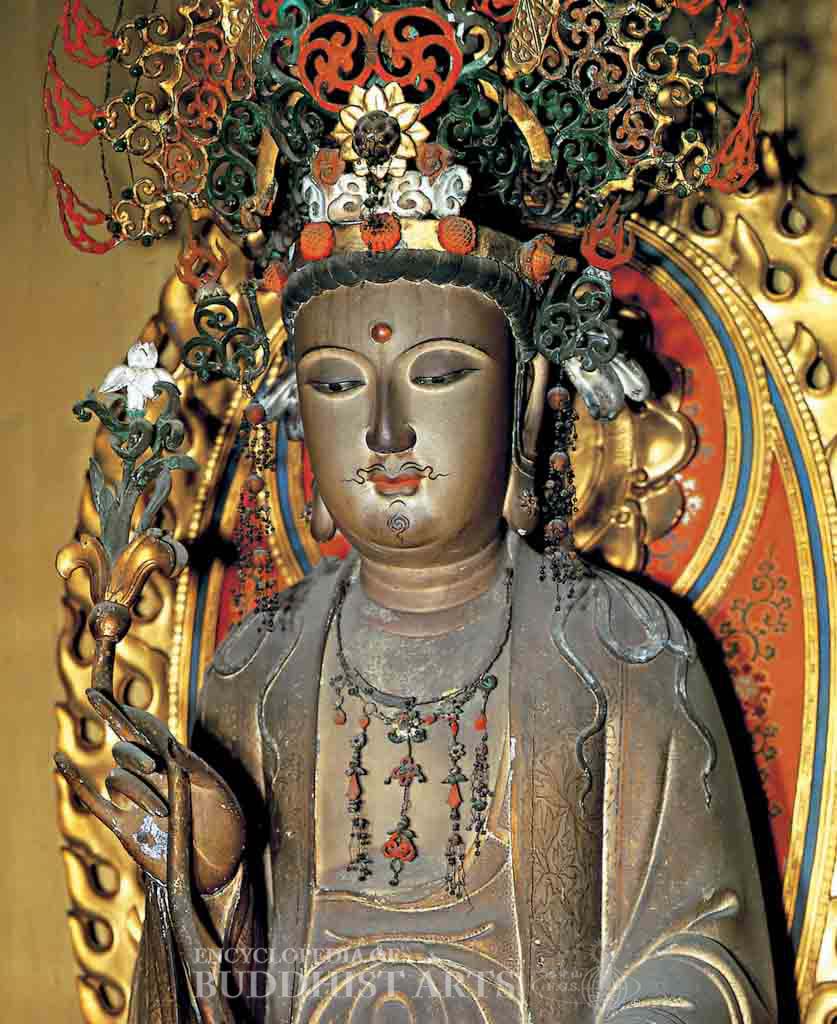
Avalokitesvara Bodhisattva (detail)
Sandalwood
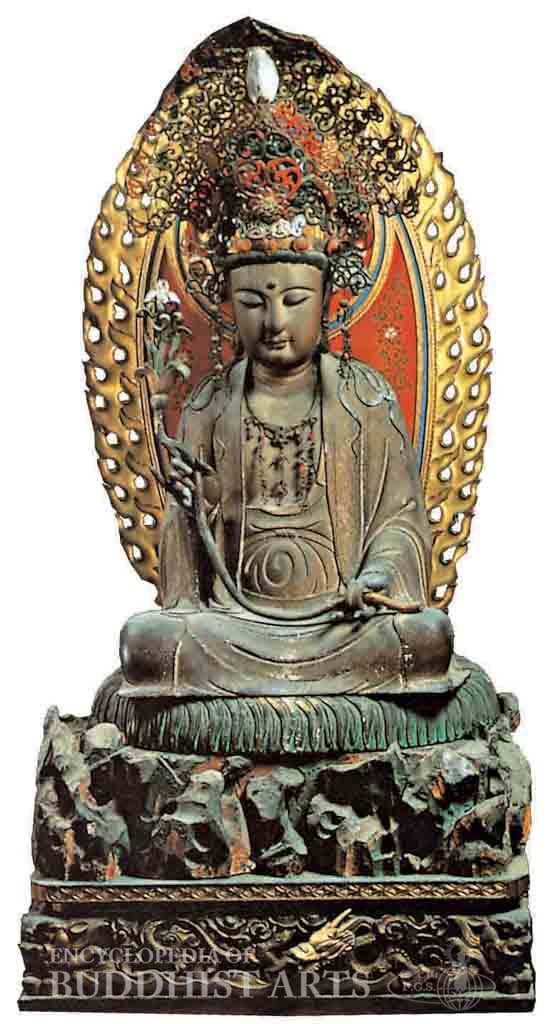
Avalokitesvara Bodhisattva
Avalokitesvara Bodhisattva
CHINA; Southern Song dynasty
The statue was reputedly modeled after the 8th century Chinese imperial concubine Yang Guifei at the order of Emperor Xuanzong (reigned 712–756) of the Tang dynasty. A priest took the statue back to Japan in 1255 and placed it within the Avalokitesvara Hall. The doors of the hall are opened only once every century for the public to pay tribute to the Bodhisattva statue. The colors are exceptionally well preserved due to the limited exposure. The statue was listed as an Important Cultural Property of Japan in 1997.
The Bodhisattva wears a delicate and heavily decorated crown ornamented with corals and precious stones. The figure’s gaze is lowered and the face has a slight mustache and beard-tuft. The Bodhisattva sits cross-legged, wearing robes with rounded folds, and supports the stem of a lotus in the right hand, which is held in the karana (warding off evil) mudra. The lotus throne is on a base of rocks, beneath which is a dragon relief. A fiery mandorla behind the figure has a solid floral inner rim. An x-ray was taken of the statue, and there appears to be a five-element stupa inside.
For more details, go to the Encyclopedia of Buddhist Arts: Sculpture A-F, page 88.
Cite this article:
author = Hsingyun and Youheng and Lovelock, Yann and Chou, Yuan and Huntington, Susan and Edson, Gary and Neather, Robert,
booktitle = {Encyclopedia of Buddhist Arts: Sculpture A-F},
pages = 88,
title = {{Avalokitesvara Bodhisattva}},
volume = 10,
year = {2016}}