
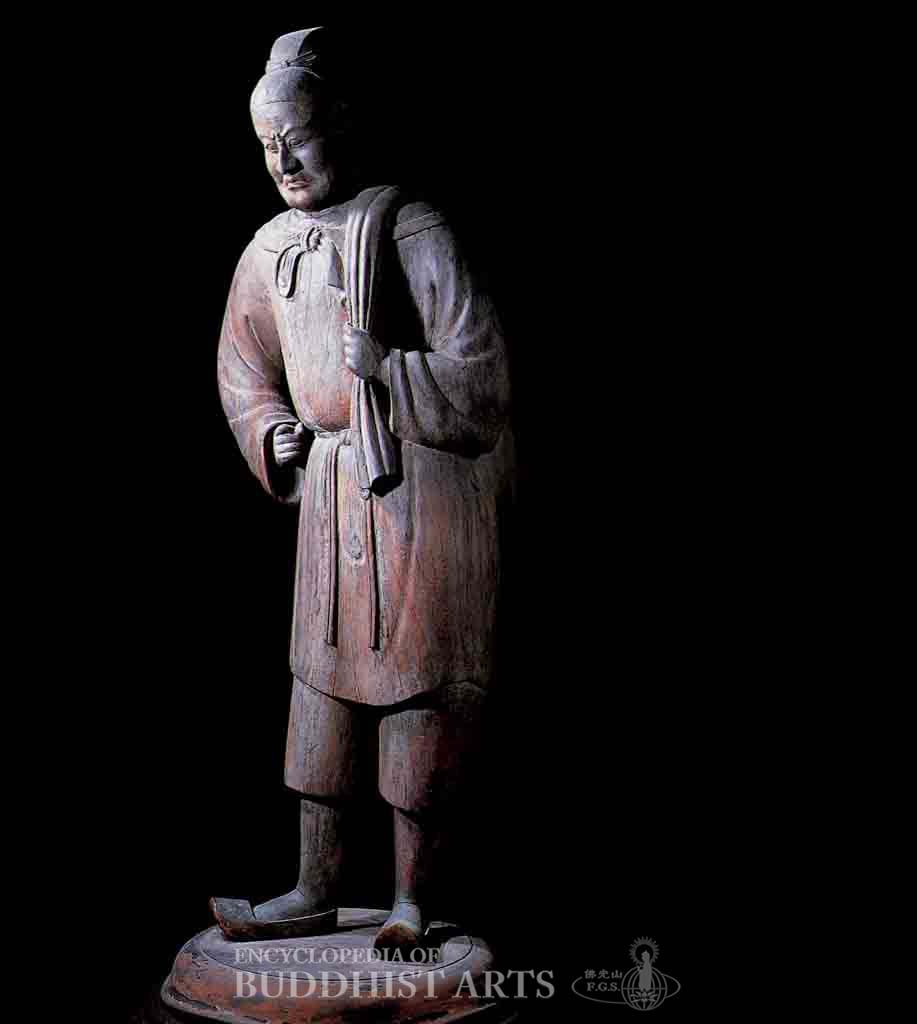
Kanzeonji Temple: Mahakala
Camphor wood
Kanzeonji Temple: Mahakala
JAPAN, Fukuoka, Dazaifu; Heian period
The statue is based on the description of the figure in the Sacred Practices of Mahakala and is listed as an Important Cultural Property. It is recorded that in 1143 the figure was enshrined in the temple’s dining hall, when it was considered a deity of food and cooking. Mahakala is now regarded as one who grants wealth and blessings.
The statue is carved from a whole piece of camphor wood. The stooped figure carries a sack over the left shoulder and steps forward wearing curved clogs. Mahakala’s forehead is creased, his mouth angrily pursed and his right hand clenched. The figure wears a wide article of clothing, girdled at the waist, and a cape across the shoulders, as well as some pantaloons that are cut off at the shins. The base was originally a rock pedestal, but when the sculpture was repaired in 1913 it was replaced by a petaled lotus.
For more details, go to the Encyclopedia of Buddhist Arts: Sculpture G-M, page 523.
Cite this article:
author = Hsingyun and Youheng and Lovelock, Yann and Chou, Yuan and Huntington, Susan and Edson, Gary and Neather, Robert,
booktitle = {Encyclopedia of Buddhist Arts: Sculpture G-M},
pages = 523,
title = {{Kanzeonji Temple: Mahakala}},
volume = 11,
year = {2016}}