
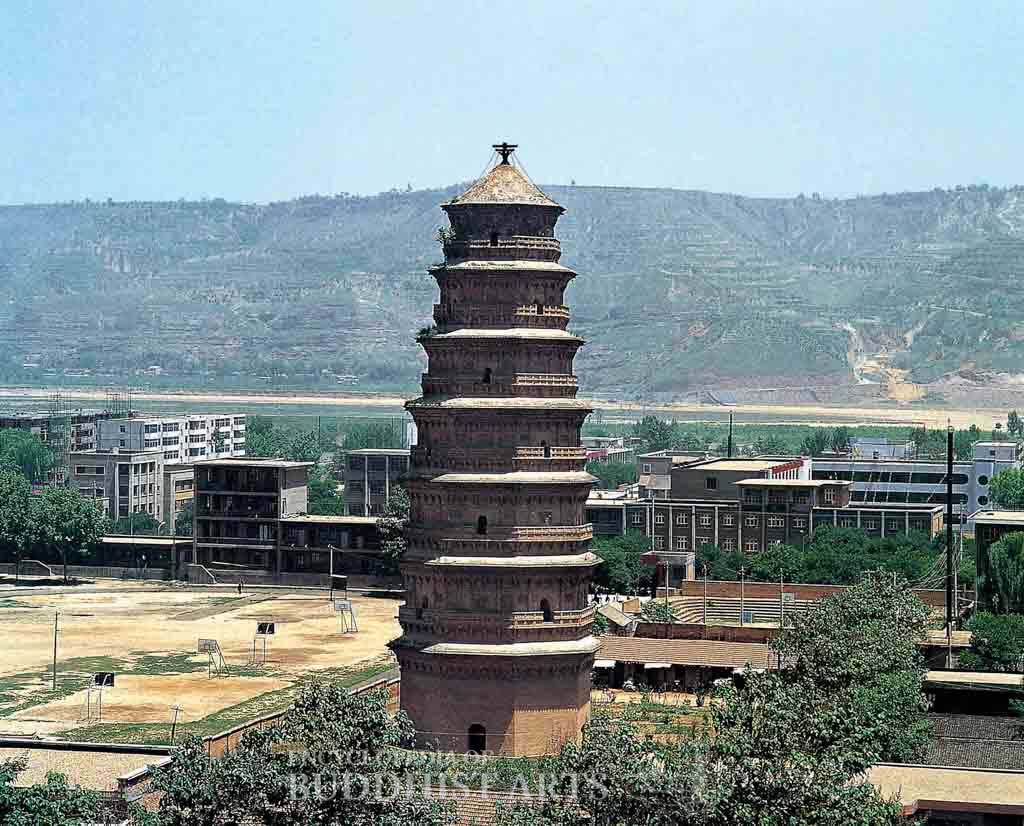
Kaiyuan Temple Pagoda
Kaiyuan Temple Pagoda
CHINA, Shaanxi, Xianyang
The pagoda was built on the grounds of Kaiyuan Temple, which no longer exists. It was constructed in 1053 during the Northern Song dynasty. When the pagoda was being repaired in 1985, some artifacts were discovered above the base of the spire. They included a copper Buddha statue and a Buddha stand. The pagoda was listed as a National Cultural Heritage Site in 2001.
The seven-story, octagonal, brick pagoda is 47.8 m high. Arched doorways are located on the north and south sides of the first story. From the second story upwards, there are four arched doorways which alternate with the ones above and below. Each wall is divided into three bays by brick pilasters. The walls without openings have false doors complete with doornails. All the side bays have vertical bar windows. The eaves are in the form of corbeling with courses of dogtooth bricks. The edges of the eaves are decorated with drip tiles and tile caps. Above each set of eaves is the base of the next story, with a balcony supported by two-tier bracket sets and two projecting bracket arms. The pyramidal roof is covered in gray tiles and surmounted by an iron spire. The pagoda has single walls and is hollow inside. The wooden stairs were replaced in 1985.
For more details, go to the Encyclopedia of Buddhist Arts: Architecture G-L, page 586.
Cite this article:
author = Hsingyun and Youheng and Johnson, Peter and Mankuang and Lancaster, Lewis,
booktitle = {Encyclopedia of Buddhist Arts: Architecture G-L},
pages = 586,
title = {{Kaiyuan Temple Pagoda}},
volume = 2,
year = {2016}}