
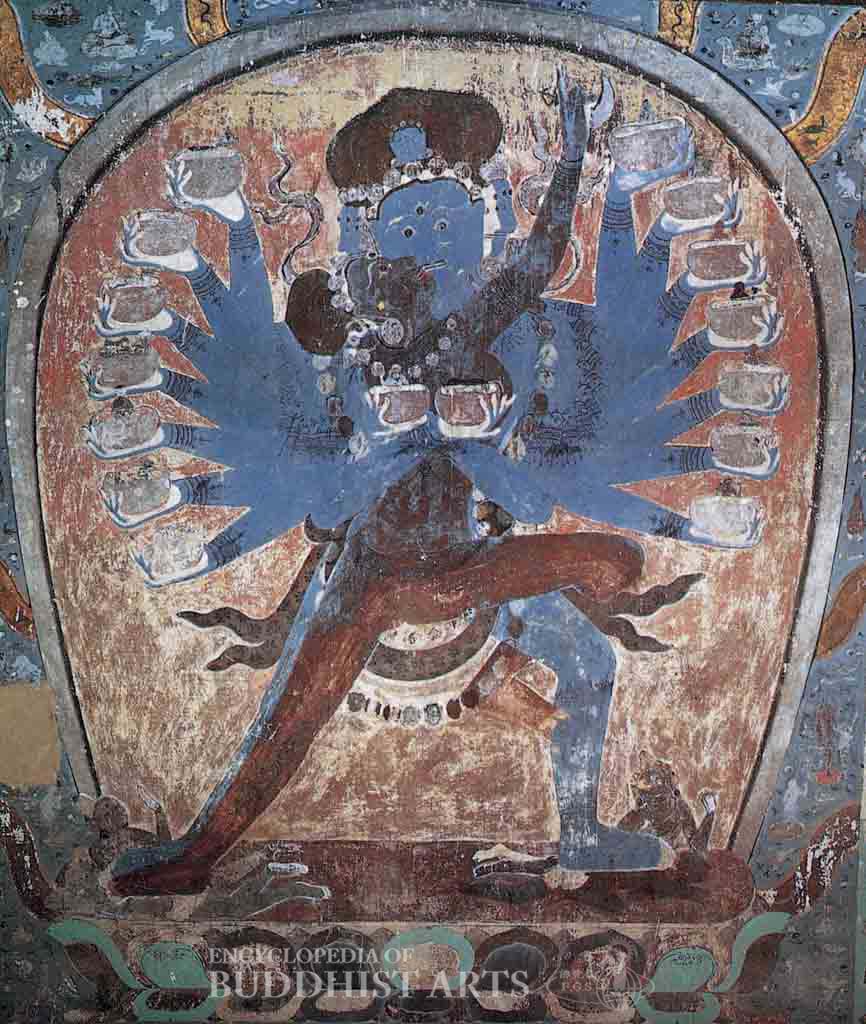
Mogao Cave 465: Hevajra
Mogao Cave 465: Hevajra
CHINA, Gansu, Dunhuang; Yuan dynasty
This figure is in the center of the north wall. Hevajra has blue skin and wild dark hair. He wears a five-skull crown, and has 16 arms. The deity has seven additional heads, three on each side of the main head and one more above the crown. The heads are blue, white, and gray, and each has three glaring eyes. The two main arms of Hevajra embrace his consort, Nairatmya, and hold skull bowls. There is a yak within the bowl in the left hand, and a tiny deity within the bowl in the right hand. The 14 remaining arms are symmetrically arranged on both sides of the body and hold skull bowls which contain horses, cows, donkeys, dogs, and various deities. Hevajra wears a short lower garment and stands on four demons, two of whom raise their hands in a pleading gesture, serving to emphasize his fearlessness and valor. Hevajra’s consort has reddish-brown skin. She wears a five-skull crown, earrings, skull necklaces, and other ornaments. The right hand is raised high and holds a vajra-chopper, and the right leg is wrapped around Hevajra’s body. The artist used a broad brush stroke technique and strong color contrasts to create a bold illustration. Twenty small images, including 12 yab-yum couples and eight patriarchs, surround the image of Hevajra.
For more details, go to the Encyclopedia of Buddhist Arts: Caves Mo-S, page 1235.
Cite this article:
author = Hsingyun and Youheng and Johnson, Peter and Mankuang and Huntington, Susan and Edson, Gary and Neather, Robert,
booktitle = {Encyclopedia of Buddhist Arts: Caves Mo-S},
pages = 1235,
title = {{Mogao Cave 465: Hevajra}},
volume = 8,
year = {2016}}