
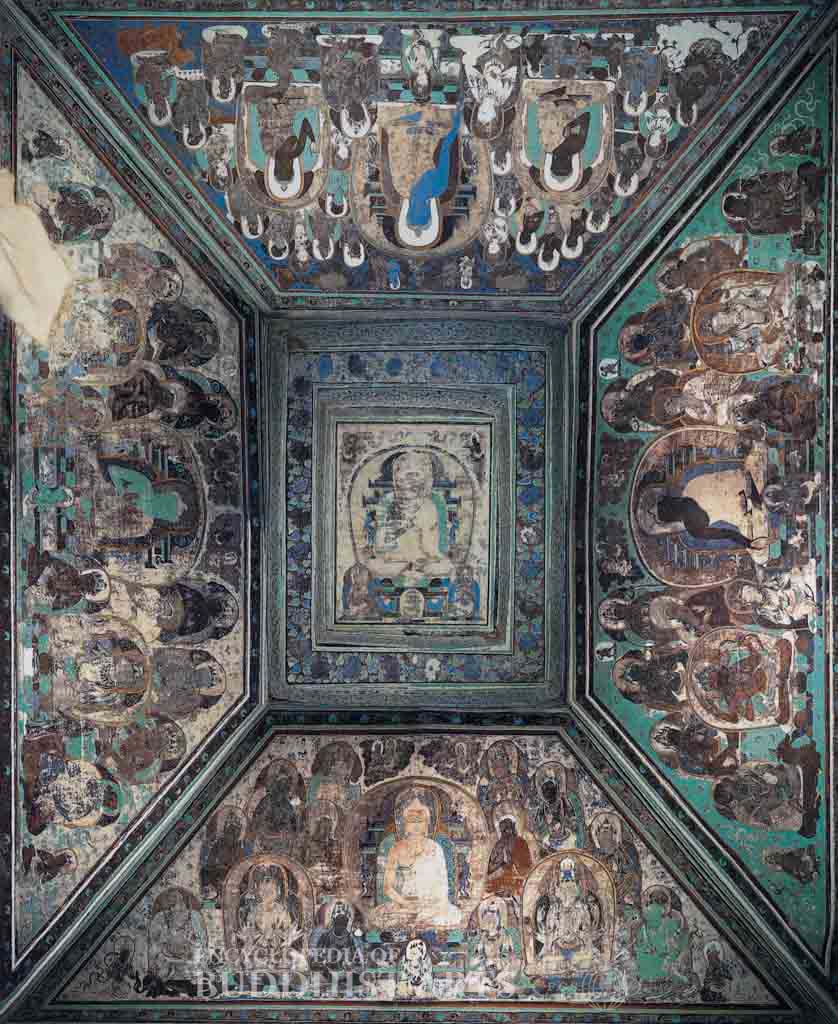
Mogao Cave 465: Ceiling
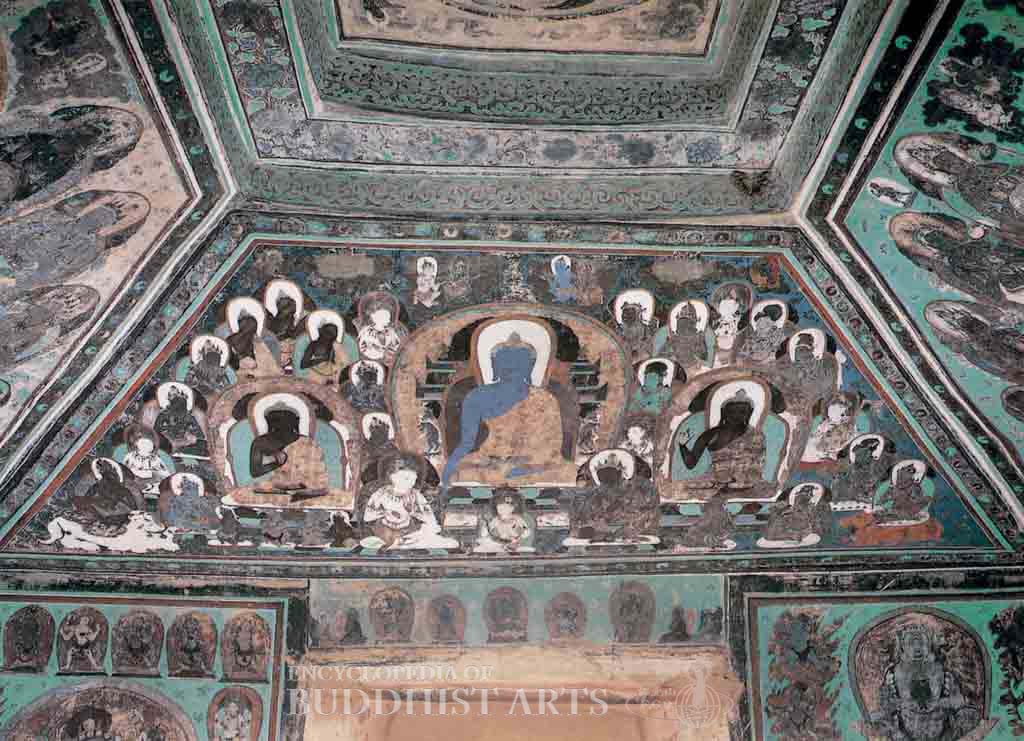
Mogao Cave 465: Ceiling (east slope)
Mogao Cave 465
CHINA, Gansu, Dunhuang
This altar cave is in the central section of the south area. The date of construction is uncertain. It was originally thought to be built in the Yuan dynasty (1271–1368), but a Tibetan inscription on the right side of the doorway on the front (east) wall of the main chamber and a record found in Mogao Cave 17 dates this cave to around 839. The cave is prized for holding some of the earliest Tibetan Buddhist murals within the Mogao Caves. It consists of an antechamber and a main chamber connected by a corridor. The front wall of the antechamber has collapsed. A portrait of a Bodhisattva is painted over the entrance on the back (west) wall, and on either side is a pagoda. In the corridor, there are auspicious clouds on the ceiling and peonies on the walls.
The main chamber has a truncated pyramidal ceiling and a multi-tier circular altar at the center. The original sculptures that once stood on the altar are now missing. On the ceiling are paintings of the Five Dhyani Buddhas: Vairocana Buddha is in the center, Amoghasiddhi rides a horse in the north, Aksobhya rides an elephant in the east, Ratnasambhava rides a garuda in the south, and Amitabha rides a peacock in the west. Five Wisdom Kings are drawn over the entrance on the front (east) wall, with Yamantaka in the middle and two monks making offerings on both the left and right. On each side of the entrance is a mandala, as well as images such as Mahadevi and Ganesa, as well as six panels at the base of the wall.
The back and side walls each display three large mandalas of Wisdom Kings surrounded by approximately 20 small deity images. The murals on the back wall, from left to right, are a single Wisdom King holding a vajra with hands crossed, a Wisdom King holding a vajra and bell together with his consort, and a single Wisdom King holding a bowl and a knife. These three murals are surrounded by 19, 19, and 18 smaller images, respectively. On the north wall, the leftmost mural has been destroyed, the central mural contains a sixteen-armed Wisdom King holding a bowl together with his consort, while the rightmost mural depicts a seven-headed, fourteen-armed Wisdom King. The three murals are all surrounded by 20 images. All three murals on the south wall each displays a Wisdom King with his consort; the Wisdom King on the left holds a bow and arrow, while the other two Wisdom Kings each rides an ox and is covered in human skin. There are 21, 20, and 20 smaller images surrounding these murals, respectively.
For more details, go to the Encyclopedia of Buddhist Arts: Caves Mo-S, page 1233.
Cite this article:
author = Hsingyun and Youheng and Johnson, Peter and Mankuang and Huntington, Susan and Edson, Gary and Neather, Robert,
booktitle = {Encyclopedia of Buddhist Arts: Caves Mo-S},
pages = 1233,
title = {{Mogao Cave 465}},
volume = 8,
year = {2016}}