
Mogao Cave 454: Spread of Buddhism
Mogao Cave 454: Spread of Buddhism
CHINA, Gansu, Dunhuang; Song dynasty
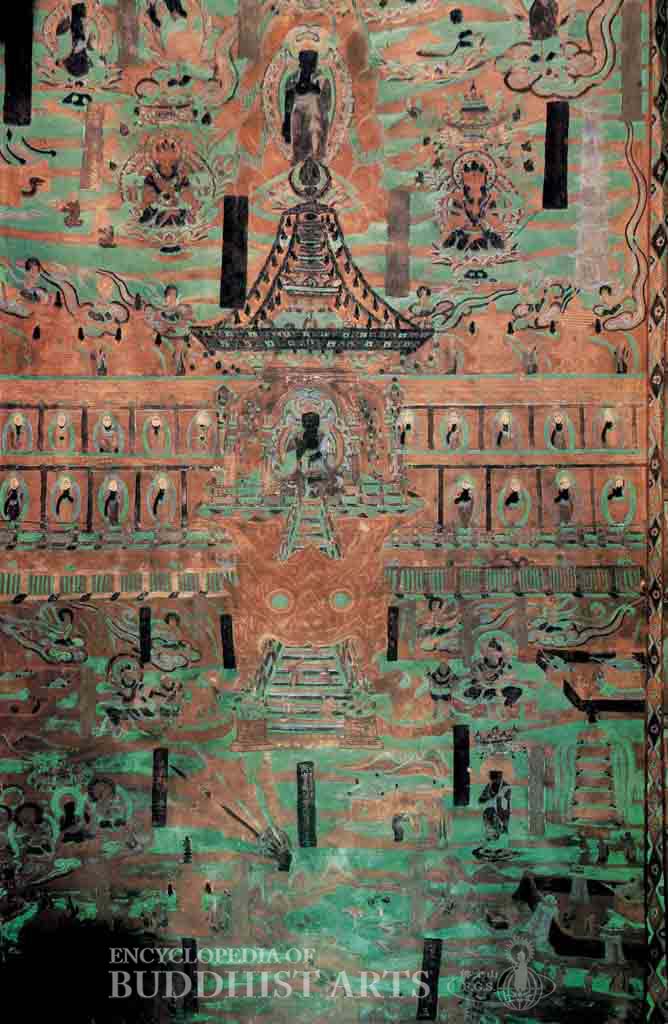
This mural, the Spread of Buddhism, is located on the ceiling of the corridor of the cave. Cave 454 is located in the south area, between Caves 452 and 455. The cave is also known as Taibao (Minister) Cave or Niangniang (Lady) Hall. It was built in the Northern Song dynasty between the years 974 and 980 as tribute to the Guiyi Army governor Cao Yangong and his wife whose surname was Murong. It was renovated in the Qing dynasty (1644–1911). The main chamber has a truncated pyramidal ceiling and an altar in the center with 12 Qing dynasty statues. All four walls display sutra illustrations and Jataka tales.
The scenes depicted in this mural are from narratives detailing the origins of Buddhism and its transmission through Central Asia to China. Some of the themes illustrated include miraculous responses to Buddhism, legends of sacred Buddhist sites, auspicious images, and stories of eminent monks and political figures.
At the center of the painting is a depiction of Gosrnga (Ox Head Mountain), which is located southwest of the city of Hotan in present day Xinjiang. According to records, it has two peaks which rise with sheer cliffs on all four sides and are said to resemble the horns of an ox. A temple is built within these cliffs. According to legend, Sakyamuni Buddha visited and gave a Dharma teaching to an assembly of heavenly beings at this site, and the Buddha image within the temple often emitted radiant light .
An ox head with green eyes and a gaping mouth is painted in the center of the mural, with a staircase leading upward passing through the mouth. Above it is a pagoda with a Buddha seated in full lotus position teaching the Dharma inside. There are orderly corridors and rooms on each side of the pagoda which contain the images of 18 standing Buddhas. The auspicious Buddha statue is represented at the top of the pagoda. Surrounding the pagoda are illustrations of stories such as An Shigao Encountering a Python, Emergence of a Pagoda in Udyana, and King Asoka Constructing Stupas. These stories are identified by cartouches next to the illustrations. The lower register of the mural displays more auspicious images and city scenes. The mural provides valuable information on architecture of the Northern Song dynasty (960–1127).
For more details, go to the Encyclopedia of Buddhist Arts: Caves Mo-S, page 1228.
Cite this article:
author = Hsingyun and Youheng and Johnson, Peter and Mankuang and Huntington, Susan and Edson, Gary and Neather, Robert,
booktitle = {Encyclopedia of Buddhist Arts: Caves Mo-S},
pages = 1228,
title = {{Mogao Cave 454: Spread of Buddhism}},
volume = 8,
year = {2016}}