
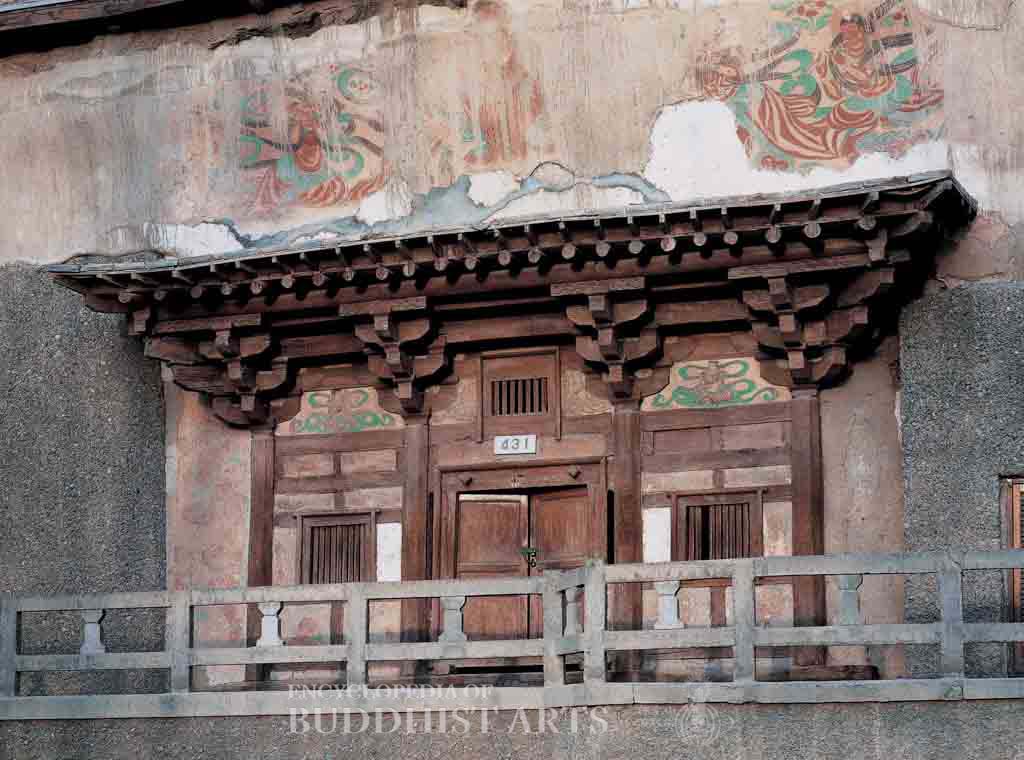
Mogao Cave 431
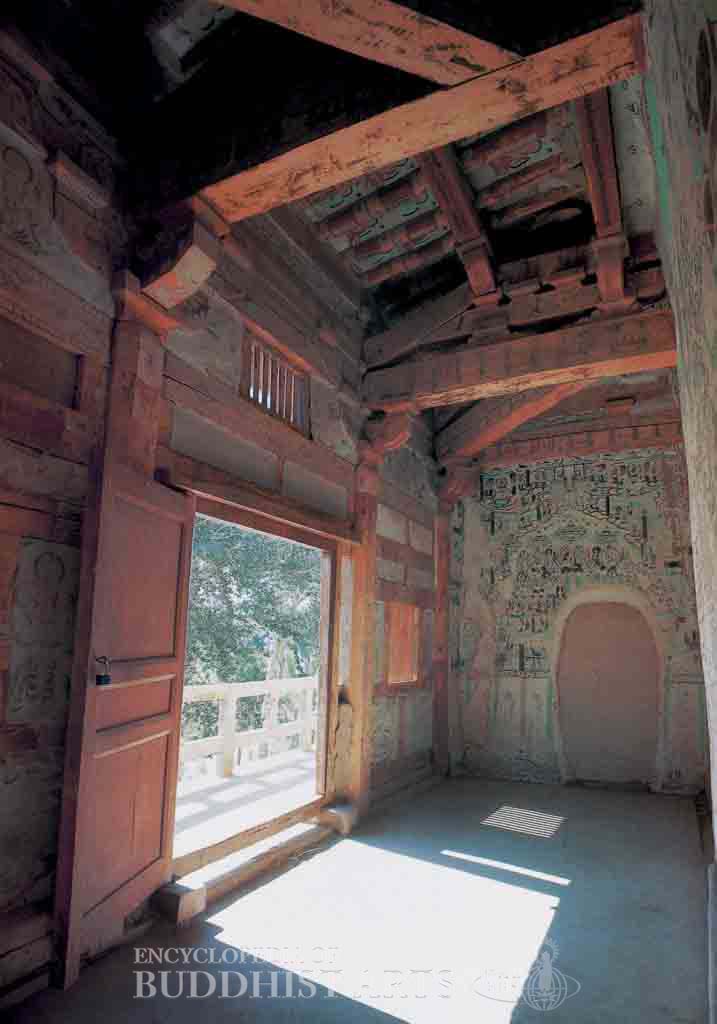
Mogao Cave 431: Antechamber
Mogao Cave 431
CHINA, Gansu, Dunhuang
This central pillar cave is located in the northern central section of the south area and was originally constructed in the Northern Wei dynasty (386–534). The cave floor was deepened and refurbished during the Early Tang period (618–712), and the eaves and the antechamber were built by Yan Zhenqing in 980 during the Northern Song dynasty.
The exterior of the cave is three bays wide and contains four octagonal columns and three-tier bracket sets. Above and on either side of the door are barred windows. The wall spaces above the roof and below the eaves are painted with heavenly musicians, apsaras, disciples, Bodhisattvas making offerings, and flowers. An image of Vajrapanibalin is found on the wall space in the far left. Within the antechamber, the wooden beams and rafters supporting the clay roof are smooth and straight. Traces of murals are visible on the walls and wooden structures. The eaves comprise one of the oldest surviving wooden structures in China, and the paintings on the wooden structures are some of the earliest and most well-preserved to be discovered thus far. The corridor ceiling is painted with images of Mahamayuri Bodhisattva and Thousand Buddhas, while the murals on the walls of the corridor are faded and indistinct.
The ceiling towards the front of the main chamber displays Northern Wei paintings of wish-fulfilling jewels and figures making offerings, and at the rear it is painted with apsaras holding lotus flowers. The ceiling is supported by a central pillar with a niche carved into each of its four sides. Each niche enshrines a Buddha seated with legs pendent. On either side of the niches are images of Bodhisattvas dressed in Song dynasty (960–1279) style clothing, as well as decorative borders, figures making offerings, and other Bodhisattvas from the Northern Wei dynasty. A niche above the doorway on the front (east) wall enshrines a Bodhisattva seated with legs crossed at the ankles. The four walls of the cave display murals of heavenly musicians, Thousand Buddhas, and Buddhas in meditation from the Northern Wei dynasty, as well as donor figures, monks, and other images painted during the Early Tang period.
For more details, go to the Encyclopedia of Buddhist Arts: Caves Mo-S, page 1215.
Cite this article:
author = Hsingyun and Youheng and Johnson, Peter and Mankuang and Huntington, Susan and Edson, Gary and Neather, Robert,
booktitle = {Encyclopedia of Buddhist Arts: Caves Mo-S},
pages = 1215,
title = {{Mogao Cave 431}},
volume = 8,
year = {2016}}