
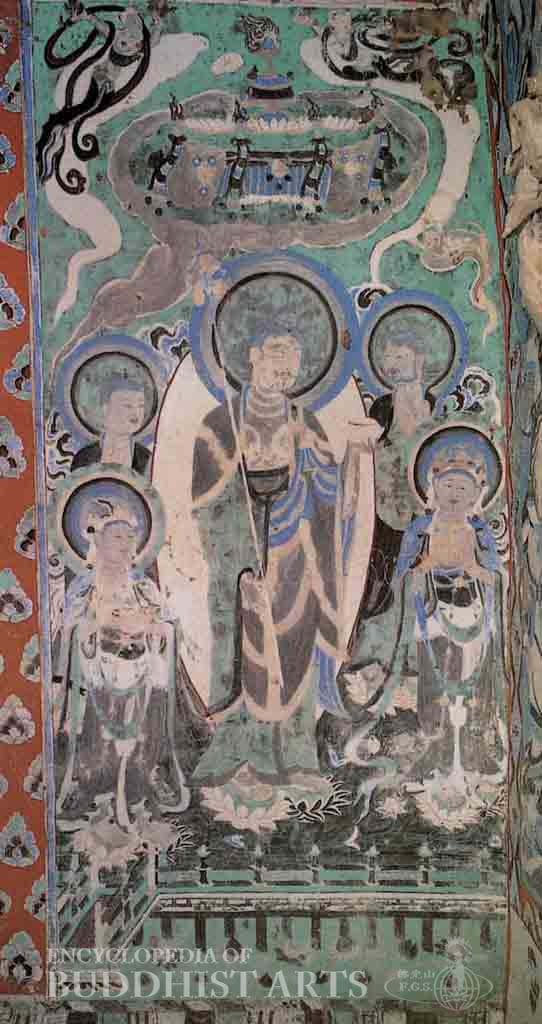
Mogao Cave 418: Medicine Buddha Propagating the Dharma
Mogao Cave 418: Medicine Buddha Propagating the Dharma
CHINA, Gansu, Dunhuang; Western Xia period
Cave 418 is located in the south area of the site. It was constructed during the Sui dynasty (581–618) and restored in the Western Xia period (1032–1227). The cave consists of an antechamber and a main chamber connected by a corridor. The main chamber contains a niche in the back (west) wall and has Sui dynasty paintings of the Thousand Buddhas on the north and south walls, as well as illustrations of the Medicine Buddha Sutra, the Amitabha Sutra, and the Medicine Buddha Propagating the Dharma from the Western Xia period.
The mural depicting the Medicine Buddha Propagating the Dharma is located on the right side of the south wall. The Medicine Buddha stands in the center and is flanked by two disciples and two Bodhisattvas. The Buddha is turned slightly to one side and has an oval face, a mustache, and three lines on the neck. He holds an alms bowl in the left hand, a staff in the right, and stands on a lotus pedestal. The disciples stand behind the Bodhisattvas and are turned toward the Buddha. The disciple on the right has an aged face and a beard. The young disciple to the left has a gentle, handsome appearance. The two Bodhisattvas wear floral headresses, jade necklaces, silk stoles, and flowing garments. There is a canopy above the Buddha, with apsaras soaring within the clouds on both sides. The five figures stand on a platform above a lotus pond. The dominant colors of this mural are mineral green and blue.
For more details, go to the Encyclopedia of Buddhist Arts: Caves Mo-S, page 1191.
Cite this article:
author = Hsingyun and Youheng and Johnson, Peter and Mankuang and Huntington, Susan and Edson, Gary and Neather, Robert,
booktitle = {Encyclopedia of Buddhist Arts: Caves Mo-S},
pages = 1191,
title = {{Mogao Cave 418: Medicine Buddha Propagating the Dharma}},
volume = 8,
year = {2016}}