
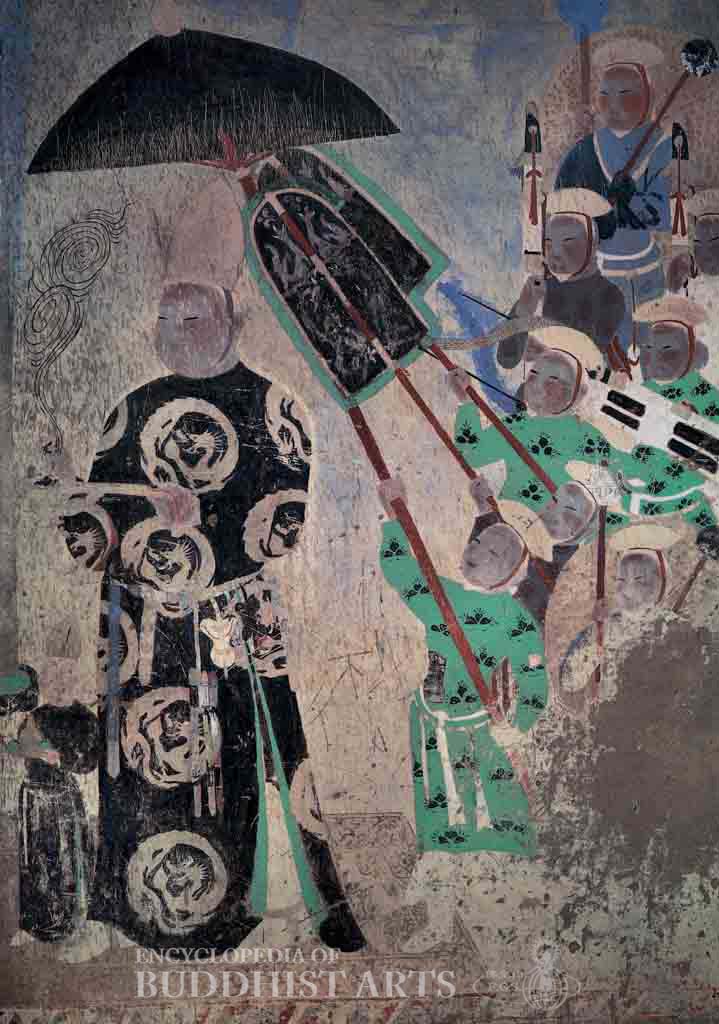
Mogao Cave 409: Western Xia King and Consorts as Donors - King and Attendants (right of the entrance)
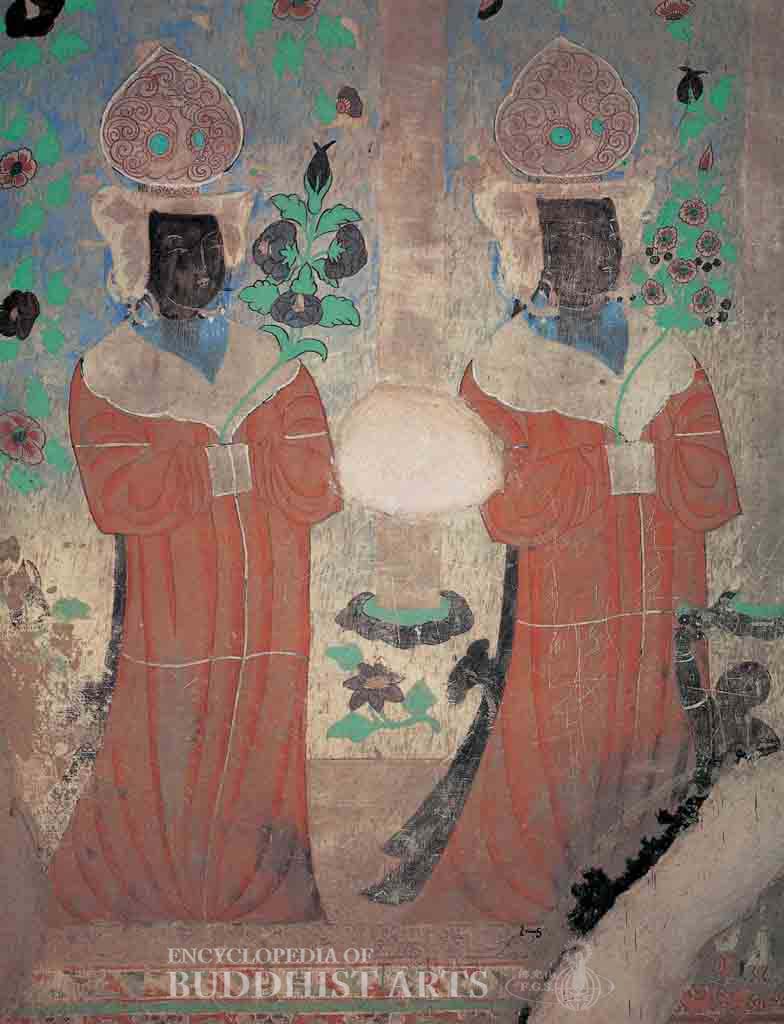
Mogao Cave 409: Western Xia King and Consorts as Donors - Consorts (left of the entrance)
Mogao Cave 409: Western Xia King and Consorts as Donors
CHINA, Gansu, Dunhuang; Western Xia period
Cave 409 is found in the northern central section of the south area. It was constructed in the Western Xia period (1032–1227) and restored in the Qing dynasty (1644–1911).
These paintings are located on both sides of the entrance on the front (east) wall. On the right side is a procession of the Western Xia King with attendants. The king leads the procession and has a round face with plump cheeks. His tall crown has a pointed top and he wears a long brocade gown decorated with circular dragons and tied at the waist with a belt. Seven objects hang from the king’s belt, including a pouch to keep writing utensils, knife, whetstone, awl, and a pouch to hold flint. In the king’s left hand is a hand-held incense burner from which a spiral of smoke ascends. There is a small boy in front of the king with a crown and similar clothing who is thought to be his son. Behind the king are nine attendants. They hold various objects, such as parasols, fans, and ceremonial staffs, and wear short flat headpieces and long gowns.
On the left side of the entrance are two female figures making offerings, likely consorts to the Western Xia King. The two women are almost identical and face toward the right. Their hair is worn in a wide bun with a large peach-shaped phoenix coronet on top. The figures are adorned with pearl earrings and ribbons, and wear gowns with large lapels and narrow sleeves. They hold long-stemmed flowers between their clasped hands. In front of the woman is a small child who wears an armlet and a bracelet. The style of attire and ornaments suggest that the three figures are of Uighur ethnicity.
For more details, go to the Encyclopedia of Buddhist Arts: Caves Mo-S, page 1187.
Cite this article:
author = Hsingyun and Youheng and Johnson, Peter and Mankuang and Huntington, Susan and Edson, Gary and Neather, Robert,
booktitle = {Encyclopedia of Buddhist Arts: Caves Mo-S},
pages = 1187,
title = {{Mogao Cave 409: Western Xia King and Consorts as Donors}},
volume = 8,
year = {2016}}