
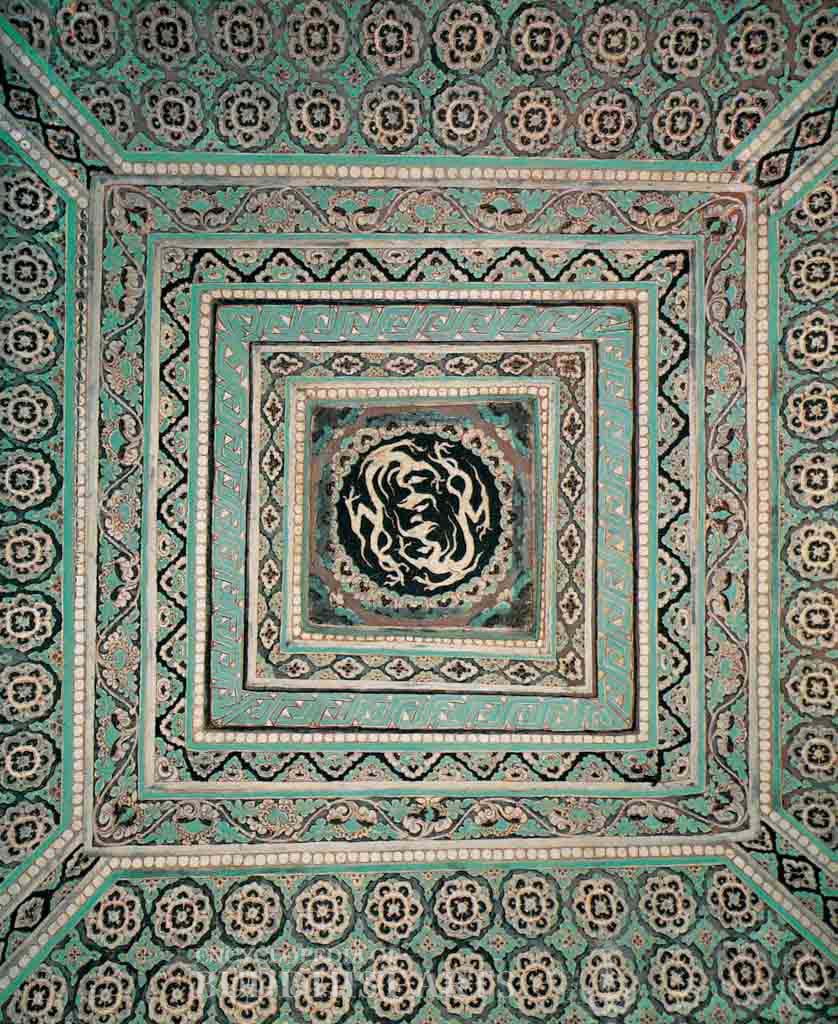
Mogao Cave 400: Ceiling
Mogao Cave 400: Ceiling
CHINA, Gansu, Dunhuang; Western Xia period
Situated in the northern section of the south area, the cave was constructed in the Sui dynasty (581–618), and was renovated in the Five Dynasties (907–960) and the Qing dynasty (1644–1911). The cave consists of an antechamber and a main chamber connected by a corridor. In the main chamber, there is a niche housing five statues on the back (west) wall, and illustrations of the Medicine Buddha Sutra and the Amitabha Sutra on the front (east), north, and south walls.
The square caisson on the ceiling of the main chamber features two dragons at the center surrounded by a ring of auspicious clouds. The caisson is framed by successive border patterns, including beads, camellia, key pattern, trefoil, and twining foliage. Floral designs cover the four slopes of the ceiling. Malachite and white are the dominant colors.
For more details, go to the Encyclopedia of Buddhist Arts: Caves Mo-S, page 1185.
Cite this article:
author = Hsingyun and Youheng and Johnson, Peter and Mankuang and Huntington, Susan and Edson, Gary and Neather, Robert,
booktitle = {Encyclopedia of Buddhist Arts: Caves Mo-S},
pages = 1185,
title = {{Mogao Cave 400: Ceiling}},
volume = 8,
year = {2016}}