
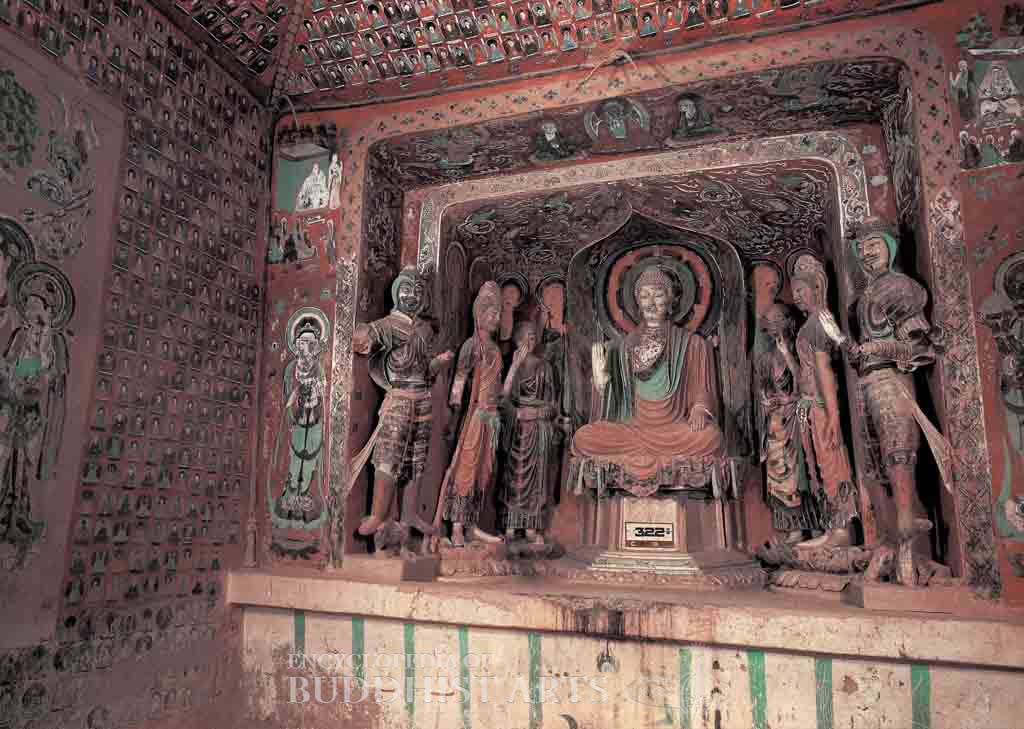
Mogao Cave 322: Main Chamber - Back Wall Niche
Mogao Cave 322
CHINA, Gansu, Dunhuang
Situated in the northern central section of the south area, this shrine cave was constructed during the Early Tang period (618–712) and was renovated during the Five Dynasties (907–960). The main chamber has a truncated pyramidal ceiling and in the center of the ceilings is a lotus medallion with twining vines, surrounded by various border patterns. Thousand Buddhas fill the four slopes of the ceiling.
On the back (west) wall is a double-recessed square niche housing sculptures of Sakyamuni Buddha, two disciples, two Bodhisattvas, and two Heavenly Kings. On the walls of the niche are images of disciples and on the ceiling are ten apsaras. The Buddha’s mandorla on the back wall is carved in bas-relief, and below the disciples painted on either side are images of Mrgasirsa and Vasu. Outside the niche on the back wall are illustrations from the Vimalakirti Sutra and two Bodhisattvas making offerings. Below the niche are Five Dynasties paintings of figures making offerings and offering vessels.
There are teaching scenes in the center of the north and south walls surrounded by Thousand Buddha images. The teaching scene on the north wall features Amitabha Buddha and on the south wall is Maitreya Buddha. To the left of the entrance on the front (east) wall are images of four seated Buddhas and a Bodhisattva, and on the right side are three teaching scenes. Bodhisattvas making offerings from the Five Dynasties period are painted along the edge of the entrance.
For more details, go to the Encyclopedia of Buddhist Arts: Caves Mo-S, page 1147.
Cite this article:
author = Hsingyun and Youheng and Johnson, Peter and Mankuang and Huntington, Susan and Edson, Gary and Neather, Robert,
booktitle = {Encyclopedia of Buddhist Arts: Caves Mo-S},
pages = 1147,
title = {{Mogao Cave 322}},
volume = 8,
year = {2016}}