
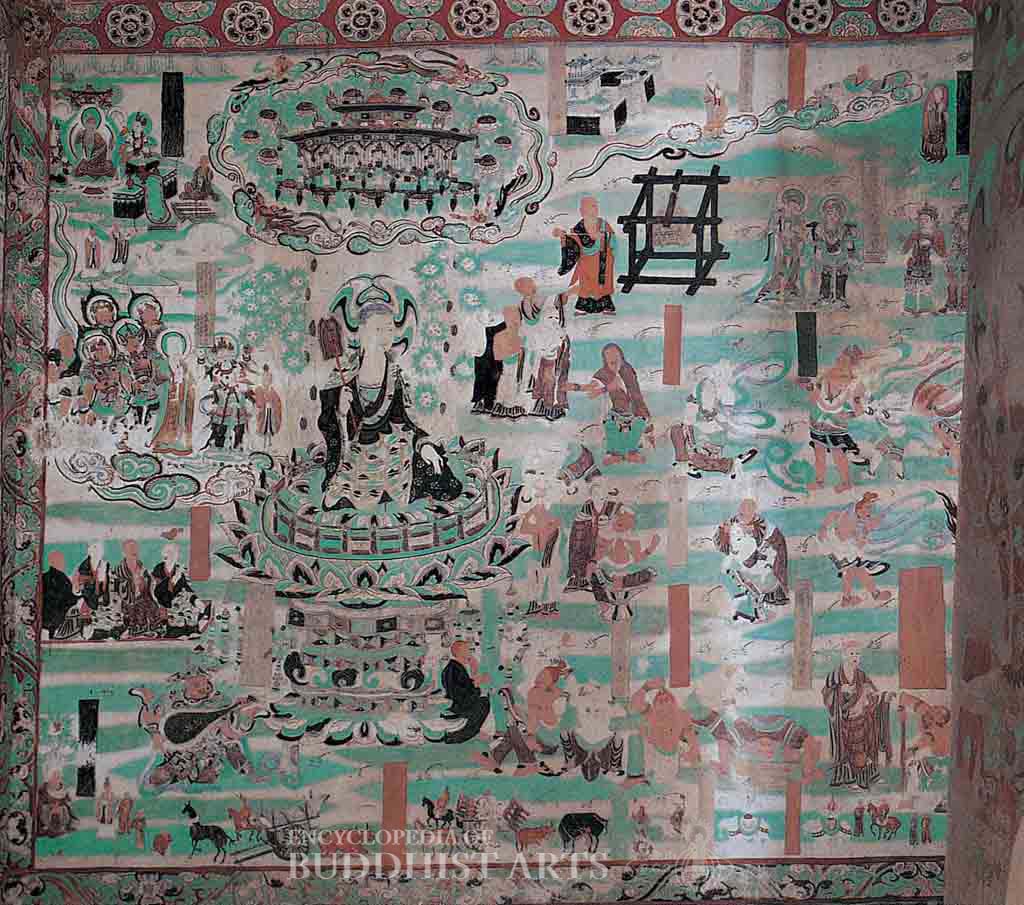
Mogao Cave 146: Battle Between Sariputra and Raudraksa (left panel)
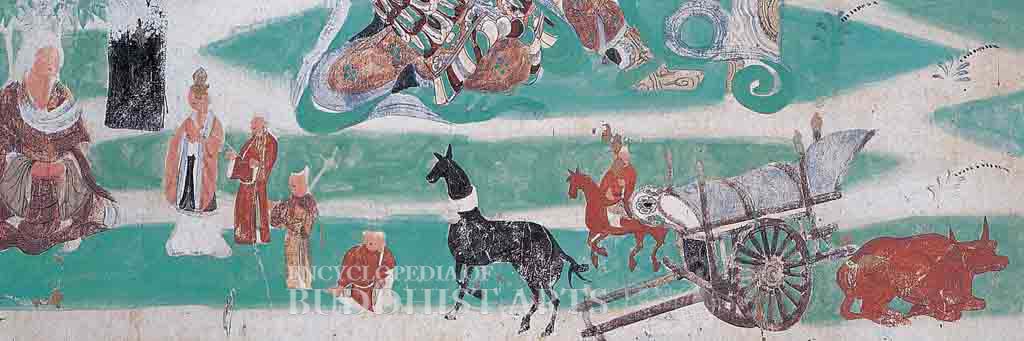
Mogao Cave 146: Battle Between Sariputra and Raudraksa - Horses and Carriage
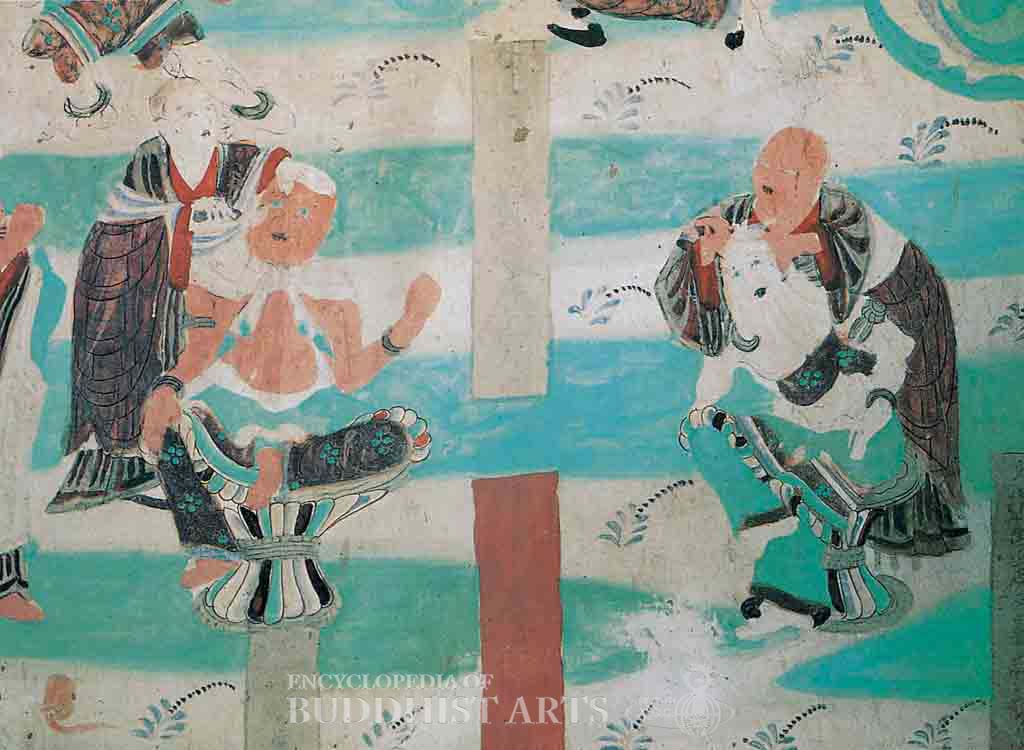
Mogao Cave 146: Battle Between Sariputra and Raudraksa - Raudraksa Recieving Tonsure
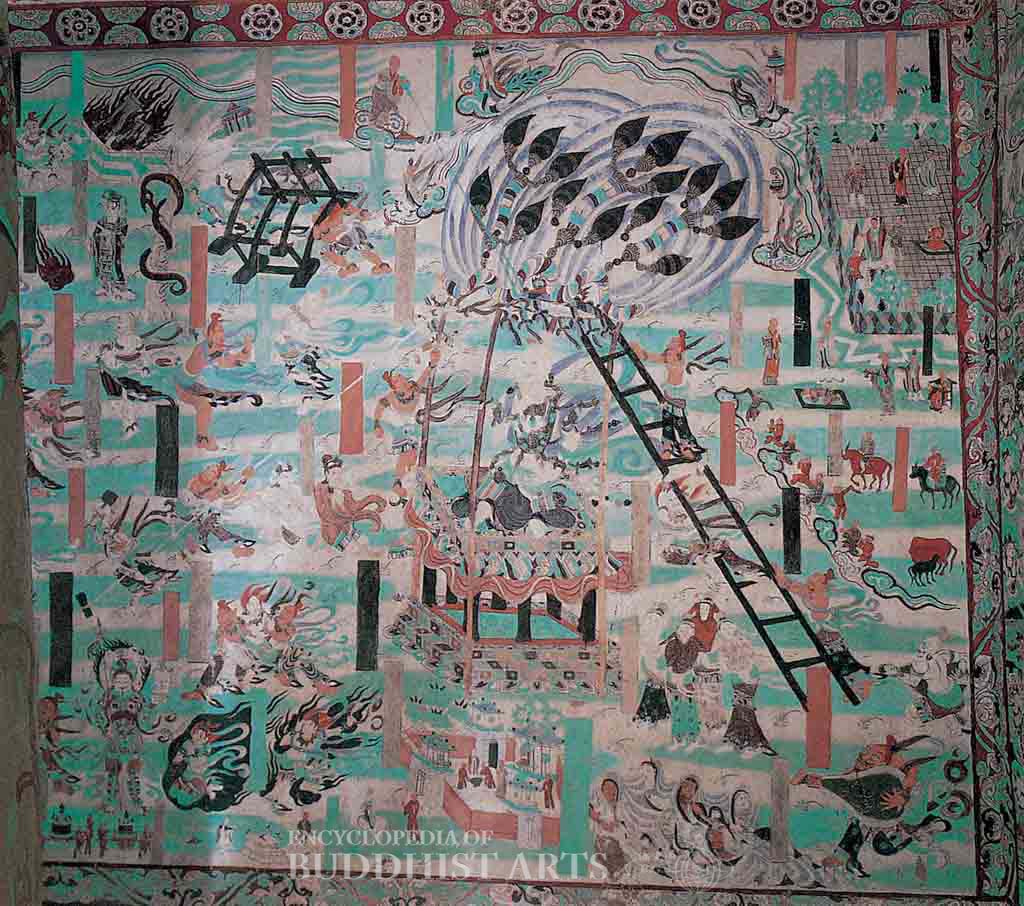
Mogao Cave 146: Battle Between Sariputra and Raudraksa (right panel)
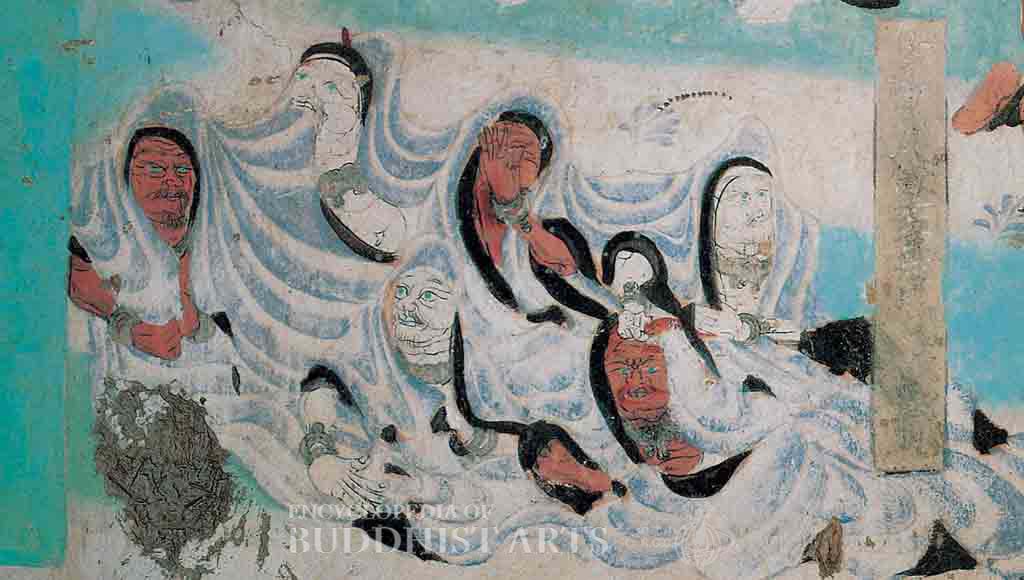
Mogao Cave 146: Battle Between Sariputra and Raudraksa - Six Figures Hiding Beneath the Canvas
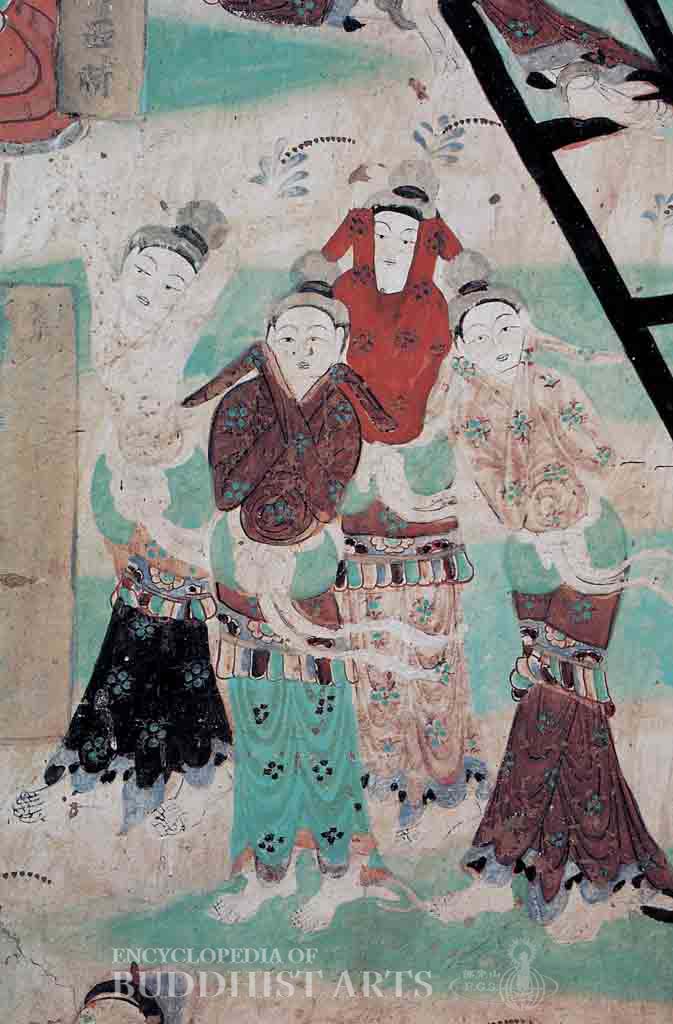
Mogao Cave 146: Battle Between Sariputra and Raudraksa - Female Devotees of Raudraksa
Mogao Cave 146: Battle Between Sariputra and Raudraksa
CHINA, Gansu, Dunhuang; Five Dynasties
This illustration of the contest of supernatural powers between Raudraksa and the Buddha’s disciple Sariputra, a story from the Sutra of the Wise and the Foolish, is painted on the back (west) wall of Cave 146. Numerous battles take place between the two before Raudraksa yields to Sariputra. The mural is divided into two sections, with Sariputra painted on the left and Raudraksa on the right.
Sariputra wears monastic robes and sits cross-legged on a grand lotus throne with a large canopy above him. His left hand is placed on his knee, while the raised right hand holds a fan embellished with Bodhi leaves. Surrounding Sariputra are various scenes from the story, including one in which Sariputra meets with Sakyamuni Buddha, and another in which the Buddha sends the Four Heavenly Kings, Eight Classes of Dharma Protectors, the Wind and Rain Deities, and Vajrapanibalins to protect Sariputra and Sudatta when they confront Raudraksa. To the right of Sariputra’s lotus throne is a scene of brahmins receiving tonsure after witnessing Sariputra’s victory. Raudraksa is among the group; he sits on a round stool, has white skin, green eyes, and black lips, and wears a dhoti and bracelets. He appears nervous and uneasy while behind him a monk shaves his head with a razor. Facing Raudraksa is another brahmin accepting tonsure. He has a scarf around his shoulders and also appears unsettled. Horses and a carriage are depicted in the lower register; this is a portrayal of Sudatta surveying the future site of a monastery. A brown ox rests on the ground behind the carriage.
In the center of the right panel of the mural, Raudraksa sits within a pavilion, his stole fluttering around him while the top of the pavilion is blown backwards by a fierce wind. This illustrates Sariputra’s invocation of a strong wind to destroy Raudraksa’s pavilion, causing panic among his followers. Figures race up a ladder to tie guy lines, which another group hurriedly secure pegs in the ground. Others hold tightly to the staggering structure. Six figures huddle together beneath a fallen canvas, hiding from the storm with only their faces and hands showing, and a group of female devotees of Raudraksa look on anxiously.
The mural contrasts the serenity and steadfastness of Sariputra, the Heavenly Kings, and the Dharma protectors on the left panel with the pandemonium of Raudraksa’s camp on the right, emphasizing the triumph of good over evil. The use of elegant colors and the combination of line strokes and washes demonstrate technical excellence.
For more details, go to the Encyclopedia of Buddhist Arts: Caves M-Mo, page 950.
Cite this article:
author = Hsingyun and Youheng and Johnson, Peter and Mankuang and Huntington, Susan and Edson, Gary and Neather, Robert,
booktitle = {Encyclopedia of Buddhist Arts: Caves M-Mo},
pages = 950,
title = {{Mogao Cave 146: Battle Between Sariputra and Raudraksa}},
volume = 7,
year = {2016}}