
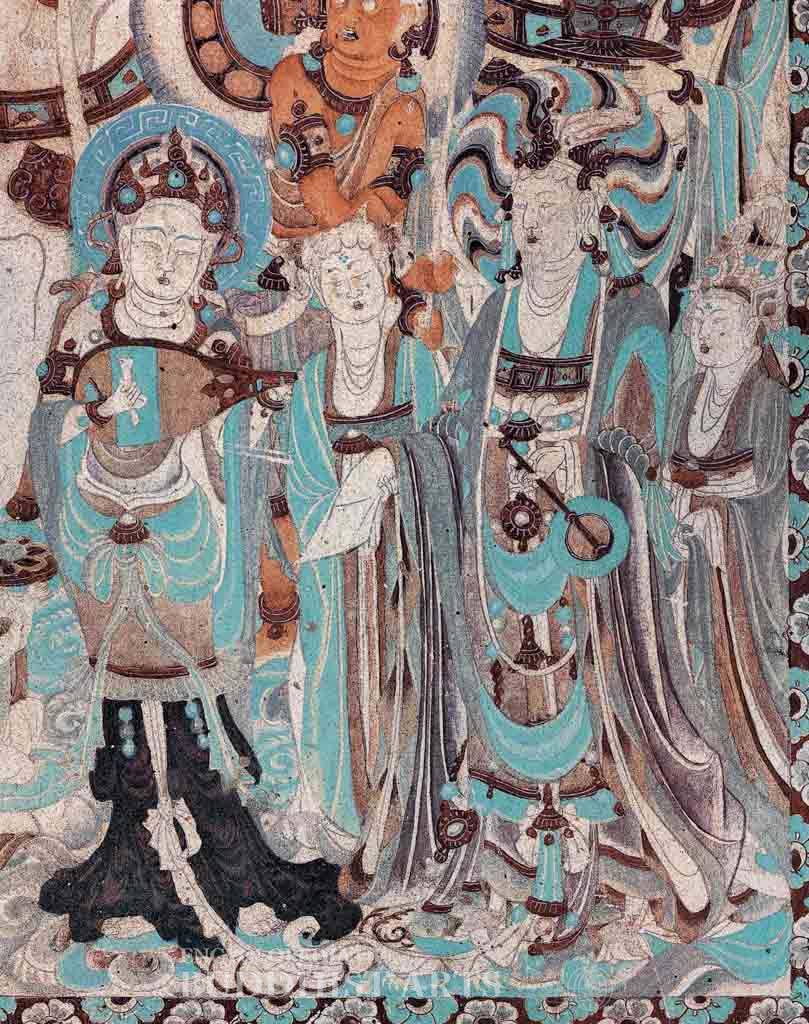
Mogao Cave 468: Manjusri and Attendants (detail)

Mogao Cave 468: Female Donors (back wall, below the niche)
Mogao Cave 468
CHINA, Gansu, Dunhuang
This shrine cave is located in the south area of the site. The ceiling and the niche in the back (west) wall were constructed between 756 and 860 during the Tang dynasty, The murals on the north, south, and front (east) walls of the main chamber, as well as those in the corridor and antechamber, were painted in 907 during the Later Liang dynasty. The ceiling of the antechamber is covered with Thousand Buddha images, now faded and indistinct, and above the entrance on the back wall are inscriptions from the year 907. On both sides of the entrance are warriors. The murals on the north and south walls are damaged, but three donors can still be distinguished on the lower walls. In the corridor, the ceiling and walls display portraits of Bodhisattvas painted during the Five Dynasties period (907–960).
The rectangular main chamber has a truncated pyramidal ceiling. Its caisson center displays three rabbits within a lotus flower and the four slopes of the ceiling have illustrations of the Lotus Sutra, including scenes from the “Introductory Chapter,” “Chapter on the Emergence of the Prabhutaratna Pagoda,” and “Universal Gateway Chapter,” as well as images of Thirty-Three Manifestations of Avalokitesvara.
The niche in the back wall of the main chamber houses statues of a Bodhisattva and two disciples, all of which are damaged. The niche has a truncated pyramidal ceiling with a caisson center embellished with flowers. Four seated Buddhas and two Avalokitesvara images are painted on the slopes of the ceiling. The walls of the niche are painted with draperies, and two panels display the Twelve Great Vows from the Medicine Buddha Sutra. The edges of the niche are decorated with a twining foliage pattern. To the left of the niche on the back wall is an illustration of Samantabhadra Bodhisattva and Attendants, and to the right is Manjusri Bodhisattvas and Attendants. The Bodhisattvas sit on lotus thrones and are surrounded by a retinue of followers. Samantabhadra rides an elephant while Manjusri rides a lion. Eleven female donors are painted below the niche on the back wall, along with an inscription in Uighur script written during the Five Dynasties period.
The north wall has an illustration of the Medicine Buddha Sutra, and to each side are depictions of the nine kinds of untimely death and the Twelve Great Vows. On the south wall is an illustration of the Amitabha Sutra, with side panels illustrating the Sixteen Contemplations and the story of Ajatasatru. Above the entrance on the front (east) wall are donor portraits, and on both sides of the entrance are murals of the Buddha teaching the Dharma. To the lower right of the entrance is an illustration of Amoghapasa Avalokitesvara, and to the lower left of the entrance is an illustration of Cintamanicakra Avalokitesvara.
For more details, go to the Encyclopedia of Buddhist Arts: Caves Mo-S, page 1236.
Cite this article:
author = Hsingyun and Youheng and Johnson, Peter and Mankuang and Huntington, Susan and Edson, Gary and Neather, Robert,
booktitle = {Encyclopedia of Buddhist Arts: Caves Mo-S},
pages = 1236,
title = {{Mogao Cave 468}},
volume = 8,
year = {2016}}