
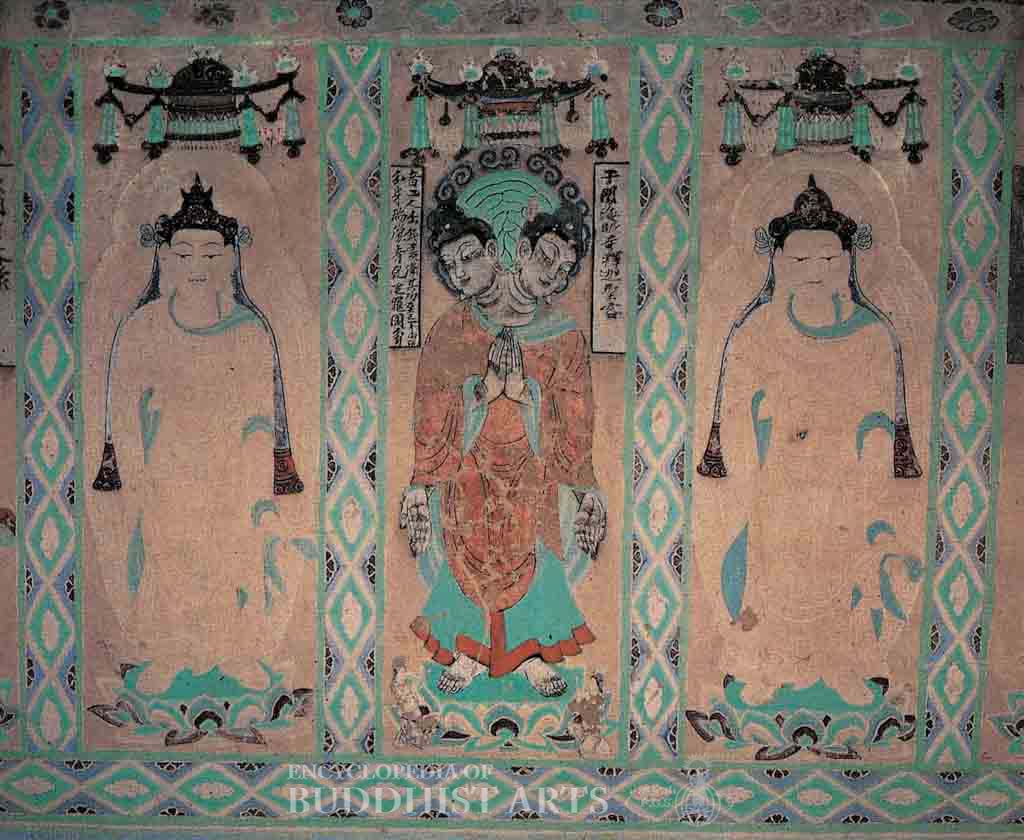
Mogao Cave 237: Auspicious Figures (back wall niche, ceiling, west slope)
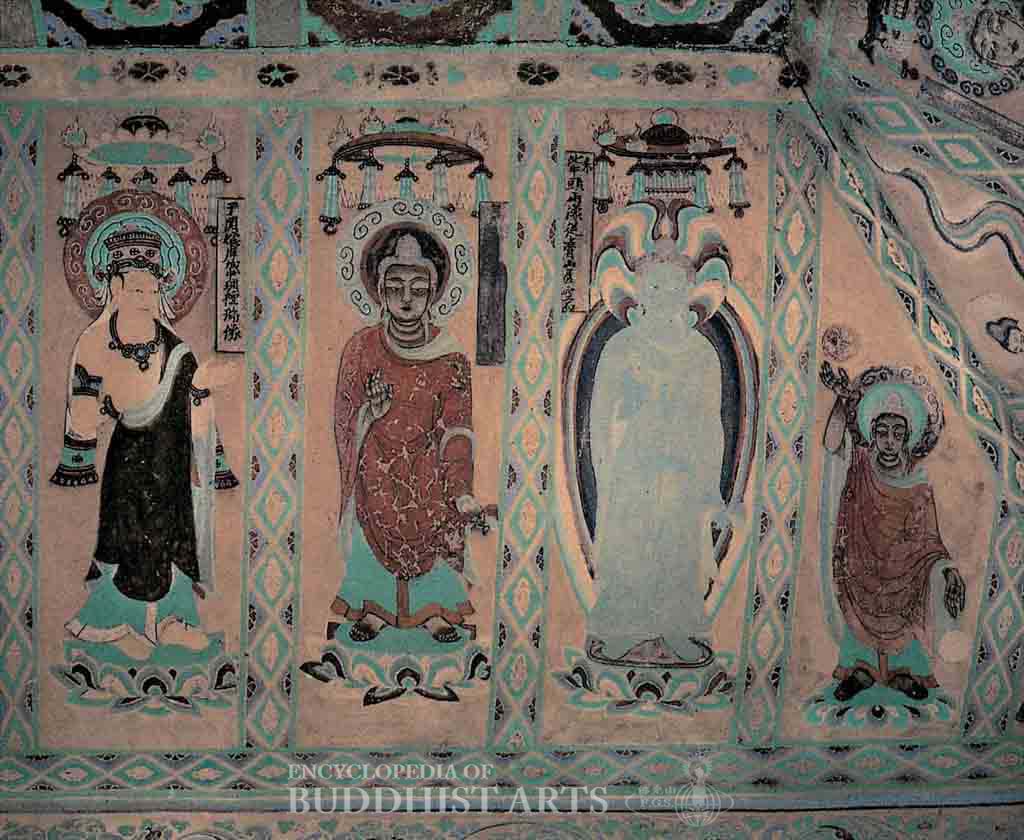
Mogao Cave 237: Auspicious Figures (back wall niche, ceiling, south slope)

Mogao Cave 237: Auspicious Figures (back wall niche, ceiling, east slope, right side)
Mogao Cave 237: Auspicious Figures
CHINA, Gansu, Dunhuang; Tang dynasty
Several auspicious images are painted on the truncated pyramidal ceiling of the niche in the back (west) wall of the main chamber. Such images began appearing in the Mid-Tang period (756–846) both within the caves of Dunhuang and elsewhere. They are likenesses of statues or images made legendary through stories of miraculous events attributed to them. These legendary figures come from all across the Buddhist world, including India, Nepal, Khotan, and Gandhara, as well as locations within China such as Zhangye and Jiuquan in Gansu province. Several caves within Dunhuang contain these auspicious images, all of them painted between the Mid-Tang period and the Northern Song dynasty (960–1127).
On the north slope of the ceiling are eight figures, including Auspicious Buddha in Jiuquan County, Avalokitesvara Rescuing People from Dangers at Magadha in India, and Auspicious Buddha in Khotan. On the east slope are 12 images including Maitreya Bodhisattva holding the sun and moon, Auspicious Buddha at Deer Park in Varanasi, an auspicious image of Fanhe where the eminent monk Liu Sahe of the Northern Wei dynasty (386–534) prophesized the appearance of an auspicious image, a Buddha image from Zhanghe, and a silver Maitreya image from India.
On the south slope are eight figures, among them are a sandalwood Buddha image in Khotan, and a standing Buddha whose right hand points up to the sun and the left hand points down to the moon. Among the 13 Buddha images on the west slope, the Two-Headed Buddha in Gandhara is a special one. Two figures pay respect at his feet and the inscription reads, “A split body auspicious image with one body and two heads was sponsored by two devotees from faraway Gandhara.” According to legend, the artist received donations from two poor devotees to paint a Buddha image. Upon completion, the painting inexplicably morphed, splitting into a two-headed, four-armed figure.
For more details, go to the Encyclopedia of Buddhist Arts: Caves M-Mo, page 1047.
Cite this article:
author = Hsingyun and Youheng and Johnson, Peter and Mankuang and Huntington, Susan and Edson, Gary and Neather, Robert,
booktitle = {Encyclopedia of Buddhist Arts: Caves M-Mo},
pages = 1047,
title = {{Mogao Cave 237: Auspicious Figures}},
volume = 7,
year = {2016}}