
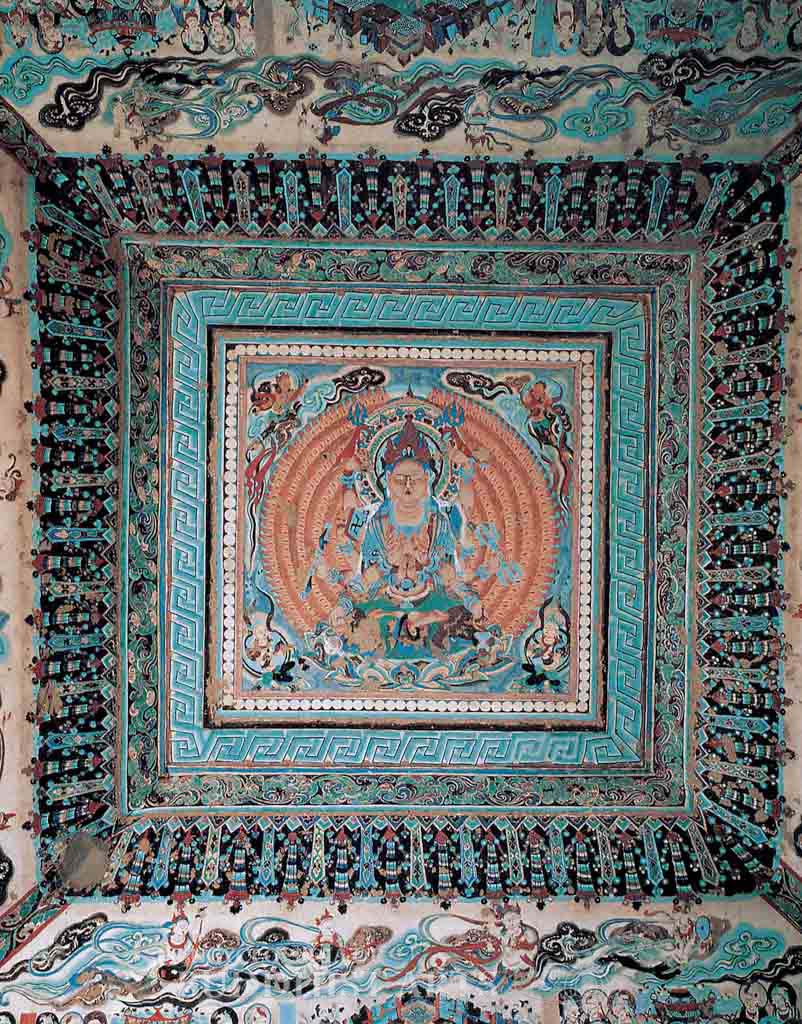
Mogao Cave 161: Ceiling
Mogao Cave 161: Ceiling
CHINA, Gansu, Dunhuang; Tang dynasty
The truncated pyramidal ceiling within the main chamber of Cave 161 is painted with unique Vajrayana images from the Late Tang period (846–907). Within the caisson center is an illustration of Thousand-Armed, Thousand-Eyed Avalokitesvara. The Bodhisattva wears a headdress with an image of Amitabha Buddha in the center, and a shawl is draped over the shoulders. Avalokitesvara is seated in full lotus position on a lotus throne. Twelve hands form mudras or hold various instruments and treasures, including vajras and vase. The smaller hands are arranged in five overlapping rings extending from the torso to form a large mandorla. In the center of each palm is an eye of benevolence.
In the four corners of the caisson are four Vajra Bodhisattvas: in the upper left is the Bodhisattva of vajra songs, Vajragiti, who plays a flute; in the upper right is the Bodhisattva of vajra dance, Vajranrti; on the lower left is the Bodhisattva of vajra flowers, Vajrapuspa, who holds a bouquet in offering; and on the lower right is the Bodhisattva of vajra garland, Vajramala, who holds a flower garland. This central image is framed by a series of patterns, including bead string, key, floral, and valance designs. Surrounding these are 16 apsaras, depicted soaring through the air with carefree ease.
For more details, go to the Encyclopedia of Buddhist Arts: Caves M-Mo, page 998.
Cite this article:
author = Hsingyun and Youheng and Johnson, Peter and Mankuang and Huntington, Susan and Edson, Gary and Neather, Robert,
booktitle = {Encyclopedia of Buddhist Arts: Caves M-Mo},
pages = 998,
title = {{Mogao Cave 161: Ceiling}},
volume = 7,
year = {2016}}