
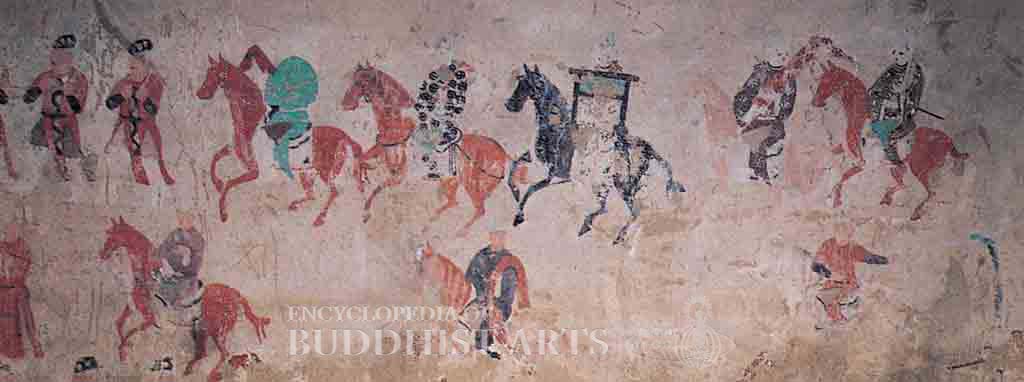
Mogao Cave 100: Journey of Cao Yijin’s Wife (detail)
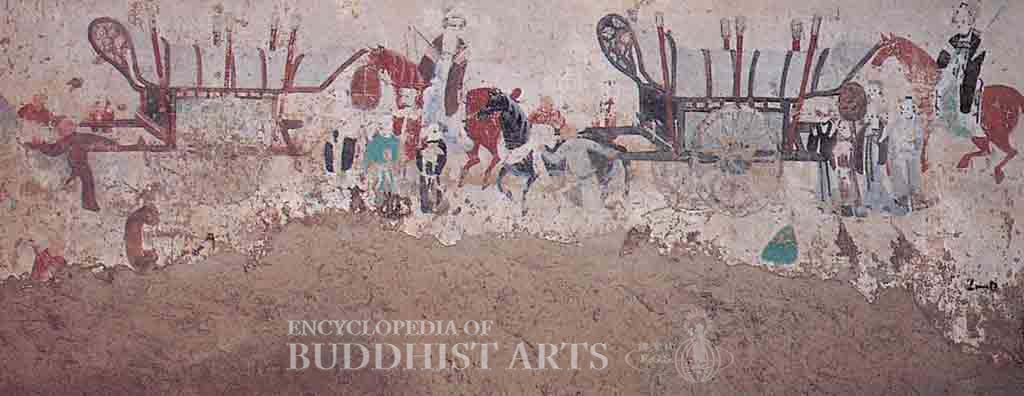
Mogao Cave 100: Journey of Cao Yijin’s Wife (detail)
Mogao Cave 100: Journey of Cao Yijin’s Wife
CHINA, Gansu, Dunhuang; Five Dynasties
Also known as the Journey of the Uighur Princess, this mural is located on the east, west, and north walls. It imitates the painting Journey of Zhang Yichao’s Wife from the Late Tang period (846–907) in Mogao Cave 156. At the front are two rows of musicians on horseback. Dressed in magnificent robes with floral designs, they play different kinds of instruments and ride horses of various colors. The resplendent colors and fervent mood of the musicians give a grand feel to the journey. Following behind the musicians are eight figures carrying a pagoda-shaped palanquin on their shoulders. Bent at the waist, they advance slowly, bearing the weight of the palanquin. Behind the palanquin are ladies-in-waiting with floral crowns and formal attire. Their servants follow carrying bags and boxes.
Behind the entourage are two horse-drawn carriages for members of the Cao family. Noblewomen ride horses alongside the carriages, trailed by servants holding fans and other objects. This illustration shows the grandeur of the Uighur princess going on a journey.
For more details, go to the Encyclopedia of Buddhist Arts: Caves M-Mo, page 931.
Cite this article:
author = Hsingyun and Youheng and Johnson, Peter and Mankuang and Huntington, Susan and Edson, Gary and Neather, Robert,
booktitle = {Encyclopedia of Buddhist Arts: Caves M-Mo},
pages = 931,
title = {{Mogao Cave 100: Journey of Cao Yijin’s Wife}},
volume = 7,
year = {2016}}