
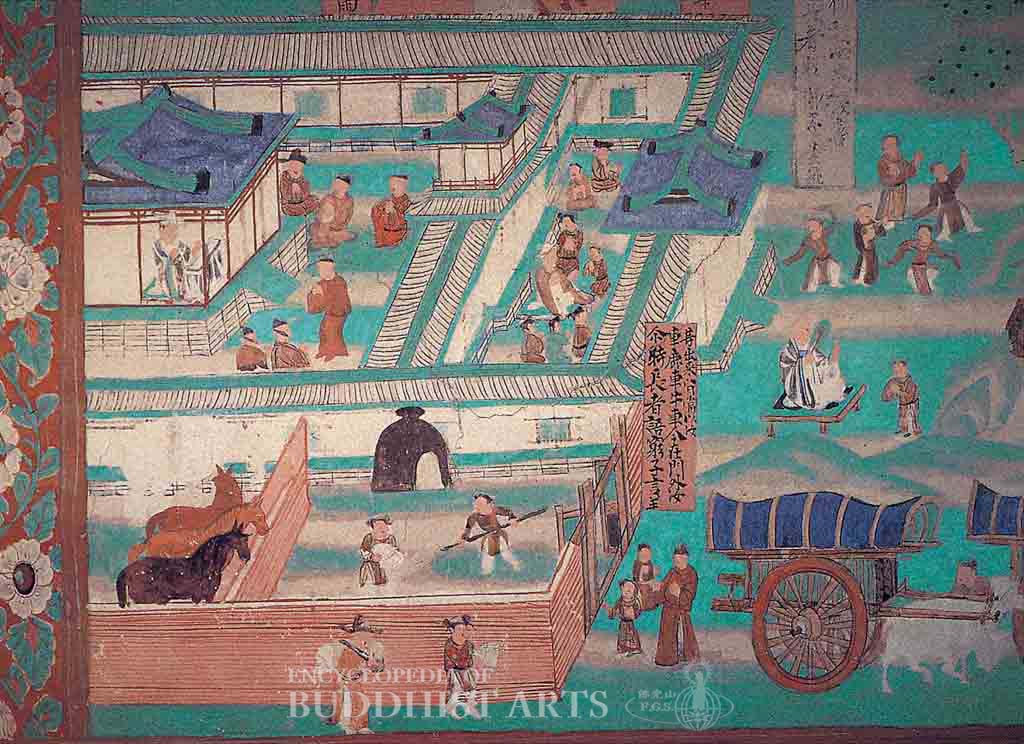
Mogao Cave 98: Illustration of Lotus Sutra - Chapter on Belief and Understanding
Mogao Cave 98: Illustration of the Lotus Sutra - Chapter on Belief and Understanding
CHINA, Gansu, Dunhuang; Five Dynasties
This scene is part of the illustration of the Lotus Sutra on the south wall. A parable in the “Chapter on Belief and Understanding” tells of a wealthy landowner’s efforts to bestow a great inheritance on his estranged, impoverished son. As a youth, the son left his father and wandered in the world, gradually becoming weary and downtrodden after many years of hardship. Meanwhile, the father moved to a new city and attained great wealth. One day, the son came to his father’s land, but he did not recognize the place or his father. The landowner recognized his son immediately, but realizing that he could not elevate him too quickly from his humble, downtrodden state, he simply offered to hire the young man as a worker. The father treated his son very well, and after many years together, the once impoverished son became capable and virtuous. The father finally revealed the truth, and the son was able to accept the fortune that was rightfully his. The parable relates the riches of the father to the wealth of Dharma offered by the Buddha.
At the bottom of the scene, workers are shown cleaning the stable grounds, and three horses and an elephant stand within an enclosure. Above, the local king sits within a hall while court officials and others gather outside in the courtyard. The landowner is shown standing with palms joined and proclaiming to the others that the poor worker is his son, and will inherit all his property.
For more details, go to the Encyclopedia of Buddhist Arts: Caves M-Mo, page 919.
Cite this article:
author = Hsingyun and Youheng and Johnson, Peter and Mankuang and Huntington, Susan and Edson, Gary and Neather, Robert,
booktitle = {Encyclopedia of Buddhist Arts: Caves M-Mo},
pages = 919,
title = {{Mogao Cave 98: Illustration of the Lotus Sutra - Chapter on Belief and Understanding}},
volume = 7,
year = {2016}}