
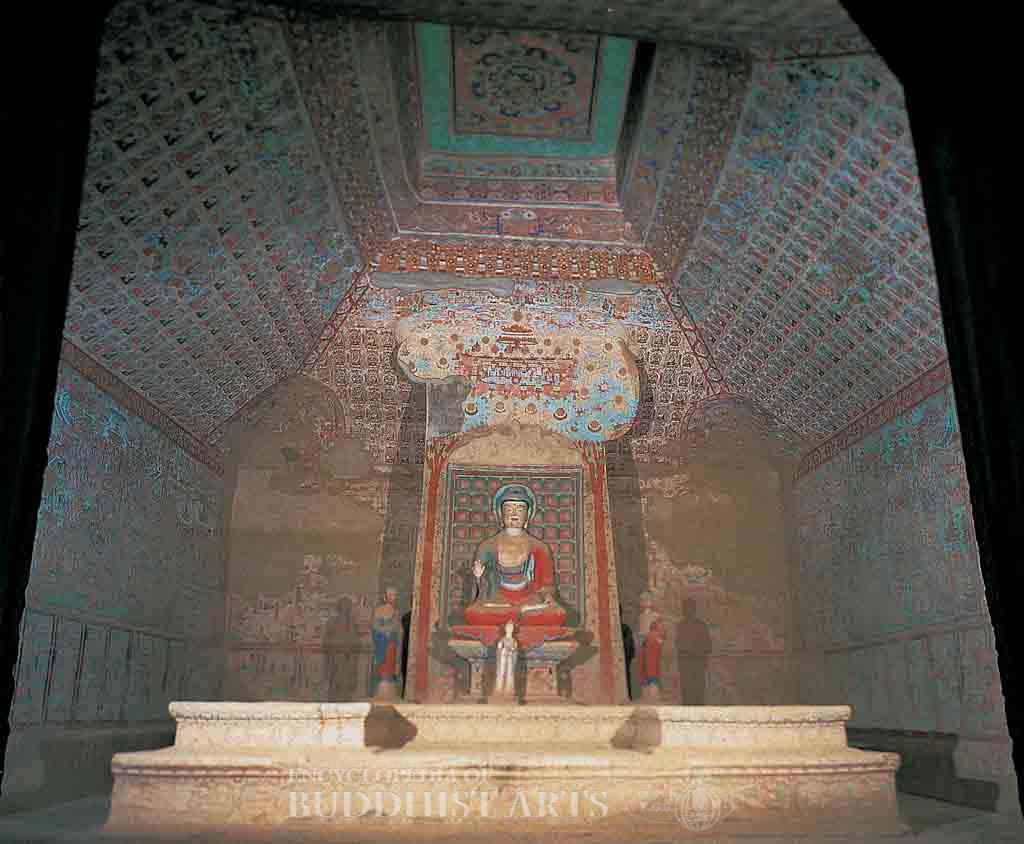
Mogao Cave 98: Main Chamber
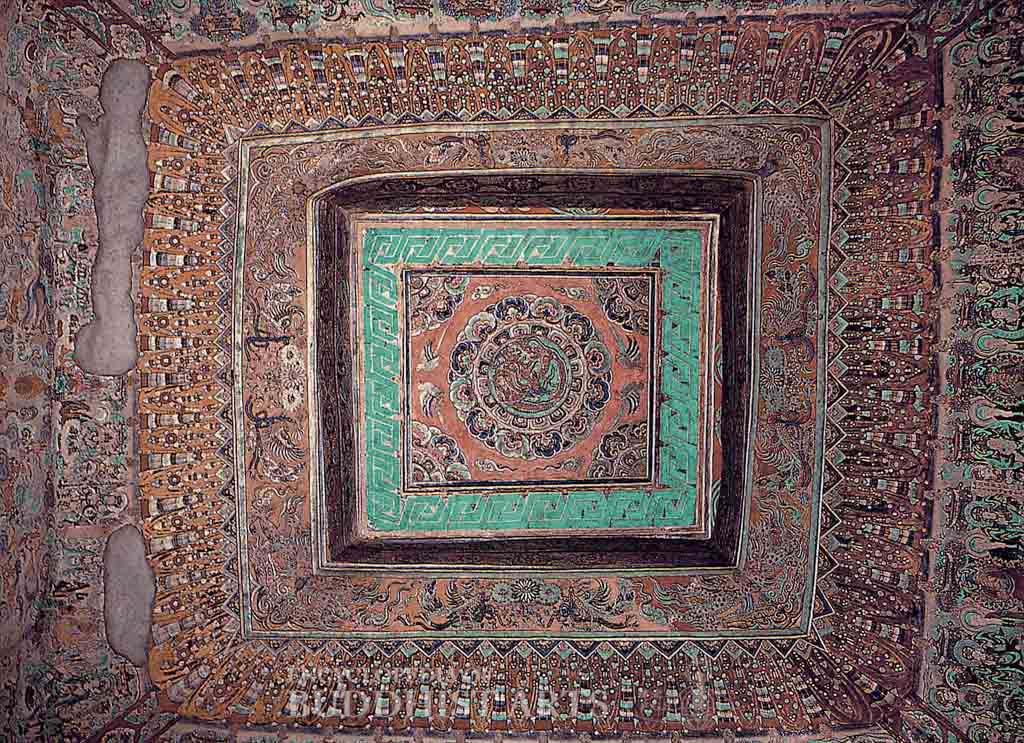
Mogao Cave 98: Ceiling
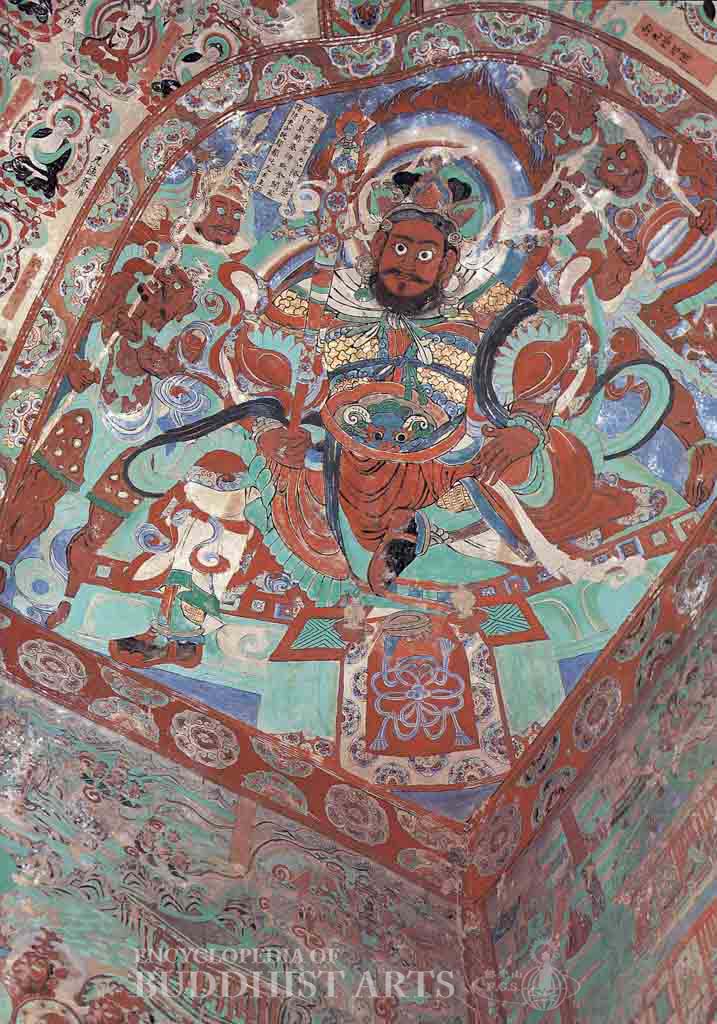
Mogao Cave 98: Heavenly King of the East (ceiling, southeast corner)
Mogao Cave 98
CHINA, Gansu, Dunhuang
Located in the south area, this altar cave is referred to as the King’s Cave in the Dunhuang manuscripts. It was built during the Five Dynasties (907–960) and was commissioned by Cao Yijin, the governor of the Guiyi Army. The main chamber is 20 m in height and has a rectangular layout measuring 220 sq m. A coiled dragon is painted within a square caisson in the center of the truncated pyramidal ceiling. The dragon has horns and holds a jewel in its mouth. Its claws are extended forward in a fierce pose. Floral patterns form a tight circle around the dragon, and four birds are painted outside the circle. The floral pattern is repeated in quarter-circle motifs in the four corners, and the square caisson is framed by several border patterns. On the four slopes of the ceiling, the Buddhas of the Ten Directions are painted on the upper portion, a Buddha teaching the Dharma is in the center of each slope, and the Thousand Buddhas fill the remaining space. Shallow niches in the corners of the ceiling contain paintings of the four Heavenly Kings.
A seated Buddha statue that was restored during the Qing dynasty (1644–1911) is installed upon a Buddha altar in front of the back (west) wall. The statue is backed by a large stone screen wall that extends up to the west slope of the ceiling and is decorated with illustrations of Bodhi trees, a canopy, and four apsaras, as well as two Heavenly Kings near the bottom. On the back of the screen wall are portraits of Cao Yijin and other donors, and on the sides are Bodhisattvas and apsaras.
There are sutra illustrations on the back and side walls. On the back wall is an illustration of the Battle Between Sariputra and Raudraksa. On the north wall are the Devata Sutra, Avatamsaka Sutra, Medicine Buddha Sutra, and the Sutra on the Questions of Visesa Cinti Brahma. On the south wall are the Maitreya Sutras, Amitabha Sutra, Lotus Sutra, and Returning Favors Sutra. Panels along the lower sections of all three walls contain narrative illustrations of the Sutra of the Wise and the Foolish. Below the panels are portraits of monks, Cao Yijin and his subordinates, and female donors of the Cao family.
On the front (east) wall is an illustration of the Vimalakirti Sutra, including a depiction of the “Chapter on Skillful Means.” To the right of the entrance on the front wall is an image of Manjusri Bodhisattva, and on the left is Vimalakirti, with portraits of donors on the lower sections of the wall including the king and queen of Khotan on the right and a Uighur princess on the left.
For more details, go to the Encyclopedia of Buddhist Arts: Caves M-Mo, page 916.
Cite this article:
author = Hsingyun and Youheng and Johnson, Peter and Mankuang and Huntington, Susan and Edson, Gary and Neather, Robert,
booktitle = {Encyclopedia of Buddhist Arts: Caves M-Mo},
pages = 916,
title = {{Mogao Cave 98}},
volume = 7,
year = {2016}}