
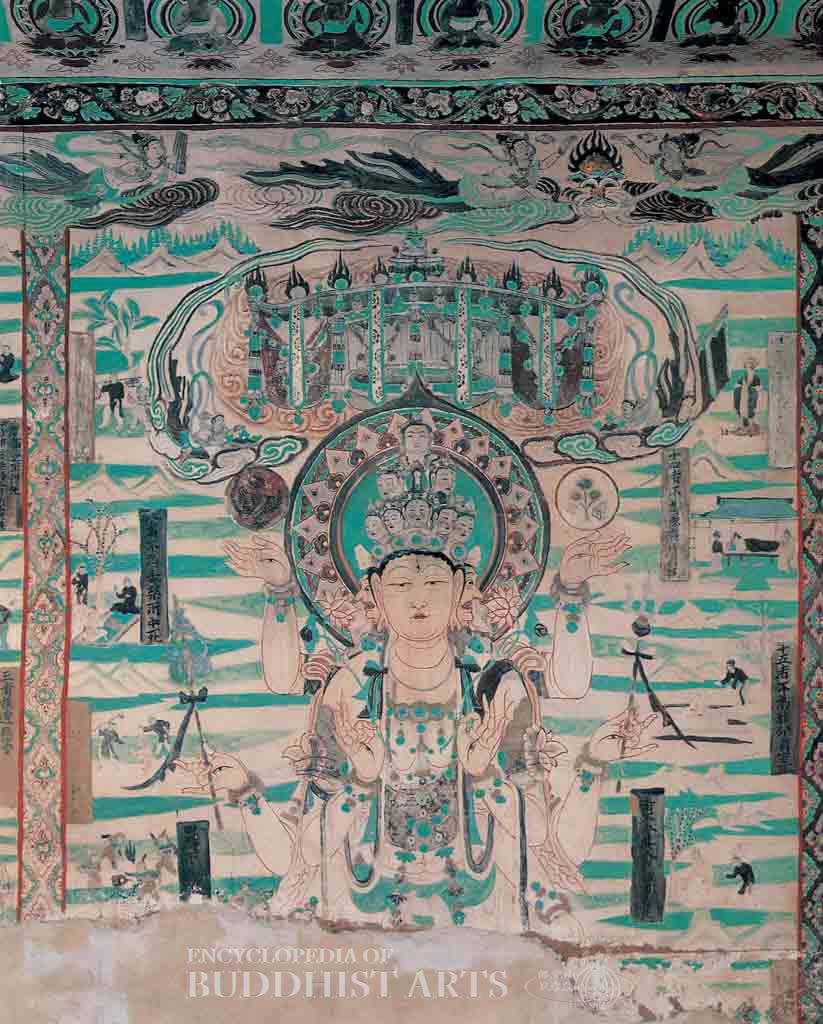
Mogao Cave 76: Illustration of the Great Compassion Dharani Sutra
Mogao Cave 76: Illustration of the Great Compassion Dharani Sutra
CHINA, Gansu, Dunhuang; Northern Song dynasty
Located on the north wall, this illustration is based on the Great Compassion Dharani Sutra. The eleven heads of Avalokitesvara Bodhisattva are arranged in the shape of a pagoda. The large central head has three eyes. All of the heads wear crowns and are surrounded by a decorative nimbus. The eight hands each have an eye in the center of the palm. One pair of hands hold lotuses with long stems before the chest. A sun and a moon disc hover above the two raised hands. Below, two hands hold a staff and a vajra. Numerous ornaments and stoles cover the body. An ornate canopy topped with flaming jewels hangs above the Bodhisattva. Beside the canopy, apsaras carrying baskets of flowers descend upon curving trails of clouds. On the upper right, two apsaras flank a flaming jewel.
To either side of the Bodhisattva are narrative illustrations of how devotees can avoid the “15 undesirable ways of dying” by chanting and following the Great Compassion Dharani Sutra. Inscriptions accompany each of these illustrations. Opposite this mural, on the south wall, is another image of Avalokitesvara Bodhisattva. This figure is surrounded by illustrations of the “15 desirable ways of living” described in the same sutra. This is the only case within the Dunhuang caves of different contents from the same sutra appearing on opposing walls.
For more details, go to the Encyclopedia of Buddhist Arts: Caves M-Mo, page 905.
Cite this article:
author = Hsingyun and Youheng and Johnson, Peter and Mankuang and Huntington, Susan and Edson, Gary and Neather, Robert,
booktitle = {Encyclopedia of Buddhist Arts: Caves M-Mo},
pages = 905,
title = {{Mogao Cave 76: Illustration of the Great Compassion Dharani Sutra}},
volume = 7,
year = {2016}}