
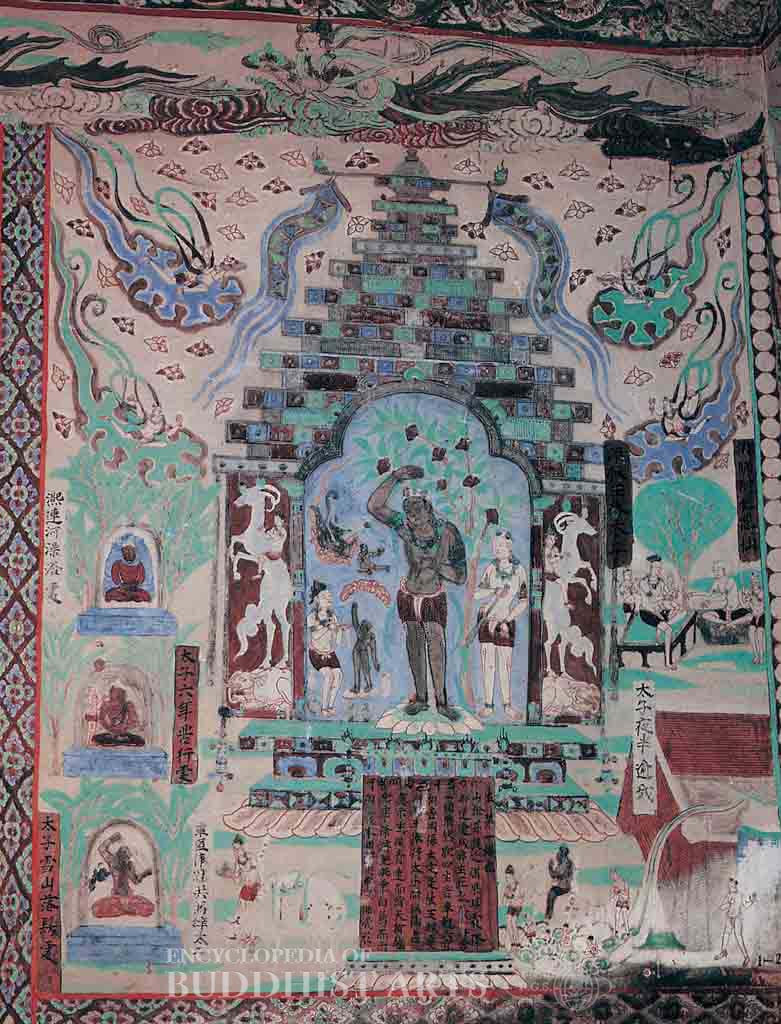
Mogao Cave 76: Eight Sacred Stupas - First Stupa (front wall, upper row, left side)
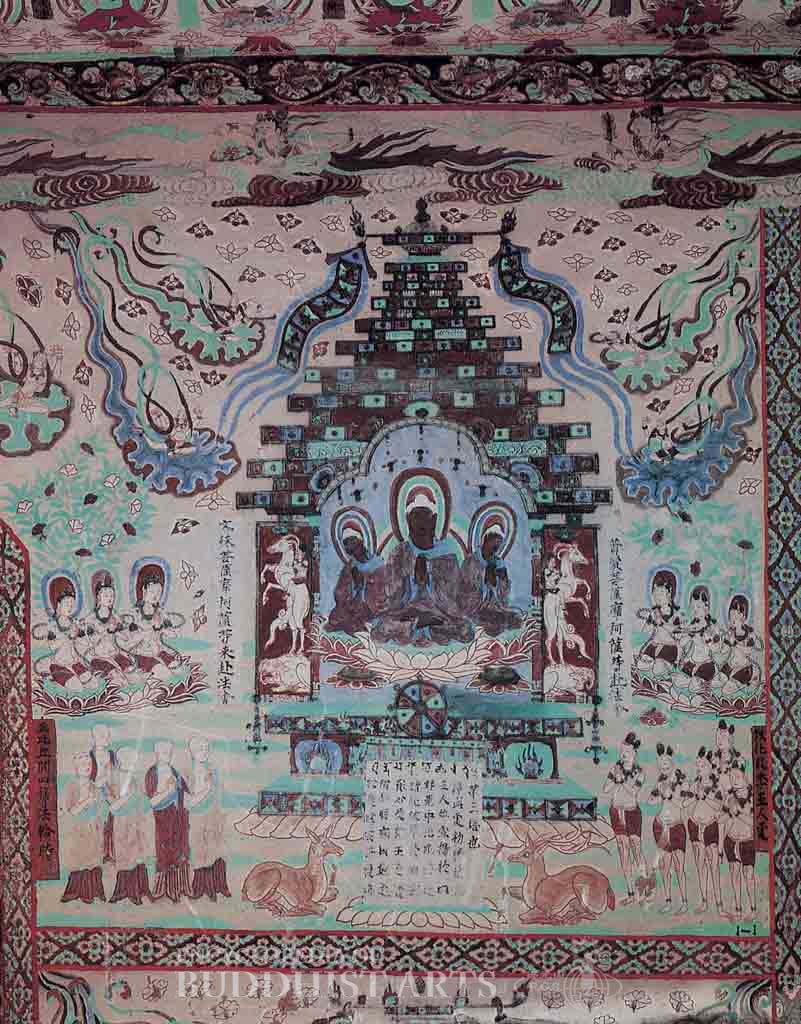
Mogao Cave 76: Eight Sacred Stupas - Third Stupa (front wall, upper row, left side)
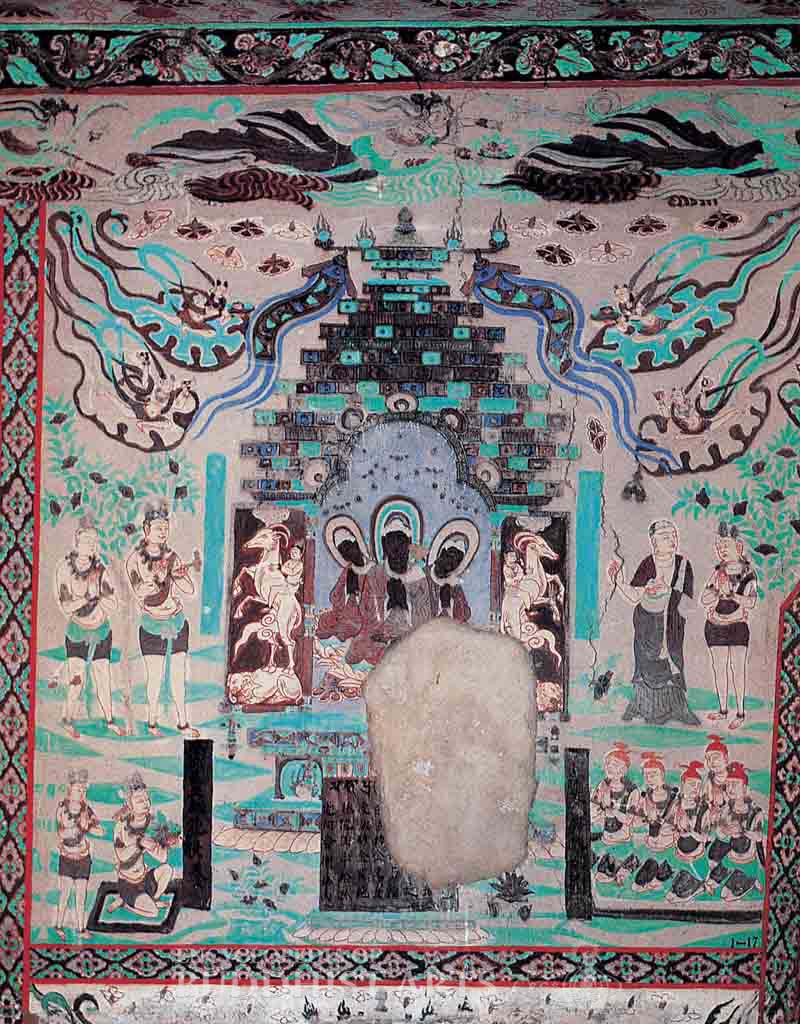
Mogao Cave 76: Eight Sacred Stupas - Fifth Stupa (front wall, upper row, right side)
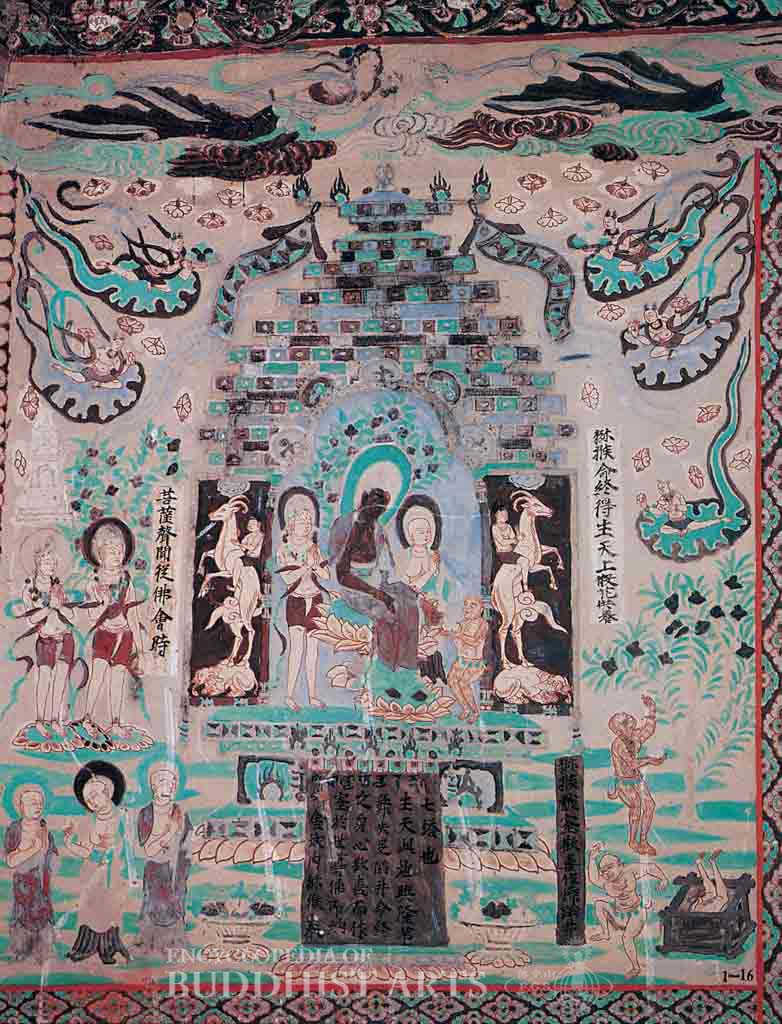
Mogao Cave 76: Eight Sacred Stupas - Seventh Stupa (front wall, upper row, right side)
Mogao Cave 76: Eight Sacred Stupas
CHINA, Gansu, Dunhuang; Song dynasty
Located on either side of the entrance on the front (east) wall, this mural is based on the “Introductory Chapter” in the Contemplation on the Mind Ground Sutra, which tells of eight sacred stupas built in the places where the eight major events in the Life of the Buddha occurred. There are four stupas arranged in two rows on each side of the entrance. The first, third, fifth, and seventh stupas are presented in the upper row. The lower row on both sides is damaged. Scenes are painted within and around each stupa. Inscriptions below each stupa describe the scenes that are illustrated.
The first stupa on the far right features images of the early life of Prince Siddhartha, from birth up to his spiritual practice as an ascetic. The third stupa presents the first teaching given by Sakyamuni Buddha after enlightenment. The stupa contains three seated Buddhas, and a Dharma wheel is displayed at the front. Two deer below the stupa symbolize the Deer Park. Bodhisattvas kneel on lotuses on the left and right. The fifth stupa is shown at Jetavana, where Sakyamuni Buddha lived and taught. Three Buddhas are seated within the stupa, and two lay practitioners stand to the left, joining their palms and holding incense in offering. King Prasenajit kneels and offers flowers on the bottom left, and on the bottom right, five people take refuge. The seventh stupa portrays a monkey offering honey in an alms bowl to Sakyamuni Buddha. Ananda and a Bodhisattva stand next to the Buddha. On the lower right, the monkey is shown harvesting the honey, dancing, and falling into a well. On the left are Bodhisattvas and disciples.
For more details, go to the Encyclopedia of Buddhist Arts: Caves M-Mo, page 903.
Cite this article:
author = Hsingyun and Youheng and Johnson, Peter and Mankuang and Huntington, Susan and Edson, Gary and Neather, Robert,
booktitle = {Encyclopedia of Buddhist Arts: Caves M-Mo},
pages = 903,
title = {{Mogao Cave 76: Eight Sacred Stupas}},
volume = 7,
year = {2016}}