
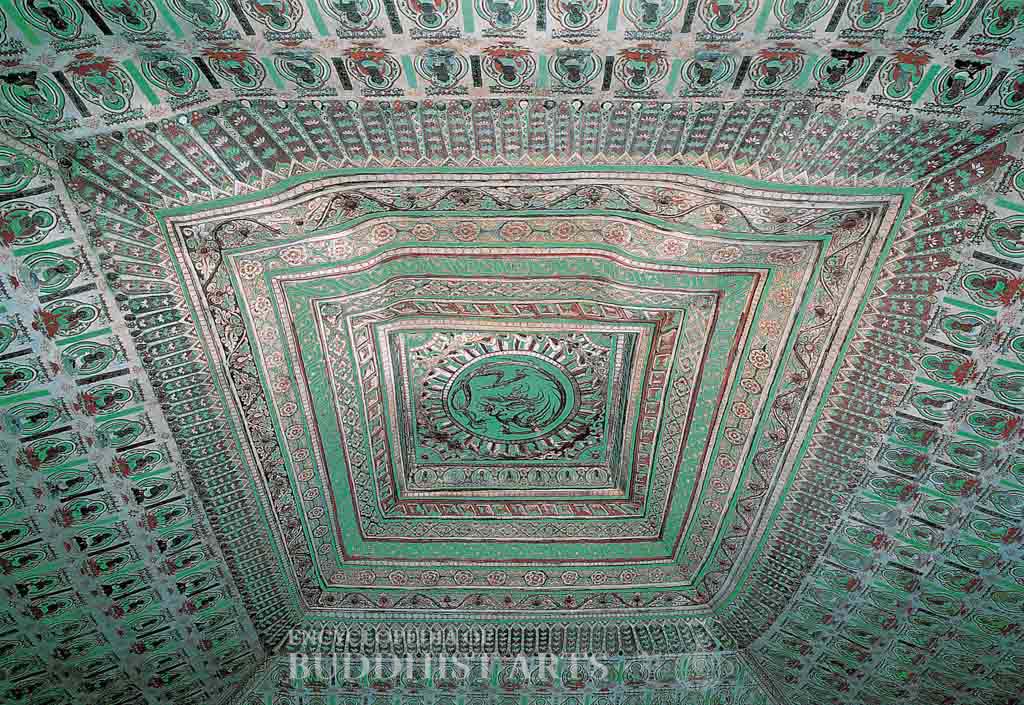
Mogao Cave 76: Ceiling
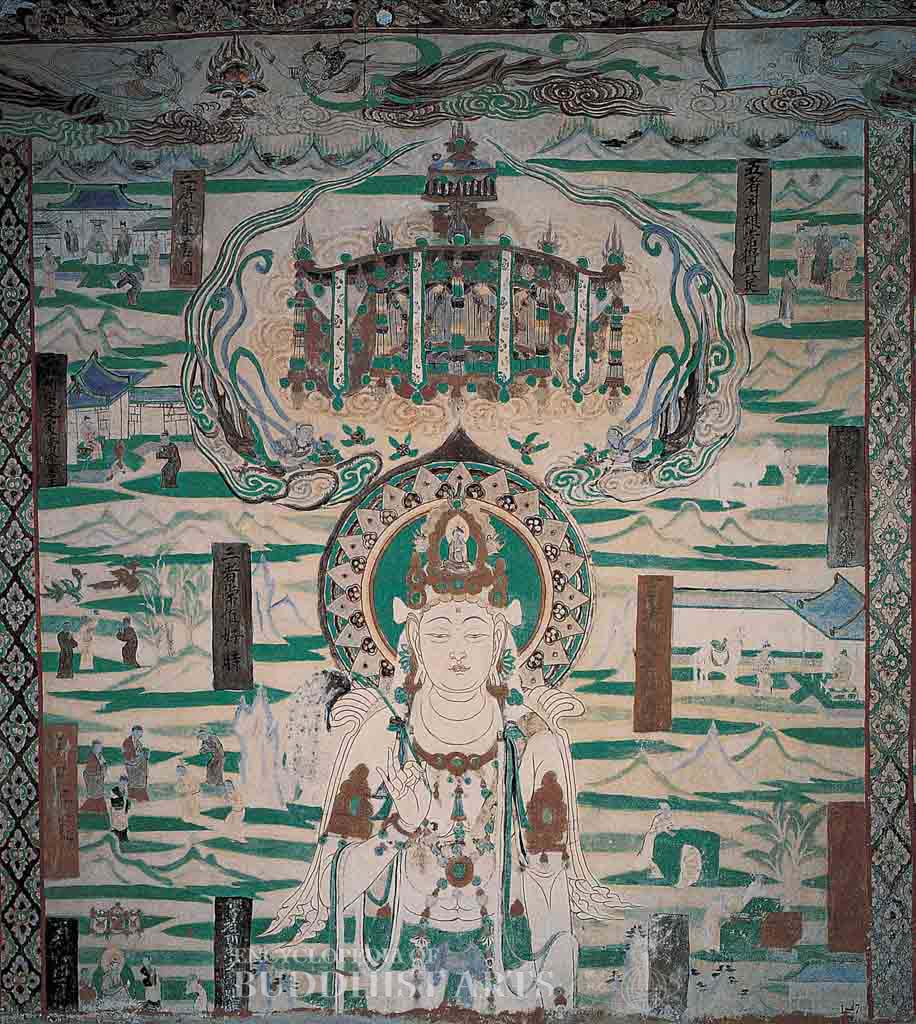
Mogao Cave 76: Great Compassion Dharani Sutra (detail) (south wall)
Mogao Cave 76
CHINA, Gansu, Dunhuang
Located in the south area, this altar cave was built during the Tang dynasty (618–907), and was renovated several times between the Song (960–1279) and Yuan (1271–1368) dynasties. It has a square layout with a truncated pyramidal ceiling. The center of the ceiling is decorated with an image of a dragon within a circle surrounded by square bands of patterning. The Thousand Buddhas are painted on the four slopes. On the altar in the center of the cave is a Song dynasty sculpture of a seated Buddha.
The murals within the main chamber were repainted in the Song dynasty. The sutra illustrations on the back (west) wall have suffered substantial damage. The north, south, and front (east) walls contain apsara images along the upper registers and sutra illustrations on the lower registers. On the north wall are illustrations of the Medicine Buddha Sutra, the Great Compassion Dharani Sutra, and the Avatamsaka Sutra. On the south wall are images of the Infinite Life Sutra, the Great Compassion Dharani Sutra, and the Lotus Sutra. The two illustrations of the Great Compassion Dharani Sutra do not depict Avalokitesvara with thousand arms, but instead illustrate how to avoid the “15 undesirable ways of dying” and to obtain the “15 desirable ways of living” described in the sutra. The seven treasures are painted above the entrance on the front wall, and panel illustrations of the eight sacred stupas line either side of the entrance.
For more details, go to the Encyclopedia of Buddhist Arts: Caves M-Mo, page 902.
Cite this article:
author = Hsingyun and Youheng and Johnson, Peter and Mankuang and Huntington, Susan and Edson, Gary and Neather, Robert,
booktitle = {Encyclopedia of Buddhist Arts: Caves M-Mo},
pages = 902,
title = {{Mogao Cave 76}},
volume = 7,
year = {2016}}