
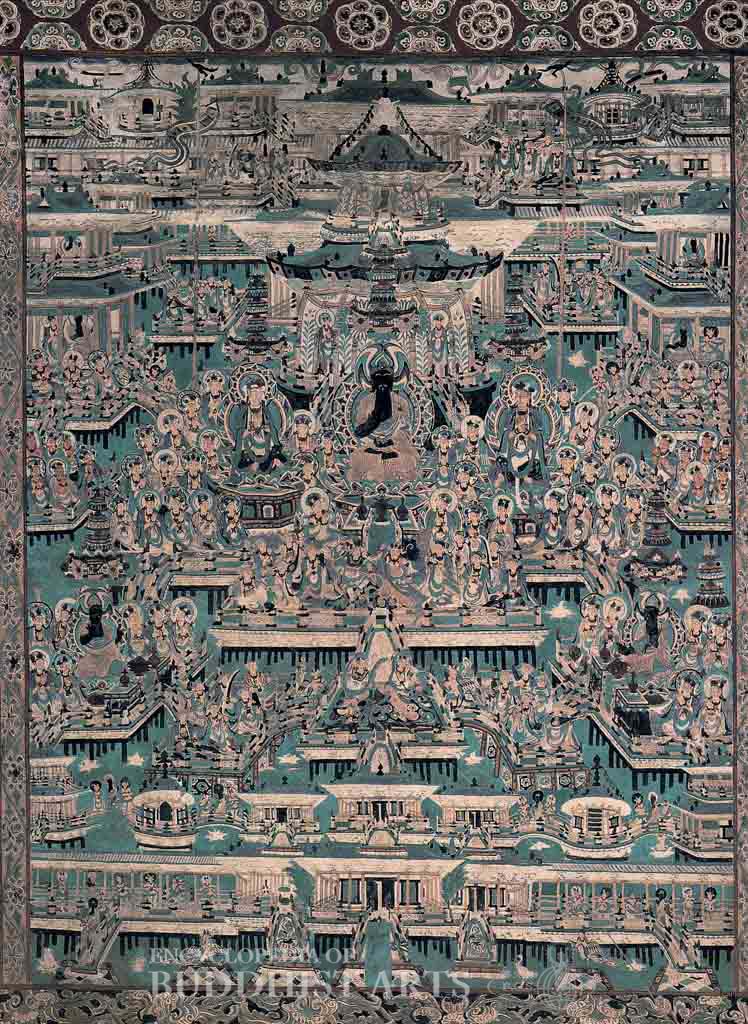
Mogao Cave 61: Illustration of the Medicine Buddha Sutra
Mogao Cave 61: Illustration of the Medicine Buddha Sutra
CHINA, Gansu, Dunhuang; Five Dynasties
This mural is painted on the north wall of the main chamber of Cave 61. The central figure, the Medicine Buddha, is shown within the interconnected palaces and balconies of his Eastern Pure Land. Seated on an open platform in the courtyard of the palace, the dark-colored Buddha holds a medicine pot in the left hand and forms a mudra with the right. Suryaprabha and Candraprabha Bodhisattvas, flank the Buddha. The three central figures all sit in full lotus positions on lotus thrones, and are backed by colorful nimbuses and aureoles. They are surrounded by an assembly of smaller Bodhisattvas and heavenly beings. Decorative canopies hang above them. An altar laid with an incense burner and other offerings are depicted below the Buddha.
In the center of the upper register is a two-story octagonal main hall on a round base. The unique design resembles a stupa. The columns are curvilinear, and the architrave is also curved. The roof has upturned eaves and a finial at the top. Surrounding the main hall are buildings on raised platforms, and flagpoles with dragon-head banners stand in the water on either side.
In the lower register, heavenly beings dance on a platform below the central assembly. Buddhas are seated on raised platforms on either side. Below is a row of seven small buildings, including a main gate, bell tower, and sutra repository. The buildings are connected by bridges. The mural portrays the magnificence and joy of the Pure Land with beautifully arranged, symmetrical buildings and contrasting jade green and black coloring.
For more details, go to the Encyclopedia of Buddhist Arts: Caves M-Mo, page 889.
Cite this article:
author = Hsingyun and Youheng and Johnson, Peter and Mankuang and Huntington, Susan and Edson, Gary and Neather, Robert,
booktitle = {Encyclopedia of Buddhist Arts: Caves M-Mo},
pages = 889,
title = {{Mogao Cave 61: Illustration of the Medicine Buddha Sutra}},
volume = 7,
year = {2016}}