
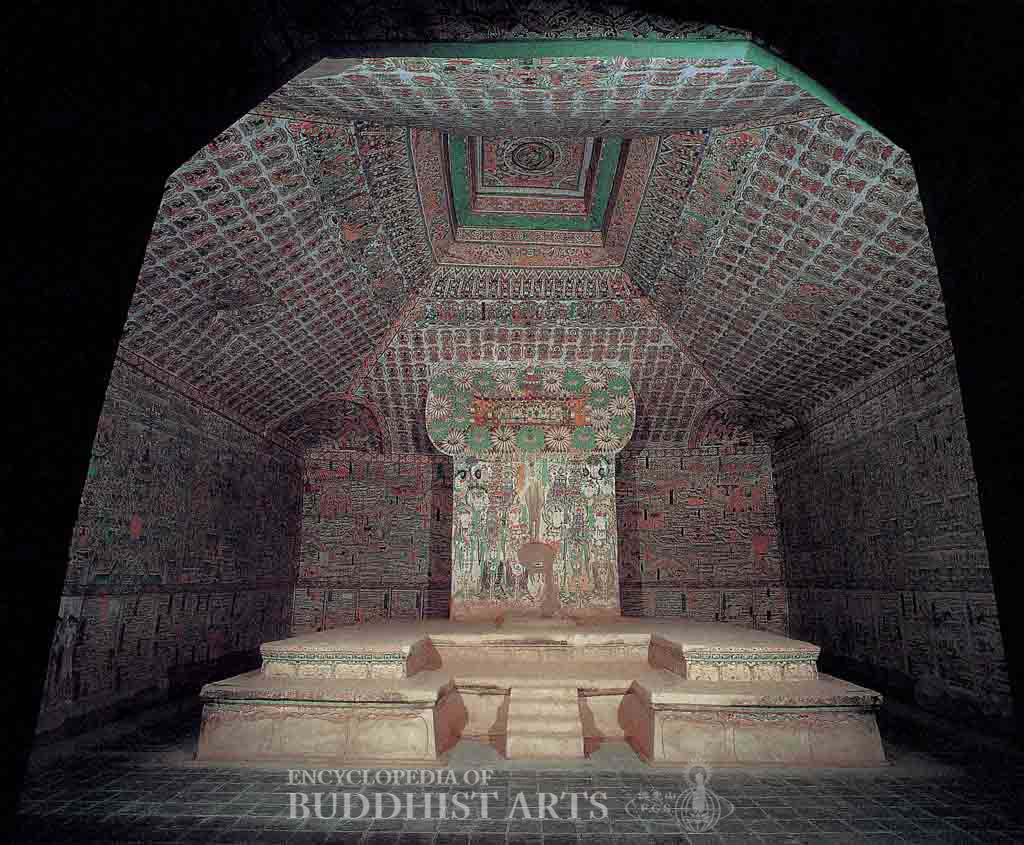
Mogao Cave 61: Main Chamber - Central Altar
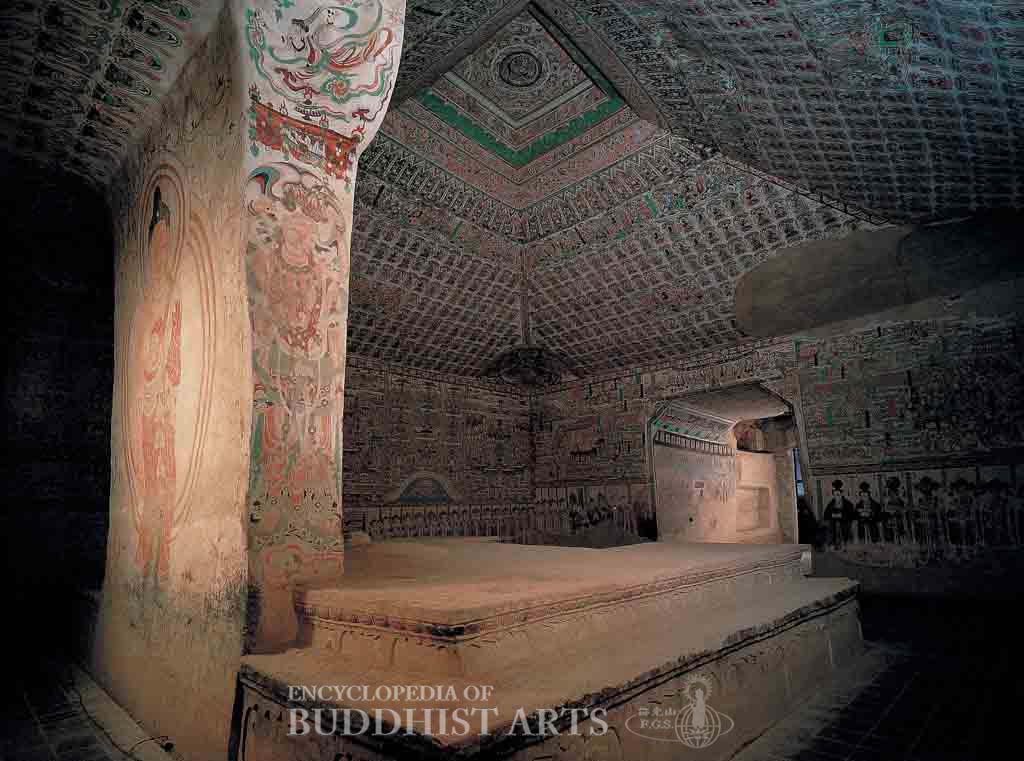
Mogao Cave 61: Main Chamber
Mogao Cave 61
CHINA, Gansu, Dunhuang
Located in the lower central section of the south area, this altar cave is also known as the Manjusri Hall. It was built by Cao Yuanzhong between 947 and 951 during the Five Dynasties. The Thousand Buddhas and the Buddhas of the Ten Directions are painted on the slopes of the truncated pyramidal ceiling, and a Heavenly King is painted in each of the four corners. A statue of Manjusri Bodhisattva seated on a lion and other figures once stood on the square Sumeru altar in the center of the cave, but these statues are now missing. All that remains on the altar is one paw of the lion. The screen wall behind the altar is painted with Bodhisattvas, Heavenly Kings, warriors, and a Bodhi tree canopy on the front, a standing Buddha on the back, and an Avalokitesvara Bodhisattva image on each side.
On the back (west) wall of the cave is a giant mural of Wutaishan (Five Plateau Mountain) that incorporates depictions of Buddhist sacred sites, landscape painting, and features of an ancient map. The lower portions of the back and side walls feature illustrations of stories from the Life of the Buddha in a sequential narrative of 128 scenes. Sutra illustrations cover the north, south, and front (east) walls. On the north wall are illustrations of the Ghanavyuha Sutra, Devata Sutra, Medicine Buddha Sutra, Avatamsaka Sutra, and the Sutra of the Questions of Visesa Cinti Brahma. On the south wall are the Lankavatara Sutra, Maitreya Sutras, Amitabha Sutra, Lotus Sutra, and Returning Favors Sutra. One of the most important sutras in Mahayana Buddhism, the Vimalakirti Sutra, is illustrated on the front wall.
Female donors are painted on the lower north, south, and front walls. The three nuns and the Khotanese princess on the front wall were added during the Song dynasty (960–1279). The ceiling and walls of the corridor were painted during the Yuan dynasty (1271–1368), including a large illustration of the Tejaprabha Buddha Sutra on the south wall.
For more details, go to the Encyclopedia of Buddhist Arts: Caves M-Mo, page 882.
Cite this article:
author = Hsingyun and Youheng and Johnson, Peter and Mankuang and Huntington, Susan and Edson, Gary and Neather, Robert,
booktitle = {Encyclopedia of Buddhist Arts: Caves M-Mo},
pages = 882,
title = {{Mogao Cave 61}},
volume = 7,
year = {2016}}